In 1906 the
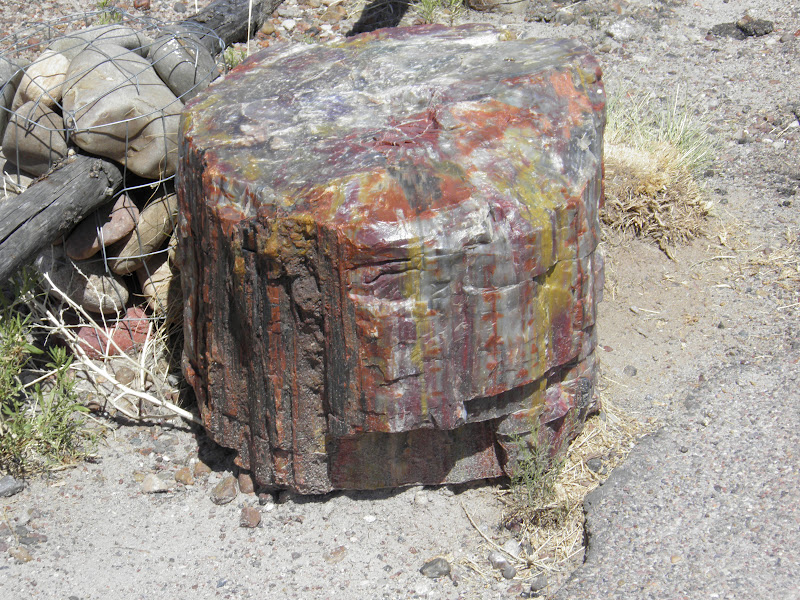
Antiquities act was passed by the United States Congress and signed into law by who we can only imagine was a rather giddy American president Theodore Roosevelt. Section 2 of the act permitted the president to set aside parcels of land deemed worthy of preservation, which caused quite a stir at the time (and still receives a bit of bad mouthing today, but thankfully bi-partisan efforts to back up executive decisions regarding the act usually quiet things down). The forth monument proclamation set aside a stretch of desert on the Colorado Plateau that had piles of petrified wood everywhere. Petrified wood was no secret treasure; nearly every state and most nations of the world have some variety of wood that has petrified by various means. Here, however, the wood was plentiful, whole logs remained intact, and looked far more beautiful than many other varieties that had been known at the time.
The problem, of course, was that people could not resist taking souvenirs. Commercial ventures and organized greed followed innocent rock hunting, and much of it had been hauled away a mere 40 years after
Lt. Amiel Whipple surveyed the land and reported about the wood. Roosevelt was certainly ready to preserve what was left of the wood, and certainly knew about the scenic beauty of the surrounding land. Congressman
John F. Lacey (credit is due to
The Wilderness Warrior by Douglas Brinkley) was apparently instrumental in getting Roosevelt to actually sign off on the deal, even while he was also working on preserving
Crater Lake and
Jewel Cave. Lacey considered the Petrified Forest to be one of the most amazing treasures of the entire continent. The Arizona territorial legislature apparently agreed with him, as they had been pushing for protection of the land since 1895. The monument was created in December of 1906, and later re-designated a full national park in 1958. Theft of the wood continues to this day, but it was greatly slowed down.
So what is so special about this place that it deserves national park status? Well, the wood itself is certainly gorgeous, but it also sits in the
Painted desert, which I have to say, certainly lives up to the name, especially at sunset. One of the reasons that color photography was first developed was to show people how beautiful this land truly is. The truth is that pictures, as is the case for so many wonders of the natural world, can barely do the place justice. Seeing this land with one's own eyes is definitely recommended, although the sensory experience does not stop there. Much of the North American deserts have such unique smells, sounds, and even just a plain feel of the air to them, and this particular portion is no exception. The air quality, in fact, is considered by the National Park Service to be among the highest of anywhere in U.S. territory. Anyway, what does the Painted desert look like?
It looks like it was painted. Much of the area is part of the huge
Chinle Formation, which extends throughout much of the southwest and can be found prominently featured in Zion, Capitol Reef, and many other fine places.
What else is here?
The Puerco pueblo, along with some associated petroglyphs, and even older markings dating back as many as 2,000 years ago.
While the land seems a bit inhospitable, the climate was apparently pretty decent in the past if such a settlement was founded here. The Puerco river, while mostly a dry wash, does have some amount of water in it underground, as evidenced by the Cottonwoods.
Far more recently, people have been using the area as a passing point. The attraction of the wood, and the convenient location off of
Route 66, now Interstate 40, has meant that a lot of tourists have come by this way. Route 66 enthusiasts consider this park and surrounding area to be one of the main highlights of the classic trip down the length of the mother road, and the old road bed can be seen here, alongside the
Painted Desert Inn, which has been lovingly restored.
Aside from all this, of course, there is the wood itself. While not exactly a "forest" in the conventional sense of the term, points of interest such as the Rainbow Forest certainly have nice collections of the stuff, including large logs.
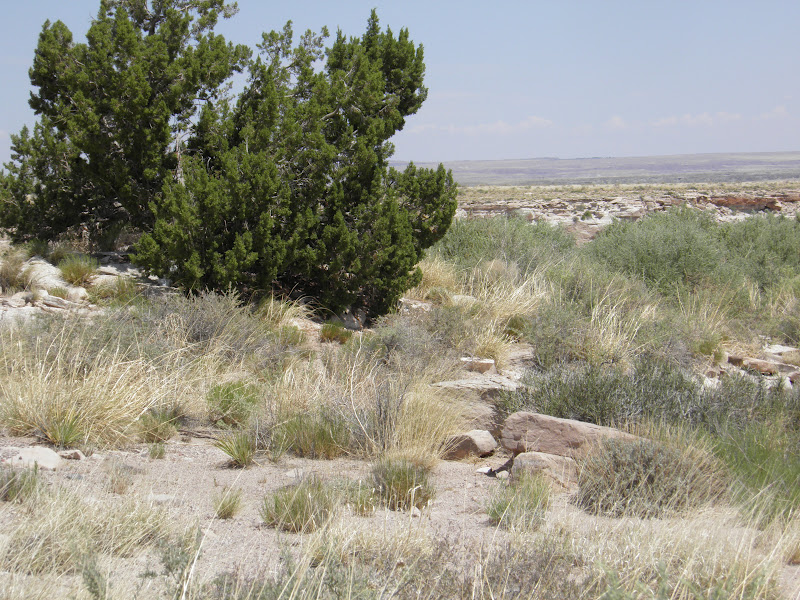
Apparently, before dissolved silica managed to turn wood into, well, almost quartz, some of these trees used to be redwoods. Such a wet climate must have seemed like a different world compared to the high desert of the Colorado plateau which exists at the present. Again, however, the desert has its charms, and this particular one, being over 5,000 feet up (the level land and presence of a rain shadow prevents much growth in the way of junipers of pinyon pines), does not have the scorching 100's of the lower deserts to the south and west. While the main attraction is definitely the wood, ruins, and painted landscape, this is probably one of the better places to explore the "fifth American desert" of the Colorado plateau. Here one can find lots of sagebrush, various smaller cacti and yuccas, as well as cottonwoods (and the disgusting, invasive, evil Tamarisks) along the Puerco river. There is even a chance to see the odd
White-tailed antelope squirrel and a lizard or two.
This had to be my favorite cactus I have seen in a while. It had a lot of character for being such a small thing.
Now, as far as the wood goes, while it is illegal to collect any within the park, and huge amounts of it have been scoured from surrounding areas, there are numerous shops that can legally sell you souvenirs of wood harvested from outside the protected area. I would recommend
Jim Gray's Petrified Wood co., which has an incredibly large shop that also sells other Arizona mineral specimens, and has fashioned logs for sale. Believe it or not, the chair was pretty comfortable. The eastern stretch of I-40 in Arizona has a bunch of other shops as well, but some might be a bit less reputable in collecting sources. Even at Jim's, I was not immediately comfortable with the ethics of the situation, though when I spoke to the staff, I changed my mind. They truly do care about the land, and were surprisingly far more polite and knowledgeable about it than the (non-ranger) staff at the actual park.
All in all, a pleasant place to visit. Due to the open nature of the terrain, and the distance from any point sources of light pollution, this would be a great place to do some wilderness excursions and back-country camping. There are supposedly more logs out there, waiting to be discovered.