Always to the frontier
Showing posts with label Religion in North America. Show all posts

Monday, March 7, 2022

 Ten years ago, I started this blog with the intention of sharing personal reflections on the landscape, history, art, and current events surrounding the North American continent (important: inclusive of Mexico).  Life intervened here and there, and the blog largely took a vacation from 2015 onward.  I spent less time traveling, more time absorbed into the 9-5, and after 2017 I started looking back on what I had written and realized I was perhaps focused on the wrong subject matter.  In 2022, I find myself looking back at a decade of intellectual development and bearing witness to noticing how much my underlying bias went into my writing.  To our detriment, historical methodology is often ignored by armchair historians.  I can't really use the excuse that I don't know what this is, as I did pursue the liberal arts in my higher education, albeit in philosophy, theology, and art history rather than history proper.  All things considered, this is not an academic blog as much as a casual blog of reflection, but one also has to consider that history is a volatile subject these days.

My last blog entry was at the dawn of the Trump administration, a time where many governments and societies across the world were (and are) experiencing upheavals in historical memory and current understanding (to put it lightly!).  I stopped writing because my efforts would have been labelled as political, and as a foreign national living in the US, I didn't want to come across as an Ambassador Genet.  I have lived in this country now since 1994 and have paid taxes since 2000, so I figure I can probably say things about the amber waves of grain.

I come back to the blog to make a bold statement:

We are still fighting the English Civil War of 1642-1651.

The players in the conflict then were different enough from our contemporaries to not be able to draw direct comparisons to what sides fit in the picture today, but we definitely still have the dominant elements in play.  While there are no more Puritans (low-church Anglicans aside), we definitely have a booming Evangelical and Pentecostal population throughout the continent, largely in conservative populations in the United States but growing in both Canada and Mexico.  Like the Puritans, they are interested in making their voices heard in politics, and it must be said, interested in legislating their voices over the rest of the population.  On the other side, we no longer have a king or an established church, but we do have a political establishment that has largely been interested in law and order and societal stability, at least until recently.  

To elaborate further is going to take a lot of posts from here on out, especially as I find myself going back to school in terms of really trying to read up on the players in the conflict.  I decided to begin with prime excuse/cause number one, Archbishop William Laud.  While Parliament had many issues to bring them into conflict with the crown, the initial spark that ignited the fire was from Puritans upset about any slight inkling of Popery/Catholicism in the Church of England, to say nothing about King Charles being married to an outwardly devout Catholic, Henrietta Maria, who the state of Maryland is named after.  That factoid is just a reminder that while this is a blog about North America, our post-Columbian history is very much a trans-Atlantic story.  In any event, one could argue that we definitely have our Lauds out there today in the form of political figures interested in the sense of stability brought about by maintaining the Unitary State (power flows down from the top authority), in contrast to our Parliamentarians, those more interested in promoting Federalism (wherein power is shared between top and local authorities).  The lines blur quite a bit here and there, so we end this post with the caveat that our complicated time shares many features with that complicated time, while the particulars definitely vary.

Here's a short clip from the 1970 classic, Cromwell (featuring absolutely brilliant performances across the board), which features the main man getting riled up by some rather bland (from Catholic standards) altar adornments.  Wars of ideas often start from messing with small things.

Sunday, October 27, 2013

"I Don't Understand You": A History Of Linguistic Diversity In Colonial North America: Part One, Mexico.

Aside from the multitudes of languages and language families that existed among the First Born before colonization, popular imagination tends to view North America as being divided between a Spanish south, English center, and French north which has been largely confined to modern Quebec.  In fact, there was a decent concentration of Dutch, Swedish, Russian, German, Gaelic, and even Greek speakers who settled the continent alongside the "big three".  This resulted, along with settlement patterns and military control of territories, in a severe disruption of communication in what was otherwise a complex network of trade corridors and relatively stable alliance set-ups that could ultimately bring people, goods, and ideas from one ocean to another.  Whereas Geronimo and his Apaches found themselves imprisoned in Florida in a different world, looking at a Gulf of Mexico and sweating in the humidity, something they could not even imagine from living in their distant Arizona, the Apaches a few hundred years before would have been decently informed about and may have even seen on some trade or military expeditions.  Colonization resulted in the continent becoming very compartmentalized, ironically an issue which affects politics in relation to language in the present day.

Let's explore who came and what happened piece by piece.  First we can take a look at New Spain.

This portrait of San Bartholome de Las Casas hangs, suprisingly, in the Senate wing of the United States Capitol Building.  More on this man below.
Spanish colonization did not take over everything from San Francisco to Cape Horn overnight.  The Caribbean islands were the first lands in which settlement and language dispersal happened, with the Spanish making their first concentrated and serious colonization efforts in Cuba after having made minor settlements in Columbia and Venezuela.  The Spanish desire for conquest was primarily fueled by lusting after gold and riches, but colonization was based off of taking advantage of trade with interior peoples and establishing a foothold for Roman Catholicism in the New World. 

While on the surface, the spread of the Spanish language would seem to be a practical way of standardizing trade and commerce and making conversion to a new faith much easier, such cultural domination happened only gradually.  Missionaries trained themselves to speak various languages and traders simply relied on existing trade networks and set-ups.  Part of this was due to the work of one man, San Bartholome de Las Casas.  Simply put, Las Casas was disgusted by what he saw as the brutal conquest that Spain was participating in against the people living with him, admittedly as his own slaves, in an exciting New World where he pledged to make a life of freedom and prosperity.  His viewpoints were hard to keep to himself, and he eventually spearheaded efforts to protect the native population of Mexico from cultural annihilation.  Together with the effects that Malinche had previously had on softening the heart of Hernando Cortez, this meant that Spanish colonization started to become a much more complicated affair than just mere conquest.

Missionary efforts were helped quite a lot by this mutual exploration, though sometimes they resulted in Catholicism simply being absorbed into existing religious practices.   Due to this and other reasons, Spanish efforts did start to turn toward cultural dominance.  Spanish did not become imposed on the populace of New Spain until 1696, but legislated cultural transformation became policy throughout the 18th century, and missionary efforts which went along with military expeditions into the northern frontiers of Alta California, Tejas, and the Rio Grande valley followed this policy, especially after the Jesuits were expelled from all Spanish dominions.  While the Franciscans who followed them were not particularly fond of cultural domination, they followed the law in spreading the take-over of Spanish language and customs.  Mexican independence, followed by strong native democratic participation in the new nation, eventually resulted in a reversal of imperialistic cultural and linguistic directives.

Thus the Spanish language has not completely replaced common usage of indigenous languages in Mexico even in the present day.  While most if nearly all non-Spanish speakers in Mexico are functionally bilingual, the majority of pre-conquest languages have survived with enough speakers around to keep them alive.  The Mexican government, in fact, recognizes 68 languages in addition to Spanish as national languages, complete with all the legal rights for those language users shared by Spanish users.  This has been law since 1917.

Native culture has indeed remained dominant in some areas of southern Mexico, and Mexican culture would not be the same without them, to say nothing of how it would be without heavy infusions from the languages of those cultures into Spanish. While efforts to diversify and protect different languages have met with, let's be honest and say completely racist efforts of suppression in the United States and Canada, Mexico simply has such an inter-mixed population that such a thing would be unthinkable there.  The same cannot be said for the rest of Latin America, but that is another story for a different day, and beyond the scope of this blog, at least for now.

Next post we travel 2,300 miles northward to New France and see what happened with French in the New World.

Wednesday, April 10, 2013

A Priest Among The Temple Of The Secular

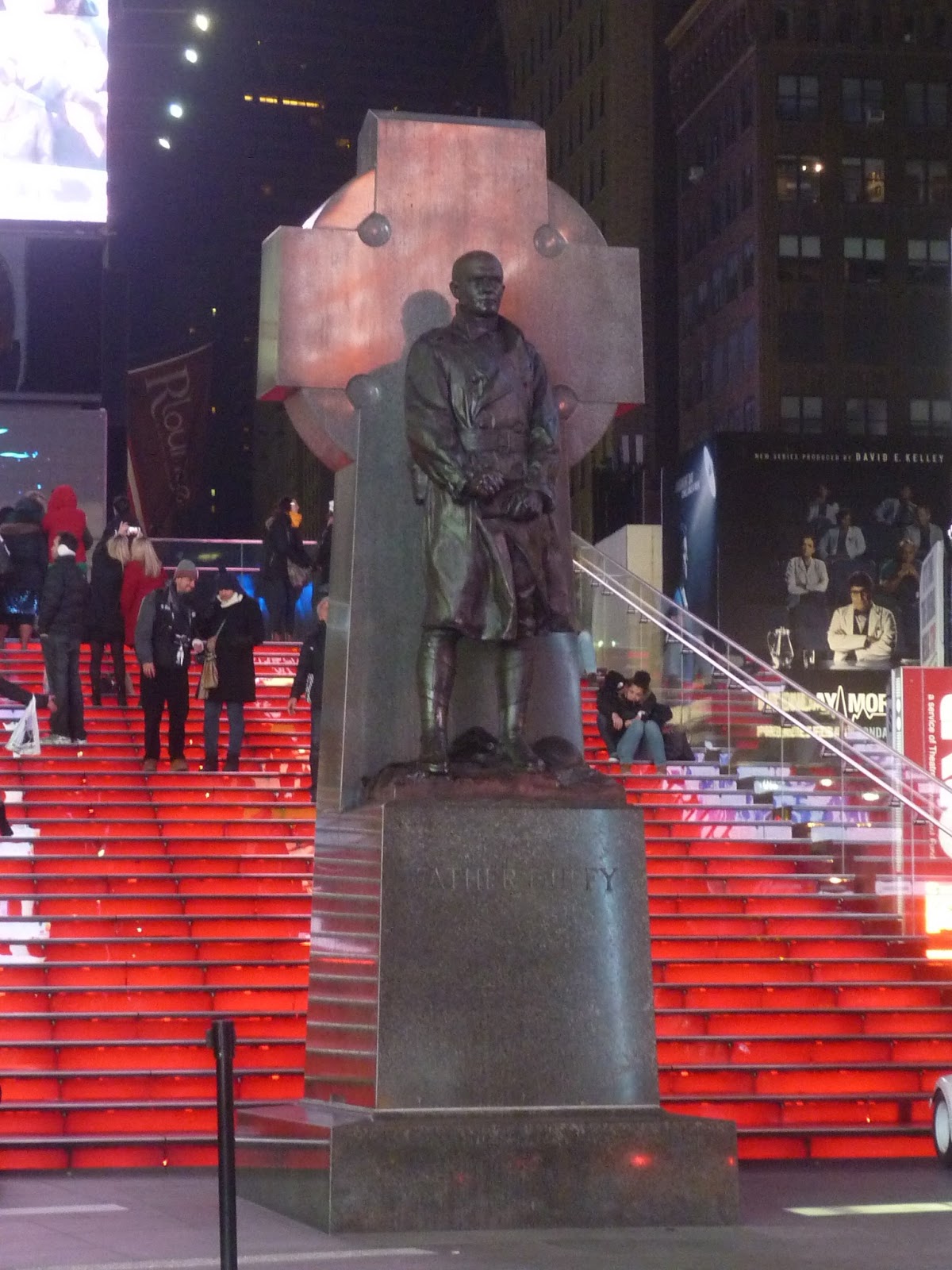
Continuing with some off the beaten path New York coverage, we come to Time's Square.  A little bit on the beaten path, you might say?  Maybe if one focuses entirely on the neon signs, huge advertisements, people lining up in restaurants and shops to spend, spend, spend...  But among the noise and glitter, right in front of everything and everyone stands a statue of a Roman Catholic priest, Father Francis P. Duffy.


Like your author, he was born in Canada, moved to the United States to live there, and responded to a divine call to become a priest in the Roman Church.

He felt very passionately about his adopted homeland and served as a military chaplain for her.  He proved himself every bit as much the leader on the battlefield that he was in a parish or seminary and was regarded highly in this respect by his Irish-American regiment.  Back home in New York he was among the most influential speakers in the public sphere to convince the country that Irish-Americans and other Catholic Americans could be and indeed were patriots and in love with their country, a rather uphill battle for anyone to fight until well into the 20th century.

Times Square, like so much of New York, has been paved over and illuminated to attract tourists, commerce, and perhaps help the city get rid of the memory of its difficult rise to global prominence.  The prosperity and immensity of today's New York, however, has been built on a foundation of racial and cultural conflict, environmental destruction, and the illumination of history.  The arduous and often bloody struggle to help define American liberty and purpose saw New York burned and turned into a pit of people against people in segregated bastions of neighborhoods.  Men and women like Father Duffy were there as American consciousness awakened here in the heart of her historical imagination and memory.

He is honored by a statue that no one looks at (not a single person took even a passing glance in the ten minutes that I stood near it just to see if anyone cared) in the northern part of a square that bears his name.  In some ways we are like a Rome of Late Antiquity, too concerned about the politics of the moment to pay any attention to the statues in our forums that record our past, even while we continue to build more monuments to the glory of our people.

If ever you find yourself among some great wonder of the human world, do not be afraid to question where the foundation lies for what you stand upon and have come to appreciate!

Friday, January 4, 2013

January 4, 1821

On this day in 1821 Elizabeth Ann Seton passed from her earthly existence.

A side altar from the basilica in Emmitsburg.


Along US 15 in Maryland just shy of the Pennsylvania border is a rather Catholic area, complete with a seminary, university, shrine, and pilgrimage grotto.  A tall gilded statue of Mary rises from the edge of the Appalachians and looks over the northern Maryland piedmont.

The scale is less than impressive, but it was a hard shot to take without 

A shrine, indeed a full blown basilica, is one of the central features of the small town of Emmitsburg, Maryland.  The grounds and edifices, of course, are dedicated to the honor and memory of Elizabeth Ann Seton, who in 1975 was made the first United States-born saint.  Emmitsburg became a place of rest for Elizabeth only after years of difficulties both financially and physically.  She was actually a New Yorker, and an Episcopalian by birth; her beginnings can be experienced in another shrine near the battery park at the southern tip of Manhattan.

Things might have remained quiet and simple for her in New York, but Elizabeth fell in love with William Seton.  William was a businessman with a small fleet of ships at his disposal, but found himself at the unfortunate end of both a failing business (due to naval problems during the Napoleonic wars) and a rather weak constitution.  His doctors recommended he spend time in the warmer climate of Italy, and took up an invitation to stay with a business partner in Livorno.  Elizabeth came along, of course, and while there encountered Roman Catholicism in living color.  She fell in love.  When she returned to the United States in 1805, she was received into the Church.

To make ends meet for her family, she opened a school for girls.  In keeping with a history of difficulty, many parents refused to send their children to a school run by a Catholic, and Elizabeth might well have disappeared into obscurity had it not been for a chance meeting with a Sulpician abbot.  Eventually, the Sulpicians invited Elizabeth to Emmitsburg to run a Catholic school.  At the time, this was something of a radical concept; the United States was largely Protestant, and in the Catholic areas of the world a Catholic school was pretty much a given, or just considered a school.  Elizabeth did not know it, but she was being a pioneer in what has since become a grand American tradition of specifically Catholic schools.  As her husband had passed away and her children were growing up and leaving for their own lives, Elizabeth took her mission of education a step further by founding a religious community dedicated to the education and care of the children of the poor.  In doing so, she founded the first congregation of religious sisters formed in the United States.

The area which became her resting place is among the oldest cores of Catholic culture within the United States and is rather notable in being a historical center focused on works of peace rather than war.  Just to the north is Gettysburg, while nearby to the southwest are Antietam and Monocacy National Battlefields.  These anniversaries have largely overshadowed the 200 year remembrance of the passing of the saint, but it is hard for most travelers passing between the battlefields not to notice a very different legacy that exists in this place.  Near Mount Saint Mary's University, along with the giant statue, is a place of repose with lovely gardens and trails built into the verdant edge of the Appalachians.

The heat and a lack of time meant that I did not stop and take pictures of this place, but you have my assurances that it is worth going to even for non-Catholics.  I do confess to a certain bias here.  Mom and I would stop there every time we drove down 15 en route to I-95 and southern Florida each year, and aside from experiencing the shrine of the North American martyrs in Midland, Ontario, the holy sites around Emmitsburg and the story of Elizabeth were among the sacred geography responsible for lighting the flame of a vocation to the priesthood in your author.

The main portion of the basilica.  The thing is actually pretty huge.

As far as the area goes, aside from being riddled with tons of historical sites, things are rural and half-wild.  This is the highly developed eastern coast of the United States, but it is also where the coast gives way to the great wall of the Appalachians, and many places feature undeveloped patches, especially along the ridge lines.  For an urban sophisticate like Elizabeth, moving out here must have been quite the transformation of lifestyle (not that she was worried about it).

Looking west from US 15 northbound, just a few miles south of Emmitsburg.  Those mountains a few miles over are the foothills of the Appalachians and part of Catoctin Mountain Park, something of a federal version of a metropark for the DC area.

Sunday, December 23, 2012

Christmas is Coming

So why not show a picture from some church somewhere, right?


Part of the courtyard at the mission of San Juan de Capistrano, in the city of the same name in California.  The missions are a great way to see some of old California, and like so many religious foundations around the world are one of the best ways to see into the heart of a people, or at least a people's past.

Wednesday, October 24, 2012

Who were the Jesuits of New France?

Ever since the first of the second born of this continent arrived here, religious transformation of the continent had been at the forefront of a new destiny for North America.  The Spanish and French would bring with them an exclusive Roman Catholicism.  The English, Dutch, Swedes, and Danes would bring with them a Protestantism that excluded this Catholicism in return.  The Russians would bring their Orthodox Christianity.  In any case, the soldiers and merchants came hand in hand with various missionaries.  Nearly all of them were as concerned with replacing as much of the culture as the religions of the peoples they encountered.  The loving message of Christian transformation for the world, sadly, often came hand in hand with a pointed gun.  The missionaries would cry out "shame, shame" or at least shake their heads in silent disapproval, but nothing really changed as a result of their weak disputes with colonial domination.

One group, however, was quite different.

Ever since their foundation in 1534, the Jesuits were drawing some of the keenest and brilliant minds in Europe into their world.  These men were scientists, philosophers, politicians, artists, even warriors, but they all shared an intense zeal for spreading their faith and love of Jesus Christ to others.  They were explorers as well, just as much concerned with evangelization as with roaming about the world and embracing its beauty and offerings.  Very often, this brought them into conflicts not only with non-Catholics Christians, but also with the other missionary orders within the Catholic Church.  By the early 1600's, such was the negative attention that they had received that other missionaries made active efforts to keep them out of new territories.  One notable exception was New France.

The Franciscans in Quebec were finding that the rough country and alien cultures of the Algonquins and Montagnais were a far cry from the so-called civilized frontiers of the Arab and Oriental worlds that they had thus far been called upon to engage in conversion efforts.  Though they had started to gain experience with the first born of North America in Mexico, such evangelization efforts in the Spanish New World were augmented with steel and gun-smoke.  French efforts to colonize and economize on the New World were an altogether different affair; the native peoples were trading partners rather than subjects, and the missionaries were warned not to get in the way of the bottom line.  As the Jesuits were certainly available, willing, and capable of engaging cultures on their own terms, the Franciscans called them in for assistance.  Pretty soon, they were running the missionary effort, as well as the exploratory and diplomatic efforts on behalf of the French expedition.  They were among the first Europeans to learn the languages of the first born, and among the only to report back to the mother countries about a richness to cultures otherwise considered savage and backward.  They did, however, heavily impact any people they came across.  New France, from Quebec to Louisiane, as well as the deserts of northern Mexico and the southwestern United States, and the upper Missouri river basin were all regions that bore the mark of passing Jesuits: native peoples who had a somewhat neutral meeting with Europeans.  Their churches still stand and are in use, monuments to healthy missionary efforts:

http://www.sanxaviermission.org/


Friday, October 19, 2012

Feast of the North American Martyrs

On this day in the Roman Catholic Church are commemorated the Jesuit martyrs of New France.  Each of them endured a pretty brutal death at the hands of the Haudenosaunee, who at the time were mortal enemies of the Wendat and French.


They are commemorated in two shrines, one in Auriesville, New York, and a grander one in Midland, Ontario, which rises over a reconstructed Wendat village.  Love them or hate them, these people had a significant role in the development of North America, particularly in the conversion to Christianity of the first born sons and daughters of this land.  Together with Matteo Ricci, who worked as a missionary in China, they are largely responsible for helping to form centuries of Jesuit missionaries.  The Society of Jesus, through the experiences and sacrifices of these missionaries, learned how to carefully introduce their religion to a culture that might otherwise be somewhat worlds away from it.

So how is this for a crazy idea?  Let's spend the next week looking at what they did.

In the meantime, enjoy this fictional, but somewhat accurate, clip of a movie that spoils the ending for you.  Hint: Mortally speaking, it was not the most pleasant of endings.

Saturday, June 2, 2012

For Greater Glory

I had intended to post on the effects of the American Civil War on Canada today, but I had forgotten that yesterday marked the release of a very, very interesting film.  In the 1920's, the Mexican government embarked on a, well, war against the Roman Catholic Church.  By the end of the decade, things had gotten ugly enough to the point where priests were being publicly executed for being caught saying Mass, and entire states had found themselves fighting off uprisings among their populations who wanted to remain Catholic.  For Greater Glory is a film about these troubling times, and not some low-budget venture either.  Among the cast are the immortal Peter O'Toole and Andy Garcia, and many theaters in the United States and Canada seem to be offering it.


Thus far, the film has received negative reviews, but to be quite honest, these were written by people who tend to miss the point of these sorts of historical costume dramas.  The New York Times, notable for usually tearing apart bad films, has actually given this one a pretty good review.  I have not yet seen the film for myself, but I have a feeling it will be pretty decent.  If you want to see an often neglected and yet very important part of North American history on the big screen, by all means, go and see it.  For one thing, it might be the last time we get to see Peter O'Toole in a major role.

Monday, April 2, 2012

The Mormon Presence in the Landscape

Cities in Utah tend to stand out from other cities found in much of the rest of the United States.  Their defining features are not huge corporate towers, grand monuments to the past, or even sporting facilities which seem to get larger and larger as the years go by.  Rather, their landmark sites are religious buildings that jump out of the developed scenery, usually painted a bright white and illuminated strongly at night.  These are Mormon temples, wherein authorized members of their faithful participate in the higher rites of their religion.  At the time of this posting, there are 136 temples worldwide, with another 15 in the works, the vast majority of which have been built in the last 30 years.  Non-authorized members and non-believers are not permitted entrance into these places, and as such, I have no photos of their interiors to show here.   I do, however, have a picture of the oldest currently operating temple, in St. George, Utah.

This temple ranks prominently in the ecclesiastical geography of the Mormons, specifically, the Church of Jesus Christ of Latter Day Saints, the largest sect of the religion.  Earlier temples existed in the migration of the faithful, who found themselves frequently on the move.  None of these have survived, and the temple of St. George is the oldest running, completed in 1877.  As is the case with most of these structures found in Utah, it tends to really stand out, even from miles away on I-15.

Other temples around the world tend to blend in a bit more, sometimes even looking like a local structure rather than something so dazzling and alien from a cityscape.  The temple in metro-Detroit, for example, could pass for a synagogue and is but one of many religious buildings found along Woodward avenue.  In Utah, however, the Mormon religion tends to stand out a bit more, even as demographic shifts in the state are changing the census counts.  There is a very long and complicated history behind this, which I will cover when I have had the chance to experience the places where this history took place for myself.  This history involves far more than just Utah; in my opinion, it actually began with a a massive forest fire in Northern Ontario in 1780, which set off a flurry of American religious development that lasted for nearly 50 years.