I love the United States of America. I love it for its sheer humanity; great dreams and noble intentions coupled with ambitions of imperial dominance set in mind to gain the most glittering crown avarice could ever offer. I love it for its achievements in human progress which it has come to increasingly display alongside a realistic look at a rather barbaric past of slavery, slaughter, reckless greed, and xenophobia. I love how the best and worst of humanity are found and acknowledged without pretense here. Sure, some history books and some pundits gloss over the issues and sugar coat an incredible history. This, however, is by and large a country wherein memorials to genocide stand out every bit as public as the temples to liberty erected in various capitals both state and Washington alike. The United States of America, you see, is very human. I would dare so much as to say that no other country in the world is so unabashedly human.
I never have left her for very long. Oh sure, my heart has longed to return to where it thinks it belongs across the northern border. My sense of adventure and imagination has even called me to Mexico. Both places are wonderful, quite different bookends to the North American collection. Canada has, until the last forty years anyway, been a country of diffident conservatism borne from a defensive nationalism. Mexico, in contrast, again except for the most recent decades, has been a country of reckless liberalism borne from a confused sense of national identity. The United States of America though? The United States has had ALL of this about it, with every element of the political battlefield making a mark in the war zone. The allure of freedom to make a mark in the fight in whatever way one chooses is, well, intoxicating. The greatest thoughts and ideas come from people looking for action! And yet...
Something can be said for the place of peace across the northern border. Maybe there is something to stepping back and taking a look at so many great thoughts and ideas from outside the fishbowl in a state of sobriety. (Take a look at any post in this blog labeled "Canada" to find out more). Maybe there is something to a country that, if not for the War of 1812, could have very easily been a part of its southern neighbor and in many ways today does not stand so distant from her in many ways. There has to be something about Canada in and of itself that makes Canadians want to proudly be what they are, even an expat like myself. I could probably drone on and on about what such things would be, but I keep finding that as time goes on, learning what it is to be Canadian, or American, or Mexican, well, it keeps unfolding in a truly North American voyage of discovery.
Canada is a land of the present world still very much connected to a much colder past of thousands of feet of ice. No political pun intended.
Canada is a place of incredible wild and scenic landscapes that have managed to remain outside the realm of the salesman or the government clerk, being at once both accessible and inaccessible by the people. Again, no pun here.
Canada has deserts, prairies, forests, mountains, lakes, tundra, and even rainforests, a diversity just like the United States but with a lot less in the way of pure extremes. Definitely not a pun in sight, keep moving folks.
Canada is my country, a house that I respect and love from the distance of the louder and interesting house next door. That said, this is also my country, and when I speak of a view from houses to other houses, I really mean it. See, I have had problems for some time now in distinguishing one side of the river from the other:
The first born used the rivers as highways, not borders. My French ancestors did pretty much the same thing (they figured mountains made for better borders). Then the English came along, and you know how they are about the whole liberty equating to property thing. The Americans are even more keen on it! Is this what makes Canada Canada and the United States the United States? Property? I mean sure, philosophy has a lot to do with it, as does perspective, but I find the differences there to be a matter of degree rather than even sides of a coin. Maybe one day this bridge will still have a toll booth, but that will be the only stop sign on it. Maybe then we will know what the meaning of things like July 1st and July 4th really are, understood in a context of a political history but not still mired in it.
At least this July 1st, in 2013, I can say with a bit more confidence than I could on a July 1st, 2002 after a certain September 11th, 2001, that July 1st is not so alien from July 4th. A sensitive topic, to be sure. But American Voyages is all about putting sensitive business aside and taking a look at the blood and guts of the continent. Here's a crazy idea then, how about either tomorrow or the 3rd, you know, just in time for the 4th, we take a look at two things that both of these countries have quite the history with: language and immigration. Maybe then we can see what these days mean to a lot of people.
Always to the frontier
Showing posts with label Part of the United States That Passes for Canada. Show all posts
Monday, July 1, 2013
Sunday, March 24, 2013
Good News For Syrup: Growing With Plants Spreads The News
After a few ridiculous winters of days as much as thirty degrees above normal giving even New Englanders and Ontarians a chance to bask in the January sun, our delayed winter of 2013 has given our lovely Sugar Maple (Acer Saccharum) trees a chance to once again shine and bring for their wonderful sap, and more importantly, sugar derived from said sap. A wonderful blog I follow, Growing With Plants, has devoted their latest post to this wonderful affair of sticky tree blood:
http://www.growingwithplants.com/2013/03/vermont-maple-sugarmakers-rejoice.html?utm_source=feedburner&utm_medium=feed&utm_campaign=Feed%3A+blogspot%2FKxxH+%28Growing+with+Plants%29
Now, to be fair, this is only mere Vermont maple syrup, which is nothing compared to Ontario or even Quebec maple syrup. I will not even try to comment on people in Illinois or Indiana claiming they can do it...
Just kidding. Or am I?
Anyway, thanks to Growing With Plants, probably one of the most entertaining and informative gardening blogs out there, for spreading the maple gospel.
http://www.growingwithplants.com/2013/03/vermont-maple-sugarmakers-rejoice.html?utm_source=feedburner&utm_medium=feed&utm_campaign=Feed%3A+blogspot%2FKxxH+%28Growing+with+Plants%29
Now, to be fair, this is only mere Vermont maple syrup, which is nothing compared to Ontario or even Quebec maple syrup. I will not even try to comment on people in Illinois or Indiana claiming they can do it...
Just kidding. Or am I?
Anyway, thanks to Growing With Plants, probably one of the most entertaining and informative gardening blogs out there, for spreading the maple gospel.
Saturday, November 10, 2012
The Most Powerful Lake in the World
On this day in 1975 a freighter sank to the bottom of Lake Superior, taking with it a huge load of taconite and the lives of 29 crew members. The Edmund Fitzgerald was an amazing ship that people living along the various rivers of the St. Lawrence seaway would run to go see. Her captain and crew were no strangers to the fact that even the largest of ships could be taken by an aggressive sea, and were perhaps on edge for some of the journey so late into the fall in such an expanse of water so far north. They radioed that they had difficulty on the trip from Duluth that was meant for Detroit and Toledo, but gave no indication of being in mortal danger either. Only minutes before she sank, Captain McSorley radioed that his crew was holding its own despite the great waves and winds of Gichigami giving him a hard time. Then there was nothing. No bodies were ever found, and the ship lay broken 530 feet below the surface. Some have suggested that the ship hit an unmarked shoal, others suggested that a rogue wave broke the vessel in two. Still others have claimed that a design flaw was responsible.
Whatever the truth of the matter might be, the fact remains that she was sailing on Lake Superior, a body of water that more than rivals some of the most dangerous parts of the oceans in sheer ferocity. Superior does have shoals, some of which suddenly rise to within feet of the surface even while they are surrounded by well over hundreds of feet of water. Gitchigami (Gitchee Gumee), as the Ojibwe call Superior, is the powerful remains of the North American ice sheet embraced and cradled by some of the oldest rock in the world, parts of the Canadian Shield rippling with muscles of iron and granite that have withstood over a billion years of erosion. She bears hurricane force winds that blow with all the force of a Sandy or Katrina. She rolls along waves that can engulf entire ships. She is blue and gray and bitterly cold even after a hot summer. She makes her own weather, and both moderates and intensifies the local climate of her shores. She is home to some of the mightiest Lake Trout (Salvelinus Namaycush) on the planet, weighing over a hundred pounds. However, she is also gentle...
| Taken at Pictured Rocks National Seashore, Miner's Beach. |
Her irons and granites are complimented by amethysts, agates, and various other lovely rocks and minerals. Her shores are adorned by the southern boreal forest, a peppering of birches, pines, spruces, and fir. Her waters remain pure, a lovely piece of art left to us by nature these thousands of years after her birth from the glaciers.
She serves as a reminder to us that while we may indeed be fertile, multiply, and come to have dominion over the earth, we are never her ultimate masters. Fortunately, though such lessons are learned painfully when disaster strikes as in the case of the loss of a great ship, Gichigami tends to inspire more than frighten. The first born living among her figured she was a divine spirit. The first French folk, including some Jesuits, who came to see her beating upon the ancient rocks for the first time with their astonished eyes were awestruck. These days, there are exploiters who want to channel her to the arid western reaches of the continent, most of whom have never even seen her in a photograph. That said, there are just as many people who have seen her that would just as soon die before letting her be channeled away. Gichigami, it seems, continues to have a powerful effect on those who would love her... or even come to fear her.
Tuesday, November 6, 2012
What is "Le Nord"?
Every now and then I label my posts with particular labels that might not necessarily be self-explanatory at first glance. Whenever I speak about French-Canadians, Canada, or the parts of the United States that pass for Canada (another such label), I usually mark such posts with "Le Nord". Le Nord is French for "The North", and as with most geographical labels that place culture ahead of actual geography, the designation can be somewhat misleading. What is "north" to an Ontarian or a Michigander might be a joke to some Cree fellow from far northern Quebec. What would the opposite of north be? South? Would some fellow from Biloxi not consider someone from Louisville to be nearly a "northerner"? Fortunately for such brazen label lords such as myself, cultural regions are only part of a greater recipe that can make geographical soup.
An area's landscape, its geology, flora, fauna, climate, and all such things conspiring to make the familiar smells and sensations of what is unique to every environment on earth have as much to do with what makes a place a place as its history, culture, and residents. Le Nord, as such, is a place that combines the rugged majesty of the Canadian Shield, with its black lakes, boreal forests, sandy soils, and cold, dry air with English, French, Cree, and Algonquin speaking people who mostly live in Canada, with a few being found in the United States as well. I thought about making a map to delineate where such a region would be, but as labels usually fall under the category of several logical fallacies, and since there are exceptions to geographical definitions, a map fell out of the question. Instead, where you can find the below landscape, you can usually find "Le Nord".
Now, pictured there we have one of those black lakes, a shoreline peppered with granitic boulders, and lovely balsam fir and eastern white pine. You can find this sort of scenery in the Adirondacks, northern Michigan through Minnesota, Manitoba, Ontario, and points eastward, a pretty diverse set of places. Yet in nearly each of them you can find little towns that look like this:
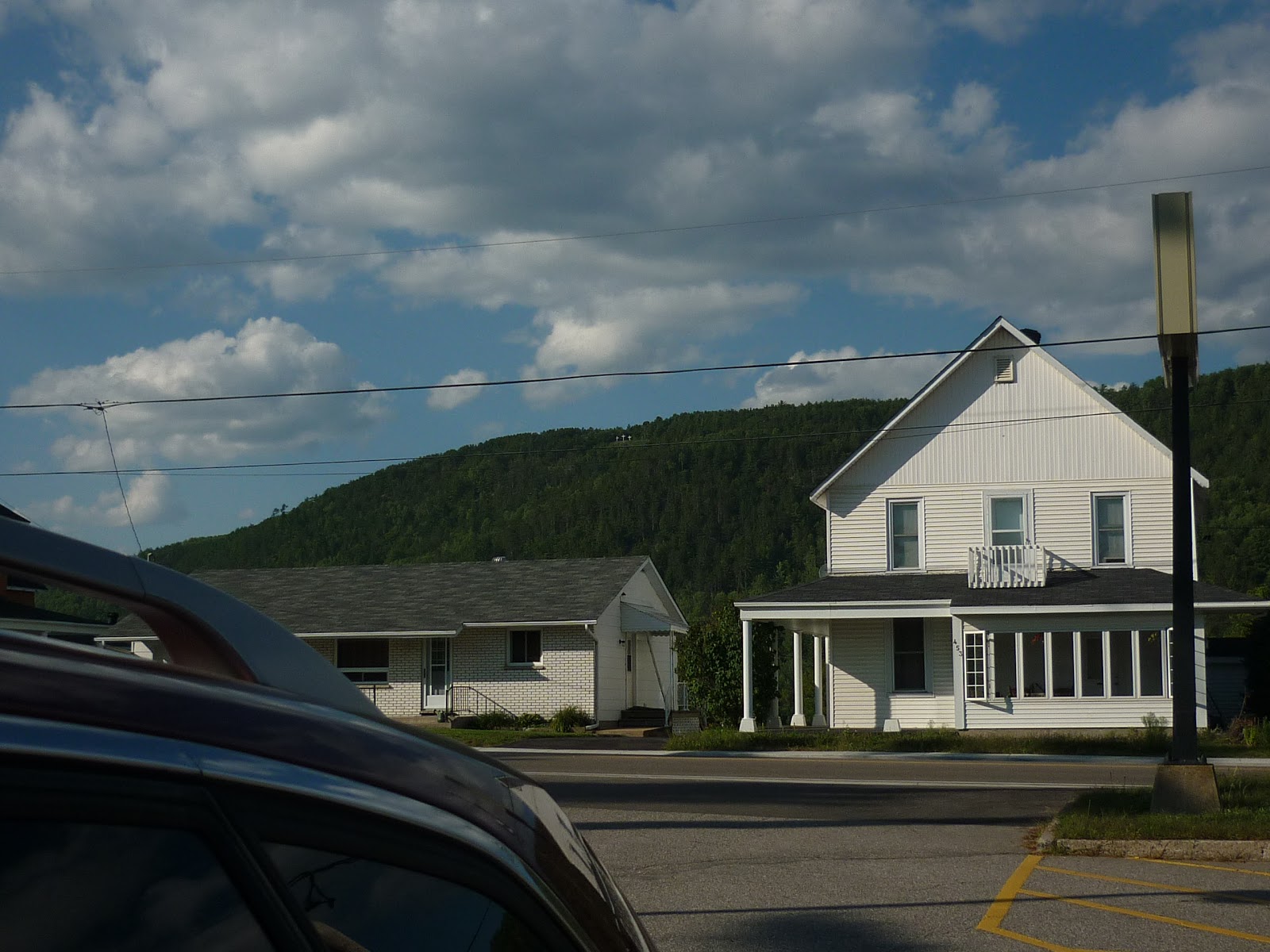
That was taken in Mattawa, Ontario, a small town which looks a bit like Munising, Michigan, or Madawaska, Maine. Sure, two of the four have pretty significant French-Canadian populations, but the cultural association is pretty much just incidental to the fact that most of the boreal parts of the world have long since been passed over as favorable for agriculture, large cities, and the other trappings of modern civilization. French-Canadian culture has endured because it happened to be concentrated in such environments. In 1763, Britain had a choice of getting Canada or Guadeloupe, a Caribbean island that at the time was worth more than all of France's North American possessions. For numerous reasons, Canada was the prize that Britain settled for. This would have normally meant mass deportations of all the French inhabitants of such lands, but owing to the need to keep the 13 colonies to the south bounded in, and because the land was not exactly a prize in the eyes of colonial settlers, French-Canadian culture remained, except on suitable land in the St. Lawrence valley further upstream where they had not yet settled in large numbers. Again, Canada is what Britain simply settled for. The real crowns of the empire were in the 13 colonies, Caribbean, and India.
In the next two centuries, French and First Born alike would be joined by other immigrants looking to reap the riches of an otherwise rugged land. In keeping with their predecessors, though, these newcomers never really mowed over as much of the landscape as those further south did. Yes, people farm in Le Nord, but that is only because a farm is one of many choices of a living in this place. Many harvest the bounty of the land in mineral, timber, and other natural resources. Large corporations do exploit the land here, but more than often the majority of people in these places are in it for themselves. Much of the land still looks a bit wild and natural as a result. That's what Le Nord is, really. A place where some people live for living, where resources could be exploited by tend to get ignored for easier circumstances elsewhere, and where life continues largely unaffected by a modern pace of consumption and life. Mattawa has fast food, wifi, and is not entirely off the beaten path away from larger cities with big box stores and huge malls, but it, and places like it, is not dominated by such things as much as it is set in a backdrop of a land where it is easy to remember that environment is more than just the most visible things.
An area's landscape, its geology, flora, fauna, climate, and all such things conspiring to make the familiar smells and sensations of what is unique to every environment on earth have as much to do with what makes a place a place as its history, culture, and residents. Le Nord, as such, is a place that combines the rugged majesty of the Canadian Shield, with its black lakes, boreal forests, sandy soils, and cold, dry air with English, French, Cree, and Algonquin speaking people who mostly live in Canada, with a few being found in the United States as well. I thought about making a map to delineate where such a region would be, but as labels usually fall under the category of several logical fallacies, and since there are exceptions to geographical definitions, a map fell out of the question. Instead, where you can find the below landscape, you can usually find "Le Nord".
Now, pictured there we have one of those black lakes, a shoreline peppered with granitic boulders, and lovely balsam fir and eastern white pine. You can find this sort of scenery in the Adirondacks, northern Michigan through Minnesota, Manitoba, Ontario, and points eastward, a pretty diverse set of places. Yet in nearly each of them you can find little towns that look like this:
That was taken in Mattawa, Ontario, a small town which looks a bit like Munising, Michigan, or Madawaska, Maine. Sure, two of the four have pretty significant French-Canadian populations, but the cultural association is pretty much just incidental to the fact that most of the boreal parts of the world have long since been passed over as favorable for agriculture, large cities, and the other trappings of modern civilization. French-Canadian culture has endured because it happened to be concentrated in such environments. In 1763, Britain had a choice of getting Canada or Guadeloupe, a Caribbean island that at the time was worth more than all of France's North American possessions. For numerous reasons, Canada was the prize that Britain settled for. This would have normally meant mass deportations of all the French inhabitants of such lands, but owing to the need to keep the 13 colonies to the south bounded in, and because the land was not exactly a prize in the eyes of colonial settlers, French-Canadian culture remained, except on suitable land in the St. Lawrence valley further upstream where they had not yet settled in large numbers. Again, Canada is what Britain simply settled for. The real crowns of the empire were in the 13 colonies, Caribbean, and India.
In the next two centuries, French and First Born alike would be joined by other immigrants looking to reap the riches of an otherwise rugged land. In keeping with their predecessors, though, these newcomers never really mowed over as much of the landscape as those further south did. Yes, people farm in Le Nord, but that is only because a farm is one of many choices of a living in this place. Many harvest the bounty of the land in mineral, timber, and other natural resources. Large corporations do exploit the land here, but more than often the majority of people in these places are in it for themselves. Much of the land still looks a bit wild and natural as a result. That's what Le Nord is, really. A place where some people live for living, where resources could be exploited by tend to get ignored for easier circumstances elsewhere, and where life continues largely unaffected by a modern pace of consumption and life. Mattawa has fast food, wifi, and is not entirely off the beaten path away from larger cities with big box stores and huge malls, but it, and places like it, is not dominated by such things as much as it is set in a backdrop of a land where it is easy to remember that environment is more than just the most visible things.
Friday, October 19, 2012
Feast of the North American Martyrs
On this day in the Roman Catholic Church are commemorated the Jesuit martyrs of New France. Each of them endured a pretty brutal death at the hands of the Haudenosaunee, who at the time were mortal enemies of the Wendat and French.
They are commemorated in two shrines, one in Auriesville, New York, and a grander one in Midland, Ontario, which rises over a reconstructed Wendat village. Love them or hate them, these people had a significant role in the development of North America, particularly in the conversion to Christianity of the first born sons and daughters of this land. Together with Matteo Ricci, who worked as a missionary in China, they are largely responsible for helping to form centuries of Jesuit missionaries. The Society of Jesus, through the experiences and sacrifices of these missionaries, learned how to carefully introduce their religion to a culture that might otherwise be somewhat worlds away from it.
So how is this for a crazy idea? Let's spend the next week looking at what they did.
In the meantime, enjoy this fictional, but somewhat accurate, clip of a movie that spoils the ending for you. Hint: Mortally speaking, it was not the most pleasant of endings.
They are commemorated in two shrines, one in Auriesville, New York, and a grander one in Midland, Ontario, which rises over a reconstructed Wendat village. Love them or hate them, these people had a significant role in the development of North America, particularly in the conversion to Christianity of the first born sons and daughters of this land. Together with Matteo Ricci, who worked as a missionary in China, they are largely responsible for helping to form centuries of Jesuit missionaries. The Society of Jesus, through the experiences and sacrifices of these missionaries, learned how to carefully introduce their religion to a culture that might otherwise be somewhat worlds away from it.
So how is this for a crazy idea? Let's spend the next week looking at what they did.
In the meantime, enjoy this fictional, but somewhat accurate, clip of a movie that spoils the ending for you. Hint: Mortally speaking, it was not the most pleasant of endings.
Thursday, June 14, 2012
Other Blogs: The Agate Lady
Among the many natural wonders to be encountered in the lands around Lake Superior are the treasures known as Lake Superior Agates. They are a rock collector's (in this part of the world anyway) dream find, and wash up in variable quantity along much of the shores of Lake Superior, some parts of the lakes below her waters, as well as down the glacial drain-ways of the Mississippi and Ottawa Rivers that helped tune the lake down a bit after the last major glaciation. Though I have found many in rock shops, I have yet to have one find my foot along the fine beaches of Le Nord.
Anyway, there is a special spot along the lake where these things wash up in abundance, enough to warrant a museum nearby dedicated to the great agate, the Gitche Gumee Agate and History Museum in Grand Marais, MI. Being nature drunk while I am in the Upper Peninsula of Michigan, I have managed to thus far neglect this fine place. I can at least admit that it is on my bucket list of places to go in Michigan. In the meantime, I follow the blog of the owner, Karen Brzys:
http://agatelady.blogspot.com/
As I am sure many of readers could care less about the agates, despite them being such a wonderful actual piece of North America itself, I do make note that the reason I have linked her blog here is because she is an absolutely wonderful photographer who travels quite a bit through the northern reaches of Michigan and surrounding lands. Karen, almost daily, gives us wonderful pictures of the Upper Peninsula. While you can continue to find good quality U.P. material here on American Voyages, by all means, check out what she has to offer, as her voyages in that neck of the woods have been far more extensive than mine. She does a good job capturing the essence of the place, especially the great sand dunes near Grand Marais.
Anyway, there is a special spot along the lake where these things wash up in abundance, enough to warrant a museum nearby dedicated to the great agate, the Gitche Gumee Agate and History Museum in Grand Marais, MI. Being nature drunk while I am in the Upper Peninsula of Michigan, I have managed to thus far neglect this fine place. I can at least admit that it is on my bucket list of places to go in Michigan. In the meantime, I follow the blog of the owner, Karen Brzys:
http://agatelady.blogspot.com/
As I am sure many of readers could care less about the agates, despite them being such a wonderful actual piece of North America itself, I do make note that the reason I have linked her blog here is because she is an absolutely wonderful photographer who travels quite a bit through the northern reaches of Michigan and surrounding lands. Karen, almost daily, gives us wonderful pictures of the Upper Peninsula. While you can continue to find good quality U.P. material here on American Voyages, by all means, check out what she has to offer, as her voyages in that neck of the woods have been far more extensive than mine. She does a good job capturing the essence of the place, especially the great sand dunes near Grand Marais.
Subscribe to:
Posts (Atom)