Always to the frontier
Showing posts with label War of 1812. Show all posts

Wednesday, November 13, 2013

"I Don't Understand You": A History Of Linguistic Diversity In Colonial North America: Part Three, Canada Continued.

These days we tend to hear an annoying little voice calling out for Quebecois liberty.  This voice has shut up a bit ever since it might have come to its senses and realized that things could be much, much worse for the otherwise fine people of Quebec, which probably has something to do with the fact that a decent majority of her people feel that they are being treated well enough as part of a united Canada and all of them know that they have the right to not only speak French and exist as they otherwise wish throughout the nation.  More on this towards the end of the post, along with the other side, which it turns out is just as bitchy as the Francophones are over "my rights".  First, just how did we manage to get to this point, anyway?

Well, the Canada of the 1770's was a very uncertain place, full of French-speaking people expecting deportation/cultural annihilation.  French anything was certainly not in vogue back in London, to say nothing of how it was openly hated and feared in the rest of English-speaking North America.  Think about things from the American perspective, especially from the viewpoint of a backcountry Pennsylvanian or Virginian: the French were the enemy, sending those terrifying Indians to attack you for no other purpose than to either kill you outright or terrorize you into leaving your land to the beavers so they could just... profit.  That's right, they did not even want to settle down in your vacated clearing and cabin.  Maybe their allies would retake some of that property, but even they would be more than likely to return to ancient lifestyles rather than set up shop in your hard-earned dwelling.  1763 was supposed to have changed all that.  1763 was supposed to be the time where London could tell France to pack up and move on and let people freely expand into that desirable western frontier.  New colonies could even spring up along the St. Lawrence and Great Lakes, where they could connect economic opportunities with the distant Hudson's Bay Company. 

Why would the newly appointed authorities of New France, be it in Quebec or Louisiana, want anything else?

Well, for one, London wanted control.  Liberty was all well and good, but imagine how it looked from an office overlooking the Thames when confronted by the image of a set of colonies slowly growing into something far more expansive than merry old England.  If nothing else, imagine how the people in such offices viewed the revenue potential of such a vast enterprise.  Such income could easily pay for any war that these colonies would get into in the future, let alone what they had already cost the motherland in that war leading up to the victory of 1763.  Now, imagine that if the colonists got their every wish and could expand as far they wanted to across the continent.  Levying a tax on such a vast population would be difficult, and the freedom-minded people might even say no...  In fact, they already had been not even 10 years after that victory had been achieved.  More than this though, mother Britain knew that she could not indefinitely keep the winning streak she was on without a nation getting a bit overwhelmed by almost constant fighting.  She needed to keep large reserves of the American prize open as potential bargaining chips down the road.  After all, Canada was won only at the cost of turning down an even more profitable prize: Guadeloupe and Martinique in the Caribbean.  Canada was just an option, and not a trophy or a purpose, for London.

So for control, for an open hand to play, for so many things, Canada was not just given to the Americans in its entirety.  Provided that they give allegiance to a new crown, the French-Canadians could remain as they were, and this was, and has ever since been, because of the vision of one man:  Lord Guy Carleton.

Unknown artist, public domain, reference number C-002833 from the National Archives of Canada.
As I said, he is the savior of the entire concept of French-Canada, and next to George Etienne Cartier is probably the only reason that there are any French-speakers left on the continent.  He made the Quebec Act of 1774 possible, and he also saved our behinds from being taken over by the Americans during the invasion of Quebec that was one of the first strategic offensive moves of the American War for Independence and the first official take-over attempt by Americans to dominate Canada.  You would not figure Guy to be fond of anything foreign, however.

You see, Guy was Protestant, and he was Anglo-Irish, meaning that he was the product of centuries of an imperial attempt to impose English dominance over the island next door.  He was also a veteran of the Jacobite wars over in Scotland, yet another exercise in said imperialism.  By all accounts, nothing French or especially Catholic should have been in any way appealing to him to let live.  That said, we know little of his earlier conviction and personal beliefs regarding English cultural sentiments, but we do know that he was a social climber and cared very much about his military career.  Even if he was not interested in an imperialistic patriotism, he was very much interested in making the right moves.  To speak out on behalf of the conquered French-Canadians was a risky move that one would not expect of a career obsessed officer.  In the end, however, he did just that.  In the end, the Protestant Anglo-Irishman asked London to let the French-Canadians not only speak French and be Catholic, but even to judge themselves according to their own civil laws.  He also put his life on the line to defend Quebec from American attack.

Now the next part is very important.

But wait, you say, Americans of the period soon learned to love the French, especially after they would come to save the day at Yorktown and later even embrace a revolution of their own.  True, but also remember that prejudice built up over generations and hundreds of years is not something to be so easily reversed.  For anyone of British, and then by extension, American, heritage, things French were the rival at best and the enemy at worst.  When we get to language in the United States, we will also cover feelings about things Spanish, but rest assured that in Anglo-American history, both cultures were not exactly well-loved ever since the reign of Henry VIII, and yes, religion complicated matters further.  Why bring this up in a topic about language in Canada?  Well, the battleground on the topic has already existed there for much longer, and now to look at the results, we turn back to Canada.

One can pretty much be certain that loyalty was almost then guaranteed in this new Canada.  In 1775 and again in 1812, any notion of joining the crusade for freedom with the Americans was pretty much junked.  Why take chances with, at best, an unknown foreign government in the colonies, and at worst, a government that would echo the sentiments of her citizens and expunge anything French from the land?  Guy offered security and potential profit: whereas Paris once controlled the economic destiny of New France, she was now joined into a network of free-enterprise with an empire that spanned the globe.  If we consider the Quebec Act to be the political birth of Canada, then we would also have to say that the Quebecois of 1775 where positively thrilled to be Canadian, and in 1812, they pretty much confirmed that notion to curious Americans.  By 1867, when Canada came into an official existence more along the lines of what we know her to be today, French was alive and well in a Canada that had since come to also embrace English and manage to somehow not extinguish languages spoken by her native peoples.

As I have rambled on a bit in this post, we will continue down this track, which does get a bit bumpy, next post.

Saturday, October 19, 2013

Are We Headed To A New Civil War?

North Americans, yes, even us comparatively politically and socially sedate Canadians and Mexicans, are an opinionated lot.  Sure, there are active ideological fronts being fought over in the rest of the world, but here we seem to have built up a culture that thrives on, or perhaps even requires, ideological diversity.  Even in some of Europe's more open societies which rely on total democratic participation to exist as they do, North Americans trump them in terms of respecting the notion of personal determination to the point of it being made into a sort of religion of liberty.  Canada and the United States largely inherited this passion for mother Britain, which in the eighteenth century was every bit as crazy over liberty than the colonies were.  The frontier mentality of rugged individualism, in fact, can largely be traced to the freedom-oriented folkways of the people of the northern borderlands between England and Scotland.  That said, such passions were later transformed by an influx of a wide diversity of immigrants, both free and enslaved, from across Europe and sub-Saharan Africa.  Down in Mexico, a reaction against a distant or otherwise oppressive Spain grew in intensity inspired by what was happening further north.

The history lesson from there on is an important one.  Whereas Britain buckled down in defending a particular concept of freedom, particularly the national identity brand, against intrusions by France and eventually Germany, North America exploded into hundreds of different camps.  In Mexico and Canada, this has always been strongly evidenced by strong provincial/regional traits; the near revolutions in Chiapas and Quebec that have never really faded away are proof enough of this without even looking at the rest of how the countries are at odds with the capitals.  In the United States, however, while the federal government remains strong and appears to be an emblem of power and unity to the rest of the world, well...

Let's just remind ourselves that the thirteen colonies almost did not rebel together, much less stick together once the final shots had been fired at Yorktown.  The backcountry was at odds with the lowcountry, both of which were at odds with the valley inhabitants of the Delaware, Hudson, and so many other watersheds, who were further at odds with the struggling remnants of Puritan power in New England, who were at odds with... you get the picture.  Or maybe not.  You see, especially in the frontier regions, regionalism was the furthest thing from the minds of towns and even just families, clans really, that preferred a lack of contact if not outright war with the neighbors.  The only thing that kept a Virginian mountaineer unarmed in the same room with a Virginian planter, to say nothing of a Bostonian merchant, would be a common threat.  The firstborn, with their ferocity in combat and every bit as strong desire to preserve home security, were the first cause of unity.  Then came their allies the French, either from across the ocean or closer to home among Les Habitants.  Both were largely dealt with in 1763.  In the decades to follow, that new threat would be mother Britain, and finally in 1812, that same mother and her new child and sister to the colonies, Canada, would be the source of final movement into a cohesive national sentiment.  Note though, the term there, for sentiment is not to be confused with identity. 

There were still identities a plenty even within the individual states.  This is how Virginia, a behemoth stretching from the mouth of the Chesapeake to the Ohio valley, eventually became broken into smaller entities, starting most vividly with the memory of the creation of Kentucky in 1797, itself an improbable geographic collage of mountains, savannas, forests, and even cypress swamps.  Yes, such a buffet of both mentality and environment combined into the rugged individualism that continues to define divides with American society.  Most people know that the West is not the Plains is not the South is not the Rustbelt is not the East Coast, but they don't know how fragmented national identity is beyond such simple distinctions.  People with the regions certainly do; no Charlestonian would ever be confused with someone from Memphis.  No "Yooper" would ever be confused with someone from metro Detroit, at least by someone in Michigan.  Buffalo feels like it is at the other end of the world from New York City, if New Yorkers even take the time to recognize that there is also a state called New York (I joke only slightly).

This is now.  How about back, say, during the Civil War?

Artillery at Cumberland Gap National Historical Park.  This gun is in Kentucky, pointed toward both Virginia and Tennessee.  The Gap never saw significant military action, but changed hands many times.  I put this photo here as a reminder that that war was very pervasive, with reminders of armed conflict surrounding nearly all of even the backcountry population.

The sides of the war are usually broken simply into North and South, with the North being pictured as a heavily urbanized industrial bastion of truth fighting against slavery and the South being painted as an agrarian civilization vainly struggling to hold on to slavery.  Military historians often focus on the main events in the Tennessee and Mississippi valleys and the front centered around Virginia.  The truth is, decently-sized battles were fought as far west as New Mexico and as far north as Indiana, and in an age when much of the population, especially in rural fronts, had access to a firearm, little skirmishes across towns were a lot more common than historical memory permits recollection for.  Recent works of fiction like Gangs of New York have managed to revive interest in the back door of the war, but common imagination likes to view the early 1860's as a brief interruption in an otherwise strong national expansion and development.  The truth is, we were all at each others throats half the time, over issues like race, class, the economy, religion, the environment, immigration, language, etc.  Sound familiar?

It should.  We never really stopped fighting, because we are all so damn passionate about these issues.  We had a series of crises, from the two world wars and a rather brutal depression, to bolster the strength of federal versus local identity, but the security, prosperity, and romanticizing of historical memory that came afterwards helped us forget about some things.  Indeed, again, we never really stopped fighting even during the outbreak of peace.

Even people who claim to hate politics and loathe taking sides feel strongly about such issues here, and given the chance to get irritated over at least one of them, will try to weigh in on how they really feel, even if they don't exactly pick up a gun and fire into the air over it.  One such issue is language, which after a delay of nearly two years in running this blog, I think I will finally just bite into and discuss next post.

But in the meantime, how about that title question up there?

Things are getting ugly, and the last lingering stabilization provided for by the Second World War might finally be fading from national consciousness.  Some serious questions are once again being asked, people are either arming themselves with guns or democratic participation in increasing numbers, and, surprisingly and ironically, camps are being formed to make the claim about who is the most American of them all!

Yes, gay and confederate.  Talk about a diversity of camps.  This was taken in a town which I will not call by name, for potential fear of some bizarre form of reprisal, in North Carolina. 

This answer is, we probably are heading to something major that is going to bring about large scale changes to our society, and in a country with a history defined so much by war, armed conflict is certainly not out of the question.  In the coming weeks, let's explore why and what this means together, and as always, through the lens of history and geography.

Saturday, October 13, 2012

On This Day...

...in 1812, Canadian forces consisting of British regulars, Upper Canadian militia, and Mohawk warriors repelled an American invasion force more than twice their number at Queenston Heights atop the Niagara Escarpment on the Niagara River.  Among the causalities at the battle was Sir Isaac Brock:

"The Death of General Brock at the Battle of Queenston Heights" by John David Kelley, 1896.  Courtesy Library and Archives Canada, C-000273.  

Despite the victory, which ensured that American forces would never achieve the quick peace and take over of Canada that they had hoped for, Brock's death would prove to be rather devastating for any hopes of a dominant Canadian position through the rest of the war.  Canada would survive, at least, if kept north of the Great Lakes.  The battle, especially in Ontario, has remained one of the high holy points of English Canadian history, a moment of triumph over American domination.  Like much of the War of 1812, the battle has also been romanticized a bit too much by Canadians, and neglected for mention in American history texts, but then, none of us were there, and our nations certainly have interesting ways of dealing with the present and future by imagining the past to be what we wish it to be.  Was Queenston Heights important?  Absolutely.  Was it, and the dramatic death of Brock, a deciding factor in the drive to keep the war going for both sides? Not nearly as much as it was the hearts and causes for all the people involved.  Wars are not glorious so much as they are crucial for understanding our consciousness of self as societies; what do we really fight for?

Rest in peace, Sir Isaac.  Your monument, the monument of all those on both sides who fell with you, stands in testament to your contribution to the history of two young and growing nations.

Wednesday, April 11, 2012

Wednesday Filler: The Maumee River

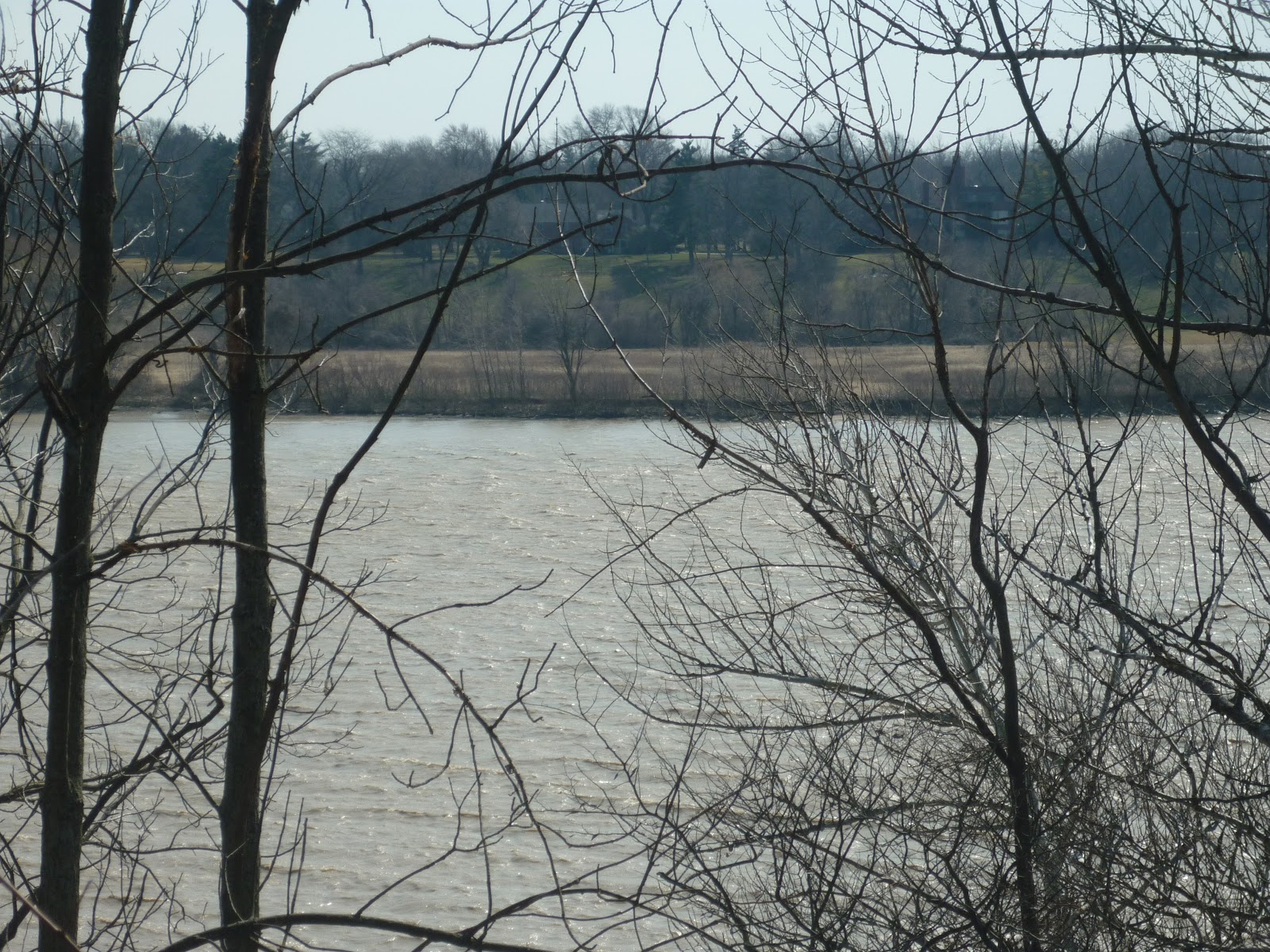
After a few posts of apologetic regionalism, it's time for something more tranquil and focused on nature.  Here we have the Maumee River, just outside of Toledo, Ohio.

The Maumee is quite wide for being such a short river with relatively few tributaries.  Despite its short length, however, the river drains the largest watershed that empties into the Great Lakes.

The Maumee was an important corridor for migration and trade amongst native peoples and early settlers.  The river was one of the routes between Lake Erie and the Ohio River, via a portage around Ft. Wayne, Indiana, to the head of the Wabash River, which was later replaced by the Wabash and Erie Canal.  Until the active frontier focused more on the Chicago portage, the Maumee was greatly desired by everyone seeking to lay a claim to the area, leading to conflicts between the British and Americans in the late 1700's and during the War of 1812.  Later on, Toledo became the great trophy over which Michigan and Ohio came pretty close to spilling blood.  The river today is much quieter, though very developed.  The banks retain some natural scenery in the many parks scattered along them, which include extensive marshlands, ash-cottonwood forests, and even some halfway decent beaches.

Wednesday, March 21, 2012

Wednesday "Filler": Friendly Faces at River Raisin National Battlefield Park

I have been putting this off for a while now, because I wanted to give it a serious post, but my guilt has got the better of me.  If you are even still reading, hello to my friends down at River Raisin National Battlefield Park, you have not been forgotten!


The Raisin was an important fight in the western theater of the War of 1812.  The second battle was an important victory for the Americans on the road to the Battle of the Thames, where Tecumseh finally met his demise.  The battles also largely spelled the end of any French-American cultural independence in Michigan, as the town of Monroe (then Frenchtown) was devastated by the assaults, and the locals just decided it was better to pack up and move on.

The park is also one of the newest units in the National Park system!  It's nice that south east Michigan is getting a bit more national attention, to say nothing of how 1812 is starting to get some recognition. Expect a series of posts on this place as I explore it in more depth in the coming year.  For now, be treated to a cannon, on a sled.  Yes, how much more Michigan/Ontario can you get than that?

If you live in the region, consider giving it a visit.  They have an impressive museum there, one of far better quality than I have seen at civil war sites.

Friday, December 16, 2011

Let's Have a Talk: The War of 1812.

I was doing some reading last night on Canadian history and came across a chapter on the War of 1812.  When I finished the chapter, the thought crossed my mind that the 200th anniversary is well on its way, and that in the United States, it will largely get ignored in lieu of the commemorations being held everywhere regarding the American Civil War.  Thinking further back, I remembered how in history classes in high school, 1812 was often ignored outright, if not given a very minor mention.  This is unfortunate, as it is one of the three conflicts I consider to be instrumental in shaping the political and cultural landscape of North America as it exists today.  For Canadians, the War of 1812 was in many ways the birth of our nation.  For Americans, it opened up your path towards Manifest Destiny, confirmed to the World what had been achieved in the earlier revolution, and served as both the finale and opening act of the generation of the founding fathers and their children, respectively.

Even more impressively, for the first time in history, a nation won a war by means of conference rather than superiority of arms.  True, the British had the business over in Europe to deal with at the time, but they were by no means distracted enough to not be able to give adequate attention to what was going on over in our world.  Quite frankly, there was some pretty amazing diplomatic force present at that Treaty of Ghent.  Despite enormous losses on the frontier, which included the capture of Detroit and Chicago (then Ft. Dearborn), and the near outright destruction of Buffalo, the United States managed to keep the border at the Great Lakes and the Saint Lawrence River.  Despite the mess that British regulars made of Washington and Baltimore, the United States kept its sovereignty intact.  While it was true that Baltimore was successfully defended, and American forces did secure a number of other victories, they were by no means significant enough to justify a return to ante bellum status of borders and rights.  Instead, the United States won a diplomatic victory the likes of which has never been trumped.  This bolstered the national confidence and gave credence to a spirit of expansionism that until then had been kept somewhat in check by the warnings of George Washington to be satisfied with independence and not become involved with international matters.    The renewed energy would result in the construction of the Erie Canal, the start of extensive settlement in the Midwest and Lakes, and the creation of a northern limit giving rise to looking towards defining a southern boundary.  This would prove to be the start of turbulent times for Native Americans and Mexicans, especially for the peoples of the Ohio Valley.

The outcome encouraged President Madison to make some interesting statements during his seventh annual State of the Union Address.  In effect, this war not only secured American independence, but that of the entire continent from foreign domination.  In an age where our economic sovereignty has come into question in the face of increasing dominance by nations such as China, we might be seeing this doctrine invoked a bit more in the future.  Ever since 1814, North America has been made into what it has become not because of world scale imperialism, but because Canada, the United States, and Mexico, have learned that cooperation and inter-dependence have truly shaped our part of the world into what it has become.   Do not get me wrong, I "believe" in humanity and the progression of the world.  At the same time, regional development counts for something.  That, I suppose, is a post for another time, a time in which I have become much more informed and can witness certain conditions first hand.

So about those neighbors then?  Well, for Canada and Canadians, who are quite well educated on the importance of this conflict, this was freedom and the start of the forging of a national identity.  While the concept of true sovereignty was a bit farther away, "Canada" looked like it was starting to have a chance beyond "land that the Yankees are going to take away maybe next year".   While the history books and popular jest like to insist that Redcoats did all the work, the truth of the matter was that the locals, be they native or transplanted, did a substantial amount of fighting.  For that matter, it was not the Redcoats that had their homes and fields burned to the ground.  Many battles had men and sometimes even women fighting for their homes that were perhaps no further than a mile or so away.  The Battle of Chateauguay, in fact, was fought almost entirely by Canadians born on North American soil.

In the coming year, I plan to visit and re-visit many of the key sites associated with the war, and will leave some posts about impressions (with photographs, of course) as I come to them.  In the meantime, check out your local bookstores for titles on the subject, which I have been noticing have been displayed even in the United States lately!