Always to the frontier

Wednesday, April 18, 2012

Wednesday Filler: Maple Saplings!

In the Nearwest, the overnight lows are moving out of the freezing temperatures, which means the forests will soon regenerate and send up new saplings.

Carpets of Sugar Maple (Acer Saccharum) will soon cover the forest floor, waiting for the canopy to open up when a tree above reaches its end.

Tuesday, April 17, 2012

Natural Beauty Roads

In May of 1995, Michigan lawmakers passed legislation that enables the Department of Natural Resources in that state to protect roads that are considered to have outstanding natural beauty, based on the criteria found in these documents.  While the act does stipulate that scenic areas are considered ripe for preservation, most of the roads protected under the act have been preserved because of their natural setting, which is to say that they represent scenery that would have existed along the road in pre-settlement times.  Although existing non-native plants are acceptable along the roadsides, the planting and proliferation of native species are a goal of this legislation.

Natural beauty roads are easily recognized by signage at the termini of their routes.

Speed limits are kept low, which is not normally an issue, as the roads are only designated on local access roads rather than main arteries.  Local access, of course, implies that this is not out in the middle of nowhere.  People do in fact live along these roads, and usually petition to keep them pristine.

As you can see, the houses do tend to be a bit obscured, but the road is obviously still in developed areas, which is the whole point of such roads.  As you can see, the natural watercourse of a draining stream is exposed instead of tunneled under a subdivision.  The drain is not large by any means, and could easily be obscured to make more building-suitable high ground around it, but the property owners decided to keep their land as they found it.  The results are a wonderful green space in, of all places, heavily urbanized Wayne County in south east Michigan.

One could hardly guess that just based on the pictures.  Natural preservation of this sort raises land values, takes little maintenance or public spending, and gives us so much more in return.

Monday, April 16, 2012

The Basilica of San Juan Capistrano

Yesterday I promised to shock everyone by taking them into the "modern" parish church of San Juan Capistrano.  Undoubtedly, some readers envisioned an ugly, hulking, modern disaster that focused more on social interaction than religious worship.  This is not unreasonable of them, as much church architecture of the past forty years or so has ended up being, how shall I put this, lacking spirit.  Some would claim such buildings were cheaper to construct, and that a more pastoral theology of the highlighting of the Eucharist, Word, and community as separate but interconnected elements is all so important.  Maybe so.  Still, nothing is wrong with the concept of tradition, or literally a "handing down" of what we have received in the past.  In the Church, as elsewhere, a nice balance is struck when we can have this intermingled with progression, adaptation, and discovery.  At the risk of sounding political, raw revolution and raw conservatism have never been good for the world.  Organic growth, on the other hand?  Well, step inside and take a look at what this sort of thing does.

The building, from the outside, is a rather plain monumental mass of adobe.  It fits in well with what California and the southwest tries to promote as an image, but it is also obviously a modern structure, which, if not for the dome and cross crowning it, does not seem too out of place.  This is rather deceptive, as the closer one gets to the building, the more the little details tend to jump out at the viewer.  Above the main doors, for example, is the coat of arms of the Diocese of Orange.  From a few more yards away, this thing is a blur that draws people in for a closer examination.  Up close, the building is revealed as a church, and a Catholic Church at that.  Otherwise non-assuming grey doors stand below this, unlocked, and ready to invite people into what appears to be yet more plain, dark space with arches and some chandeliers.

Then of course, you walk into the doors, and find a completely different world waiting.  See all the light?  This was not produced by anything other than the sun itself, which is quite plentiful in Orange county.  The chandeliers are mere accents meant for night illumination, and they are arranged in a flow leading to the altar space, which a few spot lights do illuminate, but because the reredos, or as it is known in Alta California, the retablo, is meant to draw visitors to the focal point of the meaning of the place.

The retablo is built in the baroque style that the Jesuits had brought to New Spain, and that the Franciscans chose to promote when they were forced to withdraw from the land.  All of this took around 20 years to find funding and construction time for, starting in 1986.  The Retablo itself was finished in 2007, a clear indication the the local community wanted to embrace a very different and seemingly distant past in building this sanctuary.  200 years ago, as the era of the mission was drawing to a close, this was a land of native peoples, Mexican colonists, and a frontier.  These days, the city of San Juan Capistrano is largely rich, Caucasian, and decidedly not a frontier.  The city is, however, mindful of a past which ruins and a name keep it conscious of, incorporating both the old and the new to make one of the most distinct communities left in the greater Los Angeles area.  The Catholic Church certainly thought this was a distinct church, as John Paul II made it into a basilica and national shrine.

To take a more detailed look, visit their website.

Sunday, April 15, 2012

Old California: The Missions

California.  The word conjures up images of a vast urban landscape, mountains with towering trees in them, a pleasant climate, dramatic looking beaches, orchards and vineyards that seem to go on forever, and depending on one's political views, either a paradise or a cesspool.  Both in state and abroad, the left focuses on what they deem to be progress, while the right focuses on what a mess progress has made of things.  The past gets ignored quite well here, dismissed either as backwards or a pointless exercise in nostalgia.  Here and there, historical memory can be a bit hard to ignore.  Many of the names of the cities of California bear witness to both a colonial Spanish and Mexican past, and many recall the peoples who once dwelled for thousands of years here.  In some places, the names remain unchanged or slightly altered from older designations that identified them as missions.

First, a little history.  In the push northwards into the deserts and mountains, colonial Mexico stopped sending forth armies to subdue the frontier, and instead encouraged missionaries to introduce Christianity to the various peoples there.  The Franciscans and the Dominicans were usually the first to heed the call, but they were not extremely successful in adapting to very foreign cultures.  Though they would not give up, these orders knew that they were not making steady progress in evangelization.  They were proud of their histories, and proud of the work they were doing in the name of their faith.  Needless to say, when an upstart, young, and fancy religious order came along that seemed to improve on their work everywhere they went, well, rivalries developed into heated debates.  This new group, of course, was called the Society of Jesus, known commonly as the Jesuits.

The Jesuits started off a little differently from the older religious orders.  They did not have a cloistered division, they were not founded for any particular reason to reform or combat the enemies of Roman Catholic Church, and they centered themselves on a theme of "contemplation in action", meaning they existed to bring otherwise secular experiences and disciplines into a religious and theological context and understanding.  Needless to say, they drew in many different kinds of men, but most if not all of them shared a common intellectual fire.  As such, when missionary opportunities presented themselves, the Jesuits leaped at the chance.  Evangelization, you see, was not only a chance to spread the faith, but to explore the world, and even more exciting, to explore cultures outside of the European theater.  This got them into trouble in China, when the Dominicans insisted that religious conversion had to go hand in hand with cultural assault.  The Pope sided with the Dominicans, and, well, China did not see significant missionary activity again until the 19th century.

On the other side of the world, as the doors to China were closing, the gates in New France were thrown open by the Franciscans who were daunted by the wilderness and seemingly savage native cultures before them.  They invited the Jesuits to join them, who proved to have far more vigor in engaging the mysterious forests of Quebec and Ontario than they could have imagined.  In 1629, both orders were thrown out of New France by the English, who briefly held Quebec.  When the dust settled in 1632, the Franciscans did not return.  The Jesuits, on the other hand, threw themselves into their efforts.  In 1639, they founded Sainte Marie on the southern shores of Georgian Bay, the eastern enclosure of Lake Huron.  By 1642, they had founded a mission at Windsor, which would later become Assumption Parish.  This work among the Hurons (Wyandottes), Algonquins, Muskegon, Ottawa, Montagnais, and Iroquois was extremely difficult.  Flexibility aside, the two worlds were very different from one another, with entirely different outlooks on civilization.  The Iroquois openly attacked the Jesuits and French, the Muskegon, Ottawa, and Montagnais tolerated but largely ignored their efforts, and the Algonquins and Hurons suffered greatly for supporting them.  In 1649, the Society of Jesus learned a very painful lesson in adaptation: their first major loss.  Saint Marie was burned to the ground.  Today a church stands over the long lost ruins, which, in the opinion of your author, is one of the holiest places on this planet.

The Jesuits would later return, and push further inland.  Far to the south, they opened up a second front in the Chihuahuan and Sonoran deserts.  Running the length of Baja California, as well as along the western slope of the Sierra Madre Occidental and north into Arizona, there are a series of missions founded by the Jesuits, many of which remain intact and in use as parishes.  One of the most famous remains as Tumacacori, south of Tucson.  The Jesuits had a significant impact on the local culture, offering the "northern" peoples a different look at Spanish and Mexican civilization than they had otherwise become forcibly accustomed to.  Unfortunately, again, this would not last.  On the 21st of July, 1773, after decades of struggle with European monarchs regarding human rights, the Society of Jesus was suppressed.  Overnight, the black robes in the missions were replaced with grey and brown robes of the Franciscans.  Fortunately, much had changed in the relations between the two orders by that point, and the Franciscans, while not abandoning their methods, knew that the walk in this frontier world did indeed require adaptability.  Perhaps more strikingly, they also continued the Jesuit tradition of evangelization through art, and embraced the exquisitely ornate Baroque and Rococo styling of the Jesuit missions.  They built their missions in this style as they moved up the coast of California under the leadership of Junipero Serra.  Here is the most famous of their missions, San Juan Capistrano, built in 1782.

As you can see, Alta California never really disappeared, even under the smog and glitz.  Sorry if the image was a bit blurred, I had issues keeping the camera steady because I was in a state of awe, and this is after having been throughout some pretty amazing churches in Europe.  The smell of cedar wood and countless flowers outside, in gardens planted by the friars (who are better horticulturalists than Jesuits... well... maybe), combined with the wooden beams of the ceiling and hanging chandeliers absolutely shout "Alta California".  I half expected Zorro to jump out at me!  San Juan Capistrano lies mostly in ruins, having been damaged by an earthquake in 1812.  The above "side chapel" is intact, while the main sanctuary forms some of the most impressive ruins in the United States.

This is far from the end of the story, however.  The rest of the mission is largely intact.  In 1833, the mission was secularized, but a parish was formed later, and President Lincoln returned the property to the Church in 1865.  The parish here lives on, having been rebuilt in present form in the 1980's.  Come by tomorrow to see it, and be prepared to be shocked in a good way.


Saturday, April 14, 2012

State Borders

The European mindset that a river makes for a fine border has provided many of the state borders and shapes that mark the political map as of 2012.  Some other borders are marked by mountain ranges and high ridge lines.  In many cases though, straight lines were drawn over nearly every kind of terrain imaginable.  Nature can provide for a demarcation along the boundaries designated by political decisions where land-use policies are significantly different on either sides of the line.  Farms often suddenly give way to forests, for instance.  Out west, along the long, straight borders, one pretty much needs a sign and a few planted trees to know that a boundary has been crossed.

As you can see, there is a whole lot of nothing ahead in Texas, just as in the reverse direction, there is not much that breaks the vista in Oklahoma's panhandle.  This was taken along US-83 at the line between the two states.  The signs along the major interstates are often a bit more dramatic than a simple notification and subsequent "welcome to" sign that is seen here, and roadside attractions will tend to cash in on the change of  jurisdiction.  Along the back-roads like this, though, the differences are often superficial at best.  Border regions, unless they are hotly contested, usually have an ambivalent situation about them, little pockets of transition between cultures and landscapes that are often quite diverse and fascinating.

Thursday, April 12, 2012

The Wonder of Microclimates: The Douglas Fir of Bryce Canyon

Microclimates are amazing things.  They sustain conditions to allow things to grow that would otherwise not be found growing in a particular region.  Here we have a Douglas Fir (Pseudotsuga Menziesii) growing in an otherwise dry and warm southern Utah.  
Even at the relatively high elevations of Bryce Canyon (7500 feet or so), the air is usually too dry and frequently the recipient of warmer days in the 80's.  Douglas Fir are simply not able to easily reach climax growth in such conditions, except in these dark, cooler spaces.  The sun is obviously muted here, which results in lower daytime highs and allows moisture to linger on while the rest of the countryside dries out.  Enough light reaches the trees during certain times of the day (in this picture we see a morning tree in shadow and an afternoon tree in the light behind it) to sustain growth, and when the canyon floor otherwise seemingly sits in shadow, light reflects off of the walls as well.  The larger trees sit well within the canyon amphitheater and are apparently quite the sight to behold; all of a sudden, a canyon walker can round a corner and be staring up at a tree nearly two hundred feet tall, nestled alone in between great walls of rock.

More information can be found here.  Douglas Fir are wonderful trees, and one of the few to naturally exist in Canada, the United States, and Mexico, from nearly up in Alaska all the way down to the higher mountains around Mexico City.

Wednesday, April 11, 2012

Wednesday Filler: The Maumee River

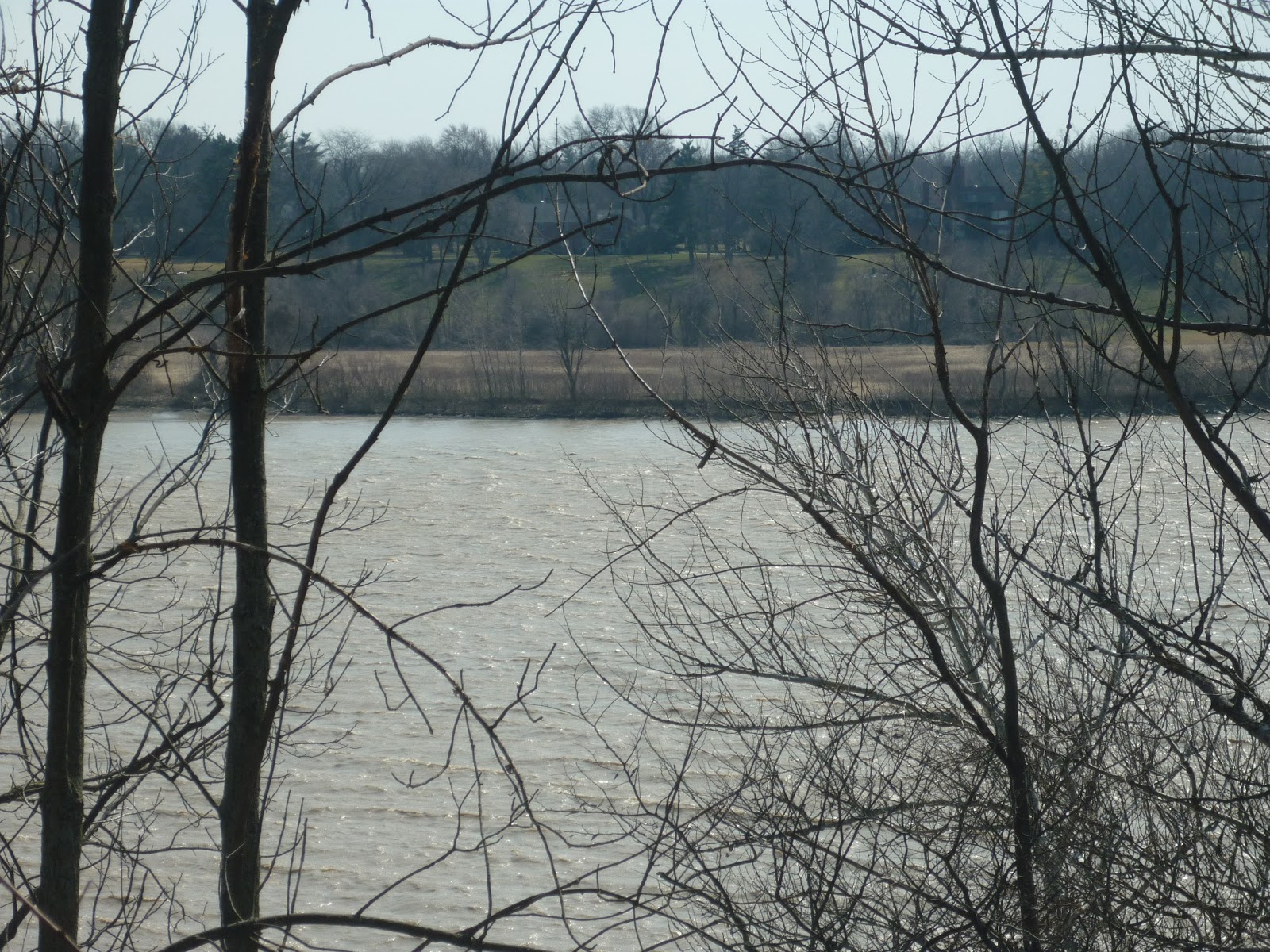
After a few posts of apologetic regionalism, it's time for something more tranquil and focused on nature.  Here we have the Maumee River, just outside of Toledo, Ohio.

The Maumee is quite wide for being such a short river with relatively few tributaries.  Despite its short length, however, the river drains the largest watershed that empties into the Great Lakes.

The Maumee was an important corridor for migration and trade amongst native peoples and early settlers.  The river was one of the routes between Lake Erie and the Ohio River, via a portage around Ft. Wayne, Indiana, to the head of the Wabash River, which was later replaced by the Wabash and Erie Canal.  Until the active frontier focused more on the Chicago portage, the Maumee was greatly desired by everyone seeking to lay a claim to the area, leading to conflicts between the British and Americans in the late 1700's and during the War of 1812.  Later on, Toledo became the great trophy over which Michigan and Ohio came pretty close to spilling blood.  The river today is much quieter, though very developed.  The banks retain some natural scenery in the many parks scattered along them, which include extensive marshlands, ash-cottonwood forests, and even some halfway decent beaches.