While I like to keep American Voyages a blog about things which I have personally experienced, and thus photographed or videoed for myself, it seems like a crime to pass up the opportunity to show this video of a loon on Craig Lake, in Algonquin, that I came across.
Now, truth be told, I have never been to Craig Lake or the higher parts of the Algonquin mountains, but I think being within 10 miles of it and spending a great deal of time in the nearby Petawawa valley qualifies me to post about the local environment and landscape. The beautiful country you see in the video is the most peaceful and beautiful land in the entire world. I will let the video do the rest of the talking.

Always to the frontier
Tuesday, April 24, 2012

The United States Botanic Garden
One of the nicest smaller side attractions on the National Mall is the United States Botanical Garden, a collection of gardens and a large greenhouse that sits only a short distance from the U.S. Capitol building. The garden had a rather exciting start back in 1820 when President James Monroe set aside 5 acres of land for a national greenhouse. The concept was that plants would be cultivated for their seeds for later distribution throughout the Union. Many of the founding fathers were "farmers", or rather, agricultural developers, and one of the passions of the more rural among them was to put the land to the plow. While this might seem a bit dull these days, the United States of that era was all about industrial and agricultural progress and innovation. The new nation wished to define itself not by directly promoting the concept of individual and civil liberties, but by demonstrating what a free nation was capable of.
On top of this love of learning and invention, a new age was coming about in the scientific world, wherein exploration for new resources was starting to give way to exploration out of love for the beauty and diversity of the natural world. The United States government, in trying to encourage its citizens to make something truly special of the continent, had already dispatched numerous surveyors and explorers into the interior. By the 1840's, this exploration reached out to distant parts of the world, with a particular interest in anything having to do with the Pacific Ocean. Species and specimen examples were streaming into Washington, and the concept of a national greenhouse became more of a need as some centralized location was needed to keep and catalogue the incoming treasures. Many of these would come to be housed in the nearby Smithsonian museums, beacons of inspiration and learning meant to jump-start the American intellect and directives. Eventually, permanent greenhouses were established in their present location. A larger arboretum and support facilities for the propagation of new plants exists closer to the Anacostia River on the eastern side of the city.
The garden, like many Mall attractions, is publicly funded and thus free to enter, though donations are always accepted. This was the intention behind its use from the beginning, and the garden has served the area as a park and place of repose as much as a learning and cultivation tool. Along the sidewalks of the surrounding streets are specimens that invite passersby in for closer inspection, complete with labels. Many of these species are natives of the Mid-Atlantic region, showing viewers what the natural side of the area once looked like before extensive development. This collection contains wonderful things like the Sweetbay Magnolia (Magnolia Virginiana), a plant of the coastal plains.

Also found here are the northern trees and plants which just range southwards into the Potomac estuary, like the Sugar Maple (Acer Saccharum).

Seeing a nice northern tree like that suffer in the soggy heat with me was sad, but it was nice to know that I was not the only Canadian wilting in the heat.
Moving in from the sidewalks, one enters a remarkably quiet and tranquil world for being so deep into the busy heart of Washington. The Mid-Atlantic plants are here joined by suitable outdoor specimens from the rest of the country, including some of the hardier Floridian species. I did not take the time to find the Needle Palms (Rhapidophyllum Hystrix) that grow unprotected in the ground here, but they are supposedly really eye catching, especially in mid-winter. There are numerous benches and wonderful views of the Capitol amongst this diverse collection of plants from across the country. Closer to the main structure, these are joined by exotic tropicals in the summer months.

For such a beautiful collection, the garden is surprisingly devoid of people in comparison to the rest of the Mall attraction. I mean, why just take a tourist shot of the Capitol when you can do so in some lush, lovely gardens? If the above picture seems deceiving, take a look at the next two pictures and see that the views from this vantage are every bit as photogenic as they are in the open sun and crowds of the grassy Mall.
The real magic starts inside the greenhouse, which aside from having some lovely air-conditioned rooms in the front parlors, features some of the lovely flora of Hawaii and the Deep South, including Southern Florida. Seen below is the first room one enters from the front parlors, a Live Oak (Quercus Virginiana) dripping in Spanish Moss!

Along with the Moss are numerous ferns, cycads, and trees that have remained somewhat unevolved since the Jurassic period.


This experience is capped off by a venture into Hawaii, complete with a waterfall and a "lava tube" made of actual lava. Things dry out a bit in the next room, dedicated to desert flora.


I was a bit plant drunk at this point, and forgot that the collection does indeed house exotic species from around the world, in addition to native plants from North America. Fortunately, everything is clearly labeled in both name and origin. While it may seem a bit off-putting that there are so many exotic species in a "national greenhouse", it turns out that many of these are here as rescues from confiscations at USDA checkpoints at international ports of entry. Yes, people actually do try to rustle and smuggle large plants into the country. A few rooms are dedicated to providing the visitor with a "native experience". The southern exposure room, for instance, is actually a model attempt at making a mid-altitude forest that can be found in the Southwest and northern Mexico. As it was raining buckets at the time (the exposure is indeed exposed), I missed on any good photos there, and instead ran for cover in the 100 foot jungle room, which... well, just take a look.


And yes, that is a log made into a bridge. Many plants here are native to Puerto Rico and the Virgin Islands. Finally, in the first and last room of the self-guided tour, one enters the lovely central court, which is full of plants that have economically and culturally impacted humanity from the early days of recorded history, surrounding a charming fountain.

All in all, one of the nicer places to visit in Washington.
On top of this love of learning and invention, a new age was coming about in the scientific world, wherein exploration for new resources was starting to give way to exploration out of love for the beauty and diversity of the natural world. The United States government, in trying to encourage its citizens to make something truly special of the continent, had already dispatched numerous surveyors and explorers into the interior. By the 1840's, this exploration reached out to distant parts of the world, with a particular interest in anything having to do with the Pacific Ocean. Species and specimen examples were streaming into Washington, and the concept of a national greenhouse became more of a need as some centralized location was needed to keep and catalogue the incoming treasures. Many of these would come to be housed in the nearby Smithsonian museums, beacons of inspiration and learning meant to jump-start the American intellect and directives. Eventually, permanent greenhouses were established in their present location. A larger arboretum and support facilities for the propagation of new plants exists closer to the Anacostia River on the eastern side of the city.
The garden, like many Mall attractions, is publicly funded and thus free to enter, though donations are always accepted. This was the intention behind its use from the beginning, and the garden has served the area as a park and place of repose as much as a learning and cultivation tool. Along the sidewalks of the surrounding streets are specimens that invite passersby in for closer inspection, complete with labels. Many of these species are natives of the Mid-Atlantic region, showing viewers what the natural side of the area once looked like before extensive development. This collection contains wonderful things like the Sweetbay Magnolia (Magnolia Virginiana), a plant of the coastal plains.

Also found here are the northern trees and plants which just range southwards into the Potomac estuary, like the Sugar Maple (Acer Saccharum).

Seeing a nice northern tree like that suffer in the soggy heat with me was sad, but it was nice to know that I was not the only Canadian wilting in the heat.
Moving in from the sidewalks, one enters a remarkably quiet and tranquil world for being so deep into the busy heart of Washington. The Mid-Atlantic plants are here joined by suitable outdoor specimens from the rest of the country, including some of the hardier Floridian species. I did not take the time to find the Needle Palms (Rhapidophyllum Hystrix) that grow unprotected in the ground here, but they are supposedly really eye catching, especially in mid-winter. There are numerous benches and wonderful views of the Capitol amongst this diverse collection of plants from across the country. Closer to the main structure, these are joined by exotic tropicals in the summer months.

For such a beautiful collection, the garden is surprisingly devoid of people in comparison to the rest of the Mall attraction. I mean, why just take a tourist shot of the Capitol when you can do so in some lush, lovely gardens? If the above picture seems deceiving, take a look at the next two pictures and see that the views from this vantage are every bit as photogenic as they are in the open sun and crowds of the grassy Mall.
 |
| The Place of Chronic Inactivity |
 |
| General Grant National Monument |
The real magic starts inside the greenhouse, which aside from having some lovely air-conditioned rooms in the front parlors, features some of the lovely flora of Hawaii and the Deep South, including Southern Florida. Seen below is the first room one enters from the front parlors, a Live Oak (Quercus Virginiana) dripping in Spanish Moss!
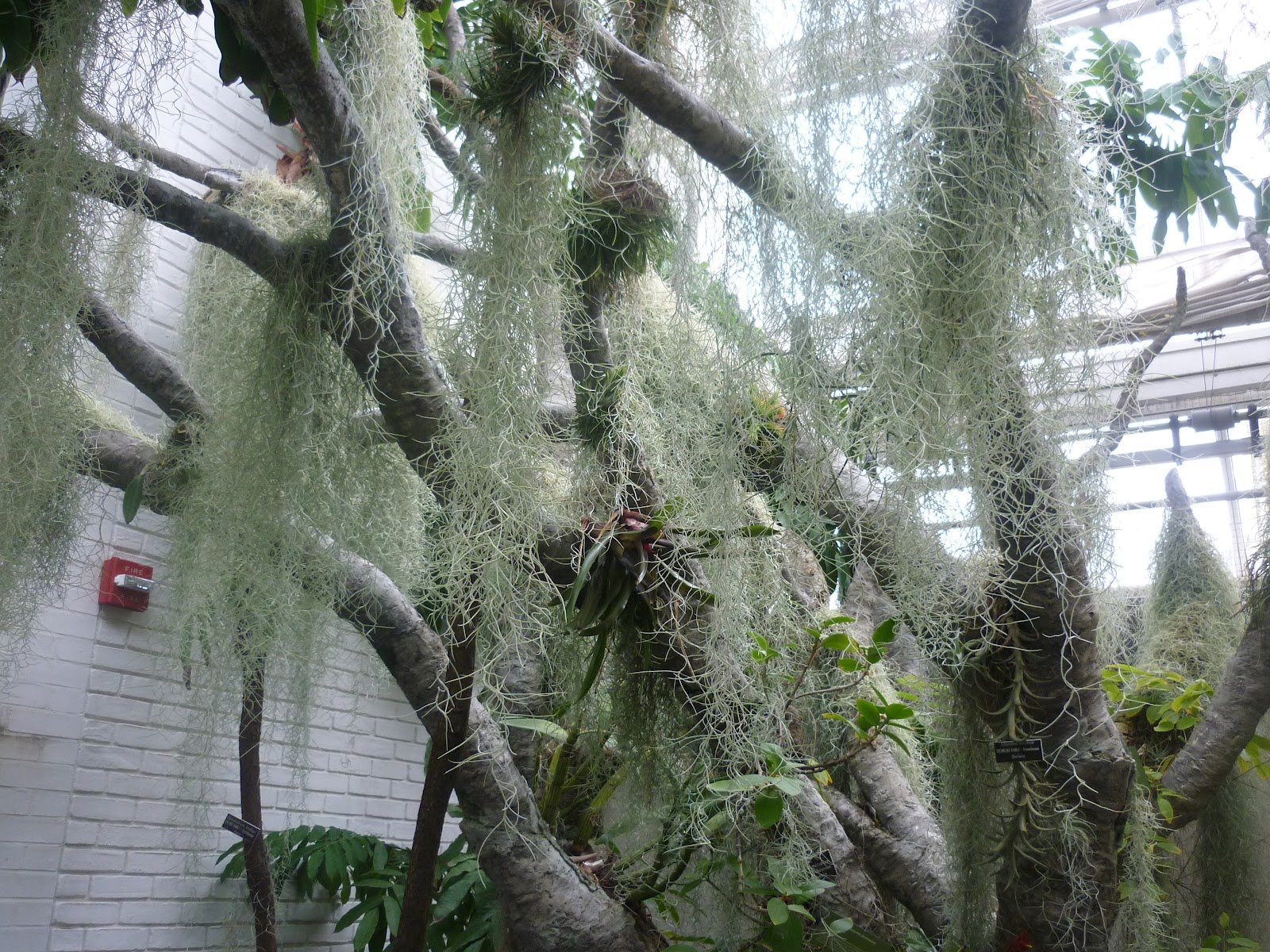
Along with the Moss are numerous ferns, cycads, and trees that have remained somewhat unevolved since the Jurassic period.


This experience is capped off by a venture into Hawaii, complete with a waterfall and a "lava tube" made of actual lava. Things dry out a bit in the next room, dedicated to desert flora.


I was a bit plant drunk at this point, and forgot that the collection does indeed house exotic species from around the world, in addition to native plants from North America. Fortunately, everything is clearly labeled in both name and origin. While it may seem a bit off-putting that there are so many exotic species in a "national greenhouse", it turns out that many of these are here as rescues from confiscations at USDA checkpoints at international ports of entry. Yes, people actually do try to rustle and smuggle large plants into the country. A few rooms are dedicated to providing the visitor with a "native experience". The southern exposure room, for instance, is actually a model attempt at making a mid-altitude forest that can be found in the Southwest and northern Mexico. As it was raining buckets at the time (the exposure is indeed exposed), I missed on any good photos there, and instead ran for cover in the 100 foot jungle room, which... well, just take a look.


And yes, that is a log made into a bridge. Many plants here are native to Puerto Rico and the Virgin Islands. Finally, in the first and last room of the self-guided tour, one enters the lovely central court, which is full of plants that have economically and culturally impacted humanity from the early days of recorded history, surrounding a charming fountain.

All in all, one of the nicer places to visit in Washington.
Monday, April 23, 2012
The Reed of Doom
One of the purposes of American Voyages is to introduce readers to the natural setting of North America, with native habitats and life within them being the primary focus of exploring that setting. That said, ever since the era of colonization began, our continent has been introduced to just about everything on the planet that can grow here. Being that we have everything from tundra to tropical rainforests here, exotic species usually find a home. In some cases, they add beauty and an interesting diversity to the landscape. In many cases, however, they completely screw around with what we had before they decided to blight their new home. We call these things invasive species, and they are just about as fun as the name suggests. One such awful, awful plant is Phragmites Australis, commonly called the common, or giant, reed. To make things confusing, we do have a friendly native version of Phragmites here, but the wicked invader is very recognizable. It is extremely tall, and looks like a pathetic excuse for wheat either in its dark green summer form or, as seen below, its dormant form.


Visually speaking, one can already notice what a problem species this is. The reeds are tall, up to 14 feet in some cases, and they tend to dominate whatever shallow water they come in contact with, including beaches, which they pretty much turn into reed beds. They turn water hazards on golf courses into walls!
 |
| St. John's golf course, Plymouth, MI. Hole 27 desecrated! |
They grow in dense stands and crowd out all other vegetation. Aside from the obvious visual and spatial impact, the reeds tend to produce and release acids which prevent most native plants from growing in shared soils. The practice of salting the earth to prevent anything from growing, it seems, can be found in the vegetable kingdom too. On top of this, Phragmites is ridiculously difficult to eradicate once established. They are not killed by surface fires, and actually regrow faster when burned. They cannot be readily killed by chemicals, as this tends to pollute the water bodies in which they grow. They reproduce by airborne seeds which tend to be released when the plants are in any way agitated.
Most state and provincial departments of agriculture and natural resources recommend notifying them if such reeds start making an appearance on private property, and will gladly assist the property owner if they wish to eradicate the pests, once they are determined to be the invasive, and not native, form. In several states, they are considered a "kill on sight" plant, having earned a reputation nearly as bad as kudzu or the tamarisk. If for some reason these reeds do not seem to be a pest, this is because you do not own a shoreline property, or care much for fishing (they also destroy spawning beds). If this was still not enough to convince you of the sheer wickedness of Phragmites Australis, they also taste bad!
Sunday, April 22, 2012
Sunday Afternoon Post: Debating the Pines
In order to give my portfolio and resume a little boost, American Voyages will soon be joined by a second, more technical blog on North American botany. It is also my hope that the focus of this second monster will guide the purpose of this blog back into more of an exploration of North America and less of a "what do I need to be mad at today" sort of venture. Anyway, today we look at our good friend, the Eastern White Pine, Pinus Strobus. Here is a fine specimen from the Oak Openings Preserve just outside of Toledo.


Normally, Eastern White Pine do not naturally seed and disperse in this area, at least according to most data maps.
 |
| Courtesy USGS. R.I.P., Elbert Little. |
I could tell that many of the specimens in the preserve were planted as an aesthetic feature, under the concept that this park was created to be a recreation area as much as it has since become a great preserve. While pines do often occur in pure stands, the absence of any large stands in the western Lake Erie environs makes it pretty obvious that much of these trees were planned aspects of the landscape. That said, all the growing conditions for the pine are present in these savannas. Eastern White Pine require well-drained soils, of which the sands of the savannas certainly qualify. They are moderately fire resistant, and when mature enough could easily withstand the grass fires that sweep through and eliminate shrubs and most other trees. Finally, the savannas were in part maintained by lightning-induced fires. What better lightning rods are there than these pines which often stick out nicely, not only in the open, but also in the canopy?

They could very well have been more widespread in pre-settlement times, before much of the population was harvested for its excellent wood. At any rate, they make a lovely scene, graceful pines spread amidst the graceful flowing grasses.
Saturday, April 21, 2012
National Park Week 2012
Every April, National Park week rolls around in the United States, offering special events and free admission to every one of the 397 units in the National Park system. Their official video:
Corny, but it goes to show how much these people love their parks. The United States was the first country in the world to set aside its treasures for the public at large, and they pretty much do this better than anyone else around these days as well. The various units in the system exhibit a wide variety of natural, cultural, historic, and recreational themes, often showing the nation what it once was, what it has become, and what it hopefully can be. As such, the parks are not mere beacons of the power of preservation, but marks of national pride and educational opportunities. Much of what is seen in this blog, in the United States anyway, is features from various parks, because they protect some of the best parts of what the nation has to offer.
This year, the special week runs from today until the 29th. Go to www.nps.gov to see if a park is around the corner, which is most likely the case.
Friday, April 20, 2012
Returning to a Sense of Wonder
Sometimes politics and culture can get a little distracting and overwhelming. It would be a shameful thing for this blog to turn into some soapbox when it is meant to expose the continent instead. Today we can take a break from anything too technical in history, culture, politics, religion, or nature, and instead just become lost in rock, vistas, and primordial creation that existed well before us and shall outlive our mortal span. Take whatever interpretation from this that you will, for nature can help rejuvenate us in different ways.

A frozen garden. Bryce Canyon is certainly something not to be passed up in a lifetime. Don't be satisfied with the pictures, because being there, experiencing any part of the world with as many of the senses as we can, is just an amazing thing.

A frozen garden. Bryce Canyon is certainly something not to be passed up in a lifetime. Don't be satisfied with the pictures, because being there, experiencing any part of the world with as many of the senses as we can, is just an amazing thing.
Thursday, April 19, 2012
My Take on Climate Change
In response to some feedback given about my jumping on the "global warming bandwagon", I offer this post about how I have not done so. For one, I don't acknowledge global warming, though I do think human-induced climate change is happening on our planet. For another, I think the issue has unfortunately been politicized to death, in some cases beyond recognition.
I am gifted in having friends who have diverse opinions regarding things political. I say this because it has allowed me a broad viewpoint from which to see how terribly polarized the political situation in North America really is. What once might have been issues that could have been tackled by united efforts on the part of a nation's politicians and peoples have instead largely been afflicted by labels which shove them off into some pocket interest of what is leftist or rightist. Take abortion, for example. What was once considered almost universally abhorrent from a human rights and social development standpoint (Jesse Jackson and Hillary Clinton were vigorously opposed to it back in the seventies) has since become politicized into an issue of freedom from government interference, ironically something that the right in Canada and the United States would otherwise support freedom of. I mention this example because it seems to be one of the most potent to use, and to better help explain my opinions regarding the political seizure of concern over climate change. What would otherwise be a rather straight-forward concern of society has instead been seized by interest groups and politicians (who, let's be honest, have a career to worry about) and turned into a "you don't have the right to tell me what to believe" battle. In this battle, some otherwise diverse issues get lumped together in odd ways, seemingly precluding the possibility that a liberal person could disdain abortion or a conservative person could support conservation efforts. This is a sad battle that is harming our society, in my opinion.
Well, we can leave that battle where it stands; if you want to argue about who has what rights (which we should all be concerned about), go find a political blog somewhere. If you want to read on here, you will find this entry largely devoted to seeing what climate change is, exactly, and, secondarily, what I think some of the issues are regarding why this is such a sticky political topic. To begin with, a disclaimer: I am not, officially, a scientist. I am currently on the path to becoming one, namely in the field of botany, which has interests in climatology in the sphere of biome-related biology. Essentially, in order to know more about plants, I need to know more about what they require for existence, a part of which is their surroundings (climate, soil, etc.). Still, I am not, and never will be, a full-fledged climatologist. Second, and this is the key to understanding the concept of knowledge and argument in general, I admit that the starting point for figuring things out is "I don't know". As such, I acknowledge that I am but one of many sources of information on the topic of climate change, or anything else for that matter. This is not to say that I accept a concept of intellectual relativism, because truth does very much exist (that darn philosophical academic background just has to pop its head in now and then), but that I also admit to my intellectual limitations. Simply put, I don't know everything, and no one really does. This entry is but one of many entries in our world of knowledge on the topic of climate change, and we do ourselves a disservice by ignoring opinions to the contrary. Google them if you want to find out more about them!
That said, I think human-induced climate change is real. I don't think some of the extreme horror stories are true, namely that according to some proponents of global warming that were waxing poetically back in the 70's and 80's, we should have seen global sea levels rise by 50 feet by now. Mind you, things were ugly, pollution wise, back in those days. There is indeed a hole in the ozone layer, and back then, it was larger than Antarctica. These days, it has shrunk by quite a bit, a sign of the progress we have been making in adapting industrial and commercial usage of chemicals to the needs of our atmosphere, as much as ourselves. Of course, this example of shifting concern is also one of the biggest groaners regarding climate change in general. Global warming is only part of climate change theories; universal warming will most likely not happen. Instead, we will see a ton of extremes of heat and cold associated with climate change, as we have in the last decade or so. Snow in Miami, F-3 and higher tornadoes in January, droughts interspersed by floods? These have been quite common lately, to the point where they are no longer considered freak occurrences. Perhaps most disturbingly, our glaciers and ice fields are indeed melting. Greenland is being melted from the bottom up! Yes, ice comes and goes, but the cycle of ice ages tends to take place over more time than just mere decades. Take a look at what is left of the glaciers in Rocky Mountain National Park:

While this alone ought to be alarming, what is perhaps more concerning is the rate at which these extremes have started to happen. Why is this happening?
Well, the most popular thing to do around the world is to blame the United States for everything. I mean come on, as a Canadian, I am honor-bound to at least sneer at American imperialism, right? Well, it turns out that the rapid acceleration of climate extremes and change in the past decade has to do with increased human activity on the global scale, which is indeed accelerating the rate at which things like solar cycles, and natural climate cycles would have already affected the global climate. Let's start with the human activity side of things. In the past decade, really more the past twenty years or so, the western world, and especially the United States, has become better at cutting down on things like fuel emissions, energy use, etc. True, population increases have meant that consumption is balancing this out a bit, but on average, we are getting better at using less to produce more, especially where agriculture is concerned. Now, about those population increases raising the roof on consumption rates? Well, the second and third worlds are starting to get more developed. More and more people in China, India, Mexico, Brazil, and other emerging economies are owning vehicles and homes with modern technology. As such, to support the burgeoning world economy, even the poorest of nations are consuming natural resources at a faster than normal rate. While there may be less use of the internal combustion engine in, say, Nigeria, than there is in Argentina, the forests there are rapidly disappearing, grasslands are being grazed into deserts, oil is being released from ancient wells like crazy, and things are accelerating quite a bit. Sure, its easy to blame the United States for everything, but let's face it, EVERYBODY is responsible for what is going on.
This is probably the source of contention for the conservation movement getting dumped into the furthest reaches of all things leftist. Take the Kyoto accords, for example. On paper, and in sound bites, the accords look fantastic. In reality, they might have been an effort by European and allied governments to economically compete with the United States by introducing different emission standards than have thus far utilized in American industry. As a result, suspicions have arisen among the American right, wherein climate change or any conservation efforts are linked to E.U. political meddling, and similar efforts at home must have been the result of the left trying to undermine the right either intentionally, or unwittingly, by crippling American industry. Never mind that much of Europe has long since been transformed away from its natural setting, and the United States, even with its incredible agricultural productivity, still retains much of its "default setting". Environment controls are, furthermore, supposedly extremely advanced in Europe, financed in part by extreme taxes on fuel. Oddly enough, North American vehicles often have better emission ratings than their European counterparts, without such brutal taxes. What I know is that I have lived in London, spent time in Paris and Rome, and my nasal mucous turned blacker than black in all of those cities (actually worse than in Los Angeles). On the other hand, Europe beats the tar out of North America, particularly the United States, when it comes to widespread use of mass transit. As we can see, the issues are not as they often get represented by, well, many sides. What it comes down to is argument over rights, rather than truly over environmental quality, which instead becomes the victim or gets ignored. The United States, or any country for that matter, fortunately, does not need political things like the Kyoto accords to be environmentally responsible. Believe it or not, while they have other failings, both the Bush and Obama administrations have remained transparent and active on this front.
The probably truth of the situation is that even while the political landscape gets messed up, we humans have had an impact on our naturally changing climate cycles. Water, species, and just plain old comfort levels are impacted by this, and I refuse to deny the reality of this situation in American Voyages. At the same time, I will never turn down an opportunity to further research this phenomenon. If you want to bring politics here, by all means, do so, left and right, because informed opinion is a blessed thing. Tomorrow we can again step away from the politics and see more of our wonderful treasures.
Subscribe to:
Posts (Atom)