Apparently a year has gone by since American Voyages has come into existence, and the thought only really occurred to me because we had our first snow of the year here in southeastern Michigan, the same thing last year being the inspiration for the blog. In this time, the focus of the blog has shifted a bit from the natural world to a bit more history and politics than I had intended to cover, but the best intellectual constructs in human culture are usually the result of organic development. History and geography, of course, are very much interrelated. While people have migrated, fought wars, and developed cultures over ideas, more often than not they settled, sued for peace, and changed cultures because of "background" things like geology, zoology, and botany. Yes, the Puritans came to New England because they wanted religious freedom, but they really showed up there because the New World really was new. Our continent contained, and contains, many unique wonders that made them consider settlement here. I firmly believe that our shared drive as humans, despite cultural differences, is a desire for exploration and growth. This blog is, and will remain, dedicated to this thrill of discovery regarding our new world that is still new after 500 years.
That said, I still get the odd question over e-mail, most of which get tossed my way when I say something provocative about history and politics. Here's one:
Q: Just where do you stand politically? I could take your ideas a bit better if I knew where they were coming from.
A: Everyone has a bias when coming to a conclusion about something. While objective truth does indeed exist, we also have to remember that we view it through an imperfect lens of human experience. When we debate politics and culture, it would be wise to remember this, and not just label the "other side" as stupid or responsible for bringing about the apocalypse. In the wake of the recent American election, we are seeing this in spades from every camp out there. In some ways, this is good. Such camps are a sign that democracy is functioning as it should, and that free development of ideas and attempts at self and societal improvements are flowing around without the need for tyrannical oversight. We have a free society in the United States, Canada, and even, despite what everyone might think, Mexico. On the other hand... "If we do not hang together, we shall all hang separately. " Benjamin Franklin said that when he noticed that the other founding fathers were being diverse to the point of polarization.
Anyway, where is my camp?
My camp is anywhere where all life, human or otherwise, is properly respected. My camp is where individuals have the right to self-determination inasmuch as it does not negatively impact the lives of others in the same regard. You can pretty much guess where I stand on a lot of issues from those two statements, but if I need to be more specific, I am not best labeled as either conservative or liberal. Being a Canadian, I could not vote last week, but I would have been hard pressed to favor either presidential candidate. Both have skewed ideas about what the above statements mean, and exist largely to curry favor with private interest groups or their own agendas.
I do find the present political climate hopeful though; now that Mr. Obama can no longer run again for president (term limits are a very, very good thing), both he and his opposition can more freely find the common ground they need to find to keep us walking in the right direction. As a result, I am very interested and following very closely the current path of John Boehner. He and the president, as respective men of repute and importance in their parties, have the chance to do remarkable things in American politics. Likewise, in my home state of Michigan, I wish I could somehow merge the drives and agendas of the current governor, Rick Snyder, with those of the former, Jennifer Granholm. The best of both of these leaders have been very good things for Michigan, in my opinion far outweighing the worst of them. In Canada, I am finding growing respect for Mr. Harper, while I am positively giddy about the prospect of a Prime Minister Justin Trudeau, because if he is even half the man his father was, he will rank among the best world leaders we have ever had. In Mexico, well, let's just say I hope that the PRI learns to grow up, and that no one is making deals with the cartels. Really, I just hope we can stop buying drugs here north of the border, because brother is it ever screwing with things south of it.
In short, I am hopeful for the future. I truly believe that we have a beautiful continent full of beautiful people, and I don't give a damn whether they say si, yes, or oui to what I think. I prefer being able to do all three!
Bring on the new day!

Always to the frontier
Tuesday, November 13, 2012

Saturday, November 10, 2012
The Most Powerful Lake in the World
On this day in 1975 a freighter sank to the bottom of Lake Superior, taking with it a huge load of taconite and the lives of 29 crew members. The Edmund Fitzgerald was an amazing ship that people living along the various rivers of the St. Lawrence seaway would run to go see. Her captain and crew were no strangers to the fact that even the largest of ships could be taken by an aggressive sea, and were perhaps on edge for some of the journey so late into the fall in such an expanse of water so far north. They radioed that they had difficulty on the trip from Duluth that was meant for Detroit and Toledo, but gave no indication of being in mortal danger either. Only minutes before she sank, Captain McSorley radioed that his crew was holding its own despite the great waves and winds of Gichigami giving him a hard time. Then there was nothing. No bodies were ever found, and the ship lay broken 530 feet below the surface. Some have suggested that the ship hit an unmarked shoal, others suggested that a rogue wave broke the vessel in two. Still others have claimed that a design flaw was responsible.
Whatever the truth of the matter might be, the fact remains that she was sailing on Lake Superior, a body of water that more than rivals some of the most dangerous parts of the oceans in sheer ferocity. Superior does have shoals, some of which suddenly rise to within feet of the surface even while they are surrounded by well over hundreds of feet of water. Gitchigami (Gitchee Gumee), as the Ojibwe call Superior, is the powerful remains of the North American ice sheet embraced and cradled by some of the oldest rock in the world, parts of the Canadian Shield rippling with muscles of iron and granite that have withstood over a billion years of erosion. She bears hurricane force winds that blow with all the force of a Sandy or Katrina. She rolls along waves that can engulf entire ships. She is blue and gray and bitterly cold even after a hot summer. She makes her own weather, and both moderates and intensifies the local climate of her shores. She is home to some of the mightiest Lake Trout (Salvelinus Namaycush) on the planet, weighing over a hundred pounds. However, she is also gentle...
 |
| Taken at Pictured Rocks National Seashore, Miner's Beach. |
Her irons and granites are complimented by amethysts, agates, and various other lovely rocks and minerals. Her shores are adorned by the southern boreal forest, a peppering of birches, pines, spruces, and fir. Her waters remain pure, a lovely piece of art left to us by nature these thousands of years after her birth from the glaciers.

She serves as a reminder to us that while we may indeed be fertile, multiply, and come to have dominion over the earth, we are never her ultimate masters. Fortunately, though such lessons are learned painfully when disaster strikes as in the case of the loss of a great ship, Gichigami tends to inspire more than frighten. The first born living among her figured she was a divine spirit. The first French folk, including some Jesuits, who came to see her beating upon the ancient rocks for the first time with their astonished eyes were awestruck. These days, there are exploiters who want to channel her to the arid western reaches of the continent, most of whom have never even seen her in a photograph. That said, there are just as many people who have seen her that would just as soon die before letting her be channeled away. Gichigami, it seems, continues to have a powerful effect on those who would love her... or even come to fear her.
Tuesday, November 6, 2012
What is "Le Nord"?
Every now and then I label my posts with particular labels that might not necessarily be self-explanatory at first glance. Whenever I speak about French-Canadians, Canada, or the parts of the United States that pass for Canada (another such label), I usually mark such posts with "Le Nord". Le Nord is French for "The North", and as with most geographical labels that place culture ahead of actual geography, the designation can be somewhat misleading. What is "north" to an Ontarian or a Michigander might be a joke to some Cree fellow from far northern Quebec. What would the opposite of north be? South? Would some fellow from Biloxi not consider someone from Louisville to be nearly a "northerner"? Fortunately for such brazen label lords such as myself, cultural regions are only part of a greater recipe that can make geographical soup.
An area's landscape, its geology, flora, fauna, climate, and all such things conspiring to make the familiar smells and sensations of what is unique to every environment on earth have as much to do with what makes a place a place as its history, culture, and residents. Le Nord, as such, is a place that combines the rugged majesty of the Canadian Shield, with its black lakes, boreal forests, sandy soils, and cold, dry air with English, French, Cree, and Algonquin speaking people who mostly live in Canada, with a few being found in the United States as well. I thought about making a map to delineate where such a region would be, but as labels usually fall under the category of several logical fallacies, and since there are exceptions to geographical definitions, a map fell out of the question. Instead, where you can find the below landscape, you can usually find "Le Nord".

Now, pictured there we have one of those black lakes, a shoreline peppered with granitic boulders, and lovely balsam fir and eastern white pine. You can find this sort of scenery in the Adirondacks, northern Michigan through Minnesota, Manitoba, Ontario, and points eastward, a pretty diverse set of places. Yet in nearly each of them you can find little towns that look like this:

That was taken in Mattawa, Ontario, a small town which looks a bit like Munising, Michigan, or Madawaska, Maine. Sure, two of the four have pretty significant French-Canadian populations, but the cultural association is pretty much just incidental to the fact that most of the boreal parts of the world have long since been passed over as favorable for agriculture, large cities, and the other trappings of modern civilization. French-Canadian culture has endured because it happened to be concentrated in such environments. In 1763, Britain had a choice of getting Canada or Guadeloupe, a Caribbean island that at the time was worth more than all of France's North American possessions. For numerous reasons, Canada was the prize that Britain settled for. This would have normally meant mass deportations of all the French inhabitants of such lands, but owing to the need to keep the 13 colonies to the south bounded in, and because the land was not exactly a prize in the eyes of colonial settlers, French-Canadian culture remained, except on suitable land in the St. Lawrence valley further upstream where they had not yet settled in large numbers. Again, Canada is what Britain simply settled for. The real crowns of the empire were in the 13 colonies, Caribbean, and India.
In the next two centuries, French and First Born alike would be joined by other immigrants looking to reap the riches of an otherwise rugged land. In keeping with their predecessors, though, these newcomers never really mowed over as much of the landscape as those further south did. Yes, people farm in Le Nord, but that is only because a farm is one of many choices of a living in this place. Many harvest the bounty of the land in mineral, timber, and other natural resources. Large corporations do exploit the land here, but more than often the majority of people in these places are in it for themselves. Much of the land still looks a bit wild and natural as a result. That's what Le Nord is, really. A place where some people live for living, where resources could be exploited by tend to get ignored for easier circumstances elsewhere, and where life continues largely unaffected by a modern pace of consumption and life. Mattawa has fast food, wifi, and is not entirely off the beaten path away from larger cities with big box stores and huge malls, but it, and places like it, is not dominated by such things as much as it is set in a backdrop of a land where it is easy to remember that environment is more than just the most visible things.
An area's landscape, its geology, flora, fauna, climate, and all such things conspiring to make the familiar smells and sensations of what is unique to every environment on earth have as much to do with what makes a place a place as its history, culture, and residents. Le Nord, as such, is a place that combines the rugged majesty of the Canadian Shield, with its black lakes, boreal forests, sandy soils, and cold, dry air with English, French, Cree, and Algonquin speaking people who mostly live in Canada, with a few being found in the United States as well. I thought about making a map to delineate where such a region would be, but as labels usually fall under the category of several logical fallacies, and since there are exceptions to geographical definitions, a map fell out of the question. Instead, where you can find the below landscape, you can usually find "Le Nord".

Now, pictured there we have one of those black lakes, a shoreline peppered with granitic boulders, and lovely balsam fir and eastern white pine. You can find this sort of scenery in the Adirondacks, northern Michigan through Minnesota, Manitoba, Ontario, and points eastward, a pretty diverse set of places. Yet in nearly each of them you can find little towns that look like this:
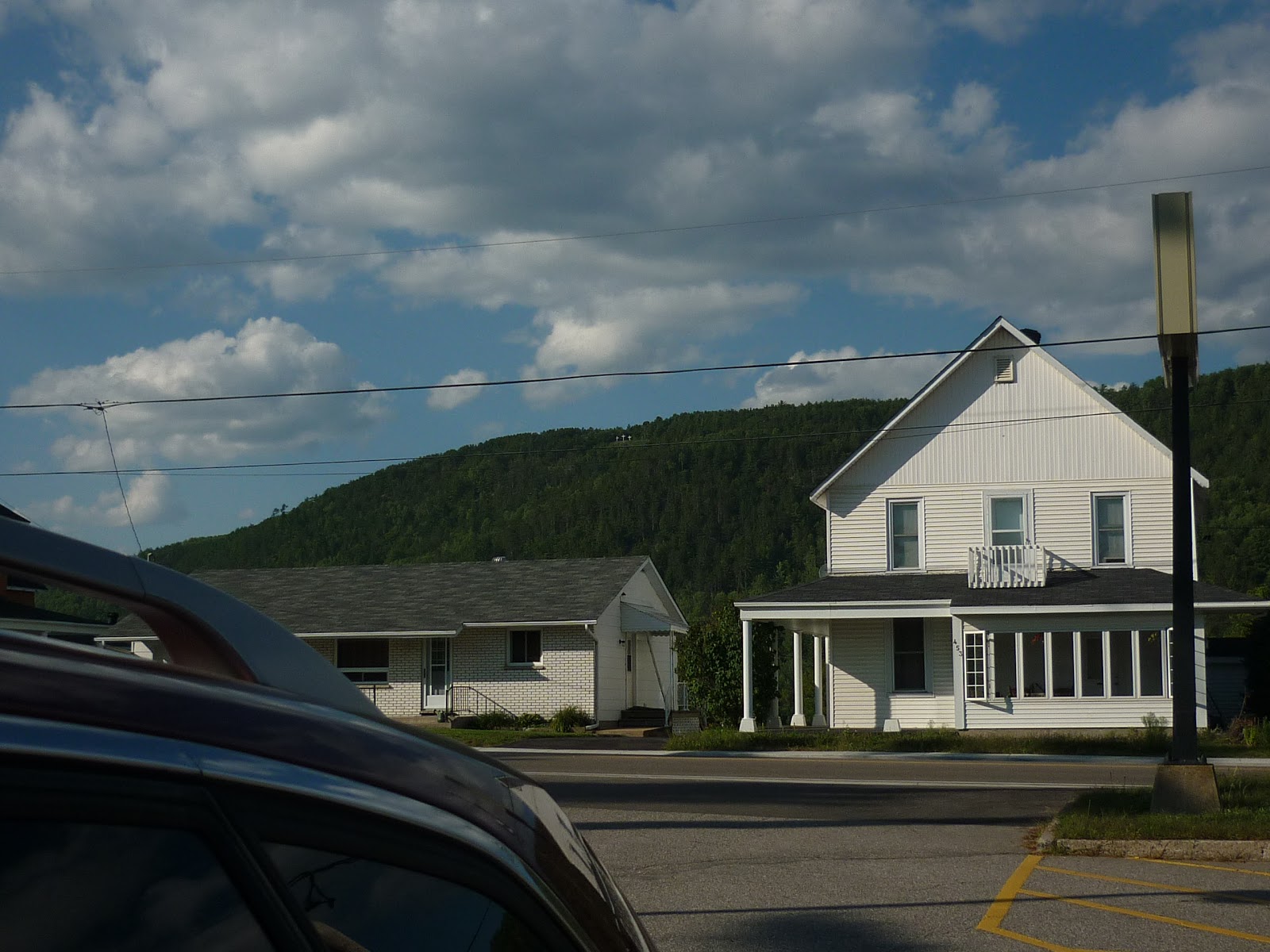
That was taken in Mattawa, Ontario, a small town which looks a bit like Munising, Michigan, or Madawaska, Maine. Sure, two of the four have pretty significant French-Canadian populations, but the cultural association is pretty much just incidental to the fact that most of the boreal parts of the world have long since been passed over as favorable for agriculture, large cities, and the other trappings of modern civilization. French-Canadian culture has endured because it happened to be concentrated in such environments. In 1763, Britain had a choice of getting Canada or Guadeloupe, a Caribbean island that at the time was worth more than all of France's North American possessions. For numerous reasons, Canada was the prize that Britain settled for. This would have normally meant mass deportations of all the French inhabitants of such lands, but owing to the need to keep the 13 colonies to the south bounded in, and because the land was not exactly a prize in the eyes of colonial settlers, French-Canadian culture remained, except on suitable land in the St. Lawrence valley further upstream where they had not yet settled in large numbers. Again, Canada is what Britain simply settled for. The real crowns of the empire were in the 13 colonies, Caribbean, and India.
In the next two centuries, French and First Born alike would be joined by other immigrants looking to reap the riches of an otherwise rugged land. In keeping with their predecessors, though, these newcomers never really mowed over as much of the landscape as those further south did. Yes, people farm in Le Nord, but that is only because a farm is one of many choices of a living in this place. Many harvest the bounty of the land in mineral, timber, and other natural resources. Large corporations do exploit the land here, but more than often the majority of people in these places are in it for themselves. Much of the land still looks a bit wild and natural as a result. That's what Le Nord is, really. A place where some people live for living, where resources could be exploited by tend to get ignored for easier circumstances elsewhere, and where life continues largely unaffected by a modern pace of consumption and life. Mattawa has fast food, wifi, and is not entirely off the beaten path away from larger cities with big box stores and huge malls, but it, and places like it, is not dominated by such things as much as it is set in a backdrop of a land where it is easy to remember that environment is more than just the most visible things.
Wednesday, October 24, 2012
Who were the Jesuits of New France?
Ever since the first of the second born of this continent arrived here, religious transformation of the continent had been at the forefront of a new destiny for North America. The Spanish and French would bring with them an exclusive Roman Catholicism. The English, Dutch, Swedes, and Danes would bring with them a Protestantism that excluded this Catholicism in return. The Russians would bring their Orthodox Christianity. In any case, the soldiers and merchants came hand in hand with various missionaries. Nearly all of them were as concerned with replacing as much of the culture as the religions of the peoples they encountered. The loving message of Christian transformation for the world, sadly, often came hand in hand with a pointed gun. The missionaries would cry out "shame, shame" or at least shake their heads in silent disapproval, but nothing really changed as a result of their weak disputes with colonial domination.
One group, however, was quite different.
Ever since their foundation in 1534, the Jesuits were drawing some of the keenest and brilliant minds in Europe into their world. These men were scientists, philosophers, politicians, artists, even warriors, but they all shared an intense zeal for spreading their faith and love of Jesus Christ to others. They were explorers as well, just as much concerned with evangelization as with roaming about the world and embracing its beauty and offerings. Very often, this brought them into conflicts not only with non-Catholics Christians, but also with the other missionary orders within the Catholic Church. By the early 1600's, such was the negative attention that they had received that other missionaries made active efforts to keep them out of new territories. One notable exception was New France.
The Franciscans in Quebec were finding that the rough country and alien cultures of the Algonquins and Montagnais were a far cry from the so-called civilized frontiers of the Arab and Oriental worlds that they had thus far been called upon to engage in conversion efforts. Though they had started to gain experience with the first born of North America in Mexico, such evangelization efforts in the Spanish New World were augmented with steel and gun-smoke. French efforts to colonize and economize on the New World were an altogether different affair; the native peoples were trading partners rather than subjects, and the missionaries were warned not to get in the way of the bottom line. As the Jesuits were certainly available, willing, and capable of engaging cultures on their own terms, the Franciscans called them in for assistance. Pretty soon, they were running the missionary effort, as well as the exploratory and diplomatic efforts on behalf of the French expedition. They were among the first Europeans to learn the languages of the first born, and among the only to report back to the mother countries about a richness to cultures otherwise considered savage and backward. They did, however, heavily impact any people they came across. New France, from Quebec to Louisiane, as well as the deserts of northern Mexico and the southwestern United States, and the upper Missouri river basin were all regions that bore the mark of passing Jesuits: native peoples who had a somewhat neutral meeting with Europeans. Their churches still stand and are in use, monuments to healthy missionary efforts:
http://www.sanxaviermission.org/
One group, however, was quite different.
Ever since their foundation in 1534, the Jesuits were drawing some of the keenest and brilliant minds in Europe into their world. These men were scientists, philosophers, politicians, artists, even warriors, but they all shared an intense zeal for spreading their faith and love of Jesus Christ to others. They were explorers as well, just as much concerned with evangelization as with roaming about the world and embracing its beauty and offerings. Very often, this brought them into conflicts not only with non-Catholics Christians, but also with the other missionary orders within the Catholic Church. By the early 1600's, such was the negative attention that they had received that other missionaries made active efforts to keep them out of new territories. One notable exception was New France.
The Franciscans in Quebec were finding that the rough country and alien cultures of the Algonquins and Montagnais were a far cry from the so-called civilized frontiers of the Arab and Oriental worlds that they had thus far been called upon to engage in conversion efforts. Though they had started to gain experience with the first born of North America in Mexico, such evangelization efforts in the Spanish New World were augmented with steel and gun-smoke. French efforts to colonize and economize on the New World were an altogether different affair; the native peoples were trading partners rather than subjects, and the missionaries were warned not to get in the way of the bottom line. As the Jesuits were certainly available, willing, and capable of engaging cultures on their own terms, the Franciscans called them in for assistance. Pretty soon, they were running the missionary effort, as well as the exploratory and diplomatic efforts on behalf of the French expedition. They were among the first Europeans to learn the languages of the first born, and among the only to report back to the mother countries about a richness to cultures otherwise considered savage and backward. They did, however, heavily impact any people they came across. New France, from Quebec to Louisiane, as well as the deserts of northern Mexico and the southwestern United States, and the upper Missouri river basin were all regions that bore the mark of passing Jesuits: native peoples who had a somewhat neutral meeting with Europeans. Their churches still stand and are in use, monuments to healthy missionary efforts:
http://www.sanxaviermission.org/
Friday, October 19, 2012
Feast of the North American Martyrs
On this day in the Roman Catholic Church are commemorated the Jesuit martyrs of New France. Each of them endured a pretty brutal death at the hands of the Haudenosaunee, who at the time were mortal enemies of the Wendat and French.

They are commemorated in two shrines, one in Auriesville, New York, and a grander one in Midland, Ontario, which rises over a reconstructed Wendat village. Love them or hate them, these people had a significant role in the development of North America, particularly in the conversion to Christianity of the first born sons and daughters of this land. Together with Matteo Ricci, who worked as a missionary in China, they are largely responsible for helping to form centuries of Jesuit missionaries. The Society of Jesus, through the experiences and sacrifices of these missionaries, learned how to carefully introduce their religion to a culture that might otherwise be somewhat worlds away from it.
So how is this for a crazy idea? Let's spend the next week looking at what they did.
In the meantime, enjoy this fictional, but somewhat accurate, clip of a movie that spoils the ending for you. Hint: Mortally speaking, it was not the most pleasant of endings.

They are commemorated in two shrines, one in Auriesville, New York, and a grander one in Midland, Ontario, which rises over a reconstructed Wendat village. Love them or hate them, these people had a significant role in the development of North America, particularly in the conversion to Christianity of the first born sons and daughters of this land. Together with Matteo Ricci, who worked as a missionary in China, they are largely responsible for helping to form centuries of Jesuit missionaries. The Society of Jesus, through the experiences and sacrifices of these missionaries, learned how to carefully introduce their religion to a culture that might otherwise be somewhat worlds away from it.
So how is this for a crazy idea? Let's spend the next week looking at what they did.
In the meantime, enjoy this fictional, but somewhat accurate, clip of a movie that spoils the ending for you. Hint: Mortally speaking, it was not the most pleasant of endings.
Saturday, October 13, 2012
On This Day...
...in 1812, Canadian forces consisting of British regulars, Upper Canadian militia, and Mohawk warriors repelled an American invasion force more than twice their number at Queenston Heights atop the Niagara Escarpment on the Niagara River. Among the causalities at the battle was Sir Isaac Brock:
Despite the victory, which ensured that American forces would never achieve the quick peace and take over of Canada that they had hoped for, Brock's death would prove to be rather devastating for any hopes of a dominant Canadian position through the rest of the war. Canada would survive, at least, if kept north of the Great Lakes. The battle, especially in Ontario, has remained one of the high holy points of English Canadian history, a moment of triumph over American domination. Like much of the War of 1812, the battle has also been romanticized a bit too much by Canadians, and neglected for mention in American history texts, but then, none of us were there, and our nations certainly have interesting ways of dealing with the present and future by imagining the past to be what we wish it to be. Was Queenston Heights important? Absolutely. Was it, and the dramatic death of Brock, a deciding factor in the drive to keep the war going for both sides? Not nearly as much as it was the hearts and causes for all the people involved. Wars are not glorious so much as they are crucial for understanding our consciousness of self as societies; what do we really fight for?
Rest in peace, Sir Isaac. Your monument, the monument of all those on both sides who fell with you, stands in testament to your contribution to the history of two young and growing nations.
 |
| "The Death of General Brock at the Battle of Queenston Heights" by John David Kelley, 1896. Courtesy Library and Archives Canada, C-000273. |
Despite the victory, which ensured that American forces would never achieve the quick peace and take over of Canada that they had hoped for, Brock's death would prove to be rather devastating for any hopes of a dominant Canadian position through the rest of the war. Canada would survive, at least, if kept north of the Great Lakes. The battle, especially in Ontario, has remained one of the high holy points of English Canadian history, a moment of triumph over American domination. Like much of the War of 1812, the battle has also been romanticized a bit too much by Canadians, and neglected for mention in American history texts, but then, none of us were there, and our nations certainly have interesting ways of dealing with the present and future by imagining the past to be what we wish it to be. Was Queenston Heights important? Absolutely. Was it, and the dramatic death of Brock, a deciding factor in the drive to keep the war going for both sides? Not nearly as much as it was the hearts and causes for all the people involved. Wars are not glorious so much as they are crucial for understanding our consciousness of self as societies; what do we really fight for?
Rest in peace, Sir Isaac. Your monument, the monument of all those on both sides who fell with you, stands in testament to your contribution to the history of two young and growing nations.
Monday, October 8, 2012
Opinion: Columbus Day?
Today the banks are closed, the mail is not being delivered, and some people will watch a news story about a statue of some Genoan who sailed for Spain looking for China a long time ago. Some other people, generally more uppity about these sorts of things, will cite that today we celebrate half a millennium of genocide, cultural and physical enslavement, and all the other bad things that have happened since 1492. These people regret that Europeans ever made contact with the West Indies that year.
I am not one of them.
What happened in 1492 did not destroy the New World. The will and actions of individuals did that. Did the discovery of a pair of continents with exploitable resources and peoples open up the gateways to domination by these people? Yes, absolutely. All the same though, Europeans, as with ALL humans, were pretty good at these things even before they made contact with the New World. Let's be honest here, on that note: Native Americans are hardly innocent noble savages, no matter how much we would want them to be as a part of our common imagination. Aztecs, Mayans, Incas, Haudenausonee, Crow, Commanches, etc... they were pretty rough cultures to be a part of, or worse, to be a neighbour to. No one is entirely innocent.
Did some truly terrible things happen? Yes, they certainly did. I dare anyone to visit Washita in Oklahoma and not feel some sort of compassion, dread, or sorrow. While away from the battlefield and in the comforts of one's armchair, Washita and other such slaughters of North America's first born can be rationalized away in the greater context of history and circumstance, witnessing the places where elders and children were mercilessly killed and horses shot simply for being beloved animals of the Cheyenne... I have problems even just typing this... well let's just say that the heart is moved.
All the same, I noted that such people were the first born of this continent. Regardless of the actions of others, we must not fall into logical fallacy and blame entire peoples for atrocities. The fact of the matter is that North America is now home to so many peoples. This continent is a very diverse place; it was even before European contact. There is no such thing as an "Indian", namely because there are so many different cultures and language groups present among the first born here. Now that new generations have come, should we ask them all to go back to the rest of the world simply because they wanted to live in harmony and peace in a land where origins contribute to destiny, rather than dominate it?
I am a North American, even if my roots are European. I think I first really came to know this when I returned home from living in London back in 2003 and looked down onto the shores of Labrador from my plane. I saw the waves of the cold northwestern Atlantic beating down on the ancient granite of the Canadian Shield, and I knew then that I was home. When I spent six weeks in Mexico refreshing my Spanish language skills back in 2008, I still felt at home among the pine-covered mountains of Morelos. When I have traveled out into the truly divine wonders of the West, I have still felt at home. Should we condemn the second child for the sake of the first? I am sorry that the first born was screwed out of an inheritance. That was wrong. But I am just as much in love with my homeland, from the jungles to the tundra, as my brothers and sisters of a different mother are.
Today is a day for reflection, for all the good and ill that has come of life here in this New World since that year (even if Basques, Celts, Norse, and East Asians probably had been here before then). Think about discovery, think about atrocity, think about a new chapter in the history of humanity. Think about so many of the peoples of the earth making a destiny for themselves set apart from their accident of birth and instead built around what they can make of themselves. Such are the hopes and dreams of Canadians, Americans, and Mexicans, no matter what their last name might be. Columbus Day is a good thing.
Oh, and by the way, today is also Canadian Thanksgiving. Yes, we have one too, and yes, it is largely about the same reason: thankfulness for the bounty of the land. While we don't have an iconography dominated by puritans and scantily clad native stereotypes, we do have turkey and stuffing. If this blog makes it to next year, count on an extended history of it then.
I am not one of them.
What happened in 1492 did not destroy the New World. The will and actions of individuals did that. Did the discovery of a pair of continents with exploitable resources and peoples open up the gateways to domination by these people? Yes, absolutely. All the same though, Europeans, as with ALL humans, were pretty good at these things even before they made contact with the New World. Let's be honest here, on that note: Native Americans are hardly innocent noble savages, no matter how much we would want them to be as a part of our common imagination. Aztecs, Mayans, Incas, Haudenausonee, Crow, Commanches, etc... they were pretty rough cultures to be a part of, or worse, to be a neighbour to. No one is entirely innocent.
Did some truly terrible things happen? Yes, they certainly did. I dare anyone to visit Washita in Oklahoma and not feel some sort of compassion, dread, or sorrow. While away from the battlefield and in the comforts of one's armchair, Washita and other such slaughters of North America's first born can be rationalized away in the greater context of history and circumstance, witnessing the places where elders and children were mercilessly killed and horses shot simply for being beloved animals of the Cheyenne... I have problems even just typing this... well let's just say that the heart is moved.
All the same, I noted that such people were the first born of this continent. Regardless of the actions of others, we must not fall into logical fallacy and blame entire peoples for atrocities. The fact of the matter is that North America is now home to so many peoples. This continent is a very diverse place; it was even before European contact. There is no such thing as an "Indian", namely because there are so many different cultures and language groups present among the first born here. Now that new generations have come, should we ask them all to go back to the rest of the world simply because they wanted to live in harmony and peace in a land where origins contribute to destiny, rather than dominate it?
I am a North American, even if my roots are European. I think I first really came to know this when I returned home from living in London back in 2003 and looked down onto the shores of Labrador from my plane. I saw the waves of the cold northwestern Atlantic beating down on the ancient granite of the Canadian Shield, and I knew then that I was home. When I spent six weeks in Mexico refreshing my Spanish language skills back in 2008, I still felt at home among the pine-covered mountains of Morelos. When I have traveled out into the truly divine wonders of the West, I have still felt at home. Should we condemn the second child for the sake of the first? I am sorry that the first born was screwed out of an inheritance. That was wrong. But I am just as much in love with my homeland, from the jungles to the tundra, as my brothers and sisters of a different mother are.
Today is a day for reflection, for all the good and ill that has come of life here in this New World since that year (even if Basques, Celts, Norse, and East Asians probably had been here before then). Think about discovery, think about atrocity, think about a new chapter in the history of humanity. Think about so many of the peoples of the earth making a destiny for themselves set apart from their accident of birth and instead built around what they can make of themselves. Such are the hopes and dreams of Canadians, Americans, and Mexicans, no matter what their last name might be. Columbus Day is a good thing.
Oh, and by the way, today is also Canadian Thanksgiving. Yes, we have one too, and yes, it is largely about the same reason: thankfulness for the bounty of the land. While we don't have an iconography dominated by puritans and scantily clad native stereotypes, we do have turkey and stuffing. If this blog makes it to next year, count on an extended history of it then.
Subscribe to:
Posts (Atom)