Over a month ago I pledged a return to regular posting on American Voyages. I wanted to share with my readers some thoughts on what direction the politics and culture of the continent were headed in, mostly spurred on by a flurry of political commentary from all fronts in the wake of the United States Federal government shutdown. Then, now, and as I hopefully will remain true to form for, I was and am for keeping this blog free of too much current political commentary. Why? Democracy has enough angry voices out there already! All joking aside, however, in general I try to view current events in light of a broader historical lens. This is probably due to several factors, notably an academic background in the humanities. Yes, a philosophy student can direct all possible energy to making bold statements about post-modernism or attempt to disprove everything that came before said student, but my own intellectual journey has found an exploration of the past, with an examination of the organic development of humanity, to be far more helpful in coming to thoughts about things in general.
That's what I had been trying to accomplish in coming to a statement about where language and the political culture surrounding language have come to. Why? The why is simple. People these days fight about everything from minimum wage to military spending (and yes, most of it revolves around money), but the thing that seems to get people, even people who could care less about all the other issues out there, very riled up. I say this because time and again I see a mother in a grocery store talking to her kids in Spanish, or some men working together again talking in that apparently taboo language, and nearby listeners almost fly into a red hot rage over the issue! "Speak English!" "This is America!" Then of course, the party in target usually apologizes, in English no less, and moves on, to no avail. Heck, Spanish is nothing, you should see the reactions I get to when I mumble to myself about how expensive gas is, en Francais, here (or even worse, in some heavily Anglo-centric place in Ontario). A personal mumble, barely audible to most people, is tantamount to treason for some people.
Needless to say, this tends to make me irate. Now, while I have every intention of continuing a historical overview of the history of how we came to this place linguistically on this continent, I might as well come out and say it for all those who were wondering: Half of this country was speaking Spanish before 1848 and a Mexican presence everywhere from California to Kansas evolved on this soil at about the same time an English-American one did (to say nothing of how many native tongues were around). For that matter, most of the people who get mad at the "Spanish threat" are buying into an old cultural imperialism despite the fact that their ancestors were probably considered second class to anything even remotely resembling a northern European, if the standards consider even other Germanic languages to be on the same level as beloved English. There. I said it. Now let me say this. English is not going anywhere. People around the world consider fluency in it to be desirable or at least profitable (believe it or not, especially in Latin America). English really is an amazing language with an incredible literary history. I say this as a person of Irish Catholic and French-Canadian heritage.
So why put off the history posts? They take a lot out of me. I can rant on easily like I did tonight, but I want American Voyages to be a place of learning, not diatribe. When I write these posts, I like them to be informed, and trust me, the next few posts in this series enter a period of remarkably complex history. Here we will see French make a thrust to the Canadian shores of the Pacific, Spanish encounter the United States again now in the friendly territories of Cuba and Puerto Rico, and native tongues get diminished everywhere. We get to see English change into so many regional variations in both countries, and we have a lot of fact checking to do. Each and every post, if I try to do it well, takes a lot out of me.
And let's face it, you all really come here just for the nature photography, right? Well, maybe not. It has been a while since I talked about the primary focus of this blog though: the land around us, and not just where the people have gone on it. The statistics indicate that A.V. has been opened to a much broader reader base even on an hourly basis, probably thanks to social media advertising, but also thanks to botanical and historical organizations out there. I need to get this thing hopping again, and the heavy posts are going to have to take a backseat until we can get things up and running. I want to share our wonderful corner of the world, after all, with the world. In particular I would like to thank The Hardy Palm International journal, based in Vancouver, of taking note not of my diatribes, but of my coverage of fun things like trees growing where they ought not. Wait a minute, palms, that sounds wonderful, let's go there next.

Always to the frontier
Wednesday, November 20, 2013

Wednesday, November 13, 2013
"I Don't Understand You": A History Of Linguistic Diversity In Colonial North America: Part Three, Canada Continued.
These days we tend to hear an annoying little voice calling out for Quebecois liberty. This voice has shut up a bit ever since it might have come to its senses and realized that things could be much, much worse for the otherwise fine people of Quebec, which probably has something to do with the fact that a decent majority of her people feel that they are being treated well enough as part of a united Canada and all of them know that they have the right to not only speak French and exist as they otherwise wish throughout the nation. More on this towards the end of the post, along with the other side, which it turns out is just as bitchy as the Francophones are over "my rights". First, just how did we manage to get to this point, anyway?
Well, the Canada of the 1770's was a very uncertain place, full of French-speaking people expecting deportation/cultural annihilation. French anything was certainly not in vogue back in London, to say nothing of how it was openly hated and feared in the rest of English-speaking North America. Think about things from the American perspective, especially from the viewpoint of a backcountry Pennsylvanian or Virginian: the French were the enemy, sending those terrifying Indians to attack you for no other purpose than to either kill you outright or terrorize you into leaving your land to the beavers so they could just... profit. That's right, they did not even want to settle down in your vacated clearing and cabin. Maybe their allies would retake some of that property, but even they would be more than likely to return to ancient lifestyles rather than set up shop in your hard-earned dwelling. 1763 was supposed to have changed all that. 1763 was supposed to be the time where London could tell France to pack up and move on and let people freely expand into that desirable western frontier. New colonies could even spring up along the St. Lawrence and Great Lakes, where they could connect economic opportunities with the distant Hudson's Bay Company.
Why would the newly appointed authorities of New France, be it in Quebec or Louisiana, want anything else?
Well, for one, London wanted control. Liberty was all well and good, but imagine how it looked from an office overlooking the Thames when confronted by the image of a set of colonies slowly growing into something far more expansive than merry old England. If nothing else, imagine how the people in such offices viewed the revenue potential of such a vast enterprise. Such income could easily pay for any war that these colonies would get into in the future, let alone what they had already cost the motherland in that war leading up to the victory of 1763. Now, imagine that if the colonists got their every wish and could expand as far they wanted to across the continent. Levying a tax on such a vast population would be difficult, and the freedom-minded people might even say no... In fact, they already had been not even 10 years after that victory had been achieved. More than this though, mother Britain knew that she could not indefinitely keep the winning streak she was on without a nation getting a bit overwhelmed by almost constant fighting. She needed to keep large reserves of the American prize open as potential bargaining chips down the road. After all, Canada was won only at the cost of turning down an even more profitable prize: Guadeloupe and Martinique in the Caribbean. Canada was just an option, and not a trophy or a purpose, for London.
So for control, for an open hand to play, for so many things, Canada was not just given to the Americans in its entirety. Provided that they give allegiance to a new crown, the French-Canadians could remain as they were, and this was, and has ever since been, because of the vision of one man: Lord Guy Carleton.
As I said, he is the savior of the entire concept of French-Canada, and next to George Etienne Cartier is probably the only reason that there are any French-speakers left on the continent. He made the Quebec Act of 1774 possible, and he also saved our behinds from being taken over by the Americans during the invasion of Quebec that was one of the first strategic offensive moves of the American War for Independence and the first official take-over attempt by Americans to dominate Canada. You would not figure Guy to be fond of anything foreign, however.
You see, Guy was Protestant, and he was Anglo-Irish, meaning that he was the product of centuries of an imperial attempt to impose English dominance over the island next door. He was also a veteran of the Jacobite wars over in Scotland, yet another exercise in said imperialism. By all accounts, nothing French or especially Catholic should have been in any way appealing to him to let live. That said, we know little of his earlier conviction and personal beliefs regarding English cultural sentiments, but we do know that he was a social climber and cared very much about his military career. Even if he was not interested in an imperialistic patriotism, he was very much interested in making the right moves. To speak out on behalf of the conquered French-Canadians was a risky move that one would not expect of a career obsessed officer. In the end, however, he did just that. In the end, the Protestant Anglo-Irishman asked London to let the French-Canadians not only speak French and be Catholic, but even to judge themselves according to their own civil laws. He also put his life on the line to defend Quebec from American attack.
Now the next part is very important.
But wait, you say, Americans of the period soon learned to love the French, especially after they would come to save the day at Yorktown and later even embrace a revolution of their own. True, but also remember that prejudice built up over generations and hundreds of years is not something to be so easily reversed. For anyone of British, and then by extension, American, heritage, things French were the rival at best and the enemy at worst. When we get to language in the United States, we will also cover feelings about things Spanish, but rest assured that in Anglo-American history, both cultures were not exactly well-loved ever since the reign of Henry VIII, and yes, religion complicated matters further. Why bring this up in a topic about language in Canada? Well, the battleground on the topic has already existed there for much longer, and now to look at the results, we turn back to Canada.
One can pretty much be certain that loyalty was almost then guaranteed in this new Canada. In 1775 and again in 1812, any notion of joining the crusade for freedom with the Americans was pretty much junked. Why take chances with, at best, an unknown foreign government in the colonies, and at worst, a government that would echo the sentiments of her citizens and expunge anything French from the land? Guy offered security and potential profit: whereas Paris once controlled the economic destiny of New France, she was now joined into a network of free-enterprise with an empire that spanned the globe. If we consider the Quebec Act to be the political birth of Canada, then we would also have to say that the Quebecois of 1775 where positively thrilled to be Canadian, and in 1812, they pretty much confirmed that notion to curious Americans. By 1867, when Canada came into an official existence more along the lines of what we know her to be today, French was alive and well in a Canada that had since come to also embrace English and manage to somehow not extinguish languages spoken by her native peoples.
As I have rambled on a bit in this post, we will continue down this track, which does get a bit bumpy, next post.
Well, the Canada of the 1770's was a very uncertain place, full of French-speaking people expecting deportation/cultural annihilation. French anything was certainly not in vogue back in London, to say nothing of how it was openly hated and feared in the rest of English-speaking North America. Think about things from the American perspective, especially from the viewpoint of a backcountry Pennsylvanian or Virginian: the French were the enemy, sending those terrifying Indians to attack you for no other purpose than to either kill you outright or terrorize you into leaving your land to the beavers so they could just... profit. That's right, they did not even want to settle down in your vacated clearing and cabin. Maybe their allies would retake some of that property, but even they would be more than likely to return to ancient lifestyles rather than set up shop in your hard-earned dwelling. 1763 was supposed to have changed all that. 1763 was supposed to be the time where London could tell France to pack up and move on and let people freely expand into that desirable western frontier. New colonies could even spring up along the St. Lawrence and Great Lakes, where they could connect economic opportunities with the distant Hudson's Bay Company.
Why would the newly appointed authorities of New France, be it in Quebec or Louisiana, want anything else?
Well, for one, London wanted control. Liberty was all well and good, but imagine how it looked from an office overlooking the Thames when confronted by the image of a set of colonies slowly growing into something far more expansive than merry old England. If nothing else, imagine how the people in such offices viewed the revenue potential of such a vast enterprise. Such income could easily pay for any war that these colonies would get into in the future, let alone what they had already cost the motherland in that war leading up to the victory of 1763. Now, imagine that if the colonists got their every wish and could expand as far they wanted to across the continent. Levying a tax on such a vast population would be difficult, and the freedom-minded people might even say no... In fact, they already had been not even 10 years after that victory had been achieved. More than this though, mother Britain knew that she could not indefinitely keep the winning streak she was on without a nation getting a bit overwhelmed by almost constant fighting. She needed to keep large reserves of the American prize open as potential bargaining chips down the road. After all, Canada was won only at the cost of turning down an even more profitable prize: Guadeloupe and Martinique in the Caribbean. Canada was just an option, and not a trophy or a purpose, for London.
So for control, for an open hand to play, for so many things, Canada was not just given to the Americans in its entirety. Provided that they give allegiance to a new crown, the French-Canadians could remain as they were, and this was, and has ever since been, because of the vision of one man: Lord Guy Carleton.
 |
| Unknown artist, public domain, reference number C-002833 from the National Archives of Canada. |
You see, Guy was Protestant, and he was Anglo-Irish, meaning that he was the product of centuries of an imperial attempt to impose English dominance over the island next door. He was also a veteran of the Jacobite wars over in Scotland, yet another exercise in said imperialism. By all accounts, nothing French or especially Catholic should have been in any way appealing to him to let live. That said, we know little of his earlier conviction and personal beliefs regarding English cultural sentiments, but we do know that he was a social climber and cared very much about his military career. Even if he was not interested in an imperialistic patriotism, he was very much interested in making the right moves. To speak out on behalf of the conquered French-Canadians was a risky move that one would not expect of a career obsessed officer. In the end, however, he did just that. In the end, the Protestant Anglo-Irishman asked London to let the French-Canadians not only speak French and be Catholic, but even to judge themselves according to their own civil laws. He also put his life on the line to defend Quebec from American attack.
Now the next part is very important.
But wait, you say, Americans of the period soon learned to love the French, especially after they would come to save the day at Yorktown and later even embrace a revolution of their own. True, but also remember that prejudice built up over generations and hundreds of years is not something to be so easily reversed. For anyone of British, and then by extension, American, heritage, things French were the rival at best and the enemy at worst. When we get to language in the United States, we will also cover feelings about things Spanish, but rest assured that in Anglo-American history, both cultures were not exactly well-loved ever since the reign of Henry VIII, and yes, religion complicated matters further. Why bring this up in a topic about language in Canada? Well, the battleground on the topic has already existed there for much longer, and now to look at the results, we turn back to Canada.
One can pretty much be certain that loyalty was almost then guaranteed in this new Canada. In 1775 and again in 1812, any notion of joining the crusade for freedom with the Americans was pretty much junked. Why take chances with, at best, an unknown foreign government in the colonies, and at worst, a government that would echo the sentiments of her citizens and expunge anything French from the land? Guy offered security and potential profit: whereas Paris once controlled the economic destiny of New France, she was now joined into a network of free-enterprise with an empire that spanned the globe. If we consider the Quebec Act to be the political birth of Canada, then we would also have to say that the Quebecois of 1775 where positively thrilled to be Canadian, and in 1812, they pretty much confirmed that notion to curious Americans. By 1867, when Canada came into an official existence more along the lines of what we know her to be today, French was alive and well in a Canada that had since come to also embrace English and manage to somehow not extinguish languages spoken by her native peoples.
As I have rambled on a bit in this post, we will continue down this track, which does get a bit bumpy, next post.
Wednesday, October 30, 2013
"I Don't Understand You": A History Of Linguistic Diversity In Colonial North America: Part Two, Canada.
The French came to North America for profit, just like the Spanish did, but they were not interested in a complicated venture of mining and looking for cities made of gold. For one, there were no grand empires denoting any sort of mineral wealth in these parts, whether they landed in the Gulf of St. Lawrence, Florida and the Carolinas, or later along the Gulf Coast. They did, however, find that if they demonstrated that they could play nice with the locals, the locals would offer them the other fruits of the interior, namely pelts. Later on, settlers would come, just as they did down in Mexico, and just like what happened in Mexico, the settlers found they had an easier time of living when the neighbors were at peace. Colonial policy thus took on a role of negotiator rather than exterminator, at least as long as the other side was willing to talk. French settlement, however, also never really took off with the intention or effect of transforming the entire land; New France was a thing mostly of the river ways. The backcountry was reserved for commerce and exploration.
This is not to say that the French language did not spread there. Here, as in Mexico, missionary efforts found that the people were more responsive to their own language in which abstract concepts could better be disseminated. The lust for Latin which was becoming part and parcel of Counter-Reformation Catholicism only played a ritual role here in a land of very different patterns of belief. What's more, the Jesuits were the primary troops deployed in the effort, and the teaching philosophy of Matteo Ricci had now been widely introduced into efforts to spread the faith through the Society beyond the tried and trusted techniques favored by the other orders back in Europe. On the commercial front, the voyageurs and fur-traders agreed that business went smoother when they decided to learn the language of the market rather than induct the other side into the fine art of French. The imposition of French language and culture never became a legal mandate by the authorities, if for no other reason than it never had to be imposed; things just worked too smoothly the way they had since the 16th century. That and, well, as had been noted above, the spread of French anything into the heart of the continent was a mix of small scale settlement and large scale commercial operations.
Thus instead of coming as a conquering force, the French world entered the scene as a new partner at best, and a manipulator at worst. Since the primary efforts, if not goal, of the settlers was commerce, French expanded far faster than any other European language did anywhere in the New World. By the end of their first century in Canada, Frenchmen could be heard speaking their native tongue from the Atlantic north to the treelines and across the breadth of the land to the Rockies, perhaps as far south as Tejas. Remember how they got along well with the locals for the most part? Well, they got a long really well, and those exploring and trading men often adopted both the lifestyle and even family of the folks they came across. Just as was the case in Mexico, where two worlds met in a marriage and produced a new people born of both, the Mestizos, here were born the Metis. As was the case in Mexico, these children did, and still do, speak the languages of both parents. In the American westward expansion of the 19th century, frontiersmen and settlers would often encounter French speakers, the Firstborn among them, as far afield as Utah and Idaho. More on the Metis in another post.
Unlike in Mexico, fortunes changed hands for French-speakers relatively soon after foundations had been laid for a permanent presence there. The English won sovereignty of the land after they chose it as a victory prize in the French and Indian War. Something remarkable happened, though, that had never before occurred in Anglo-French rivalry: tolerance. In 1763, when Quebec, Montreal, Detroit, St. Louis, and New Orleans had to officially raise the British flag, everyone expected that deportations would occur, language and customs suppressed for those who remained, and the place would start looking a lot more New York than New France. This is what went down when the Acadians were forcibly removed from Nova Scotia not even a year prior, and back in Britain cultural transformation of a defeated foe had long been in vogue, especially in Ireland, and more memorably in 1745 in the Scottish Highlands. Just as what had happened in Mexico, however, something in the individualistic, idealistic North American air got to someone and made them say no.
His name was Guy Carleton, and he is the savior of my people's culture.
Come by next post for more!
This is not to say that the French language did not spread there. Here, as in Mexico, missionary efforts found that the people were more responsive to their own language in which abstract concepts could better be disseminated. The lust for Latin which was becoming part and parcel of Counter-Reformation Catholicism only played a ritual role here in a land of very different patterns of belief. What's more, the Jesuits were the primary troops deployed in the effort, and the teaching philosophy of Matteo Ricci had now been widely introduced into efforts to spread the faith through the Society beyond the tried and trusted techniques favored by the other orders back in Europe. On the commercial front, the voyageurs and fur-traders agreed that business went smoother when they decided to learn the language of the market rather than induct the other side into the fine art of French. The imposition of French language and culture never became a legal mandate by the authorities, if for no other reason than it never had to be imposed; things just worked too smoothly the way they had since the 16th century. That and, well, as had been noted above, the spread of French anything into the heart of the continent was a mix of small scale settlement and large scale commercial operations.
Thus instead of coming as a conquering force, the French world entered the scene as a new partner at best, and a manipulator at worst. Since the primary efforts, if not goal, of the settlers was commerce, French expanded far faster than any other European language did anywhere in the New World. By the end of their first century in Canada, Frenchmen could be heard speaking their native tongue from the Atlantic north to the treelines and across the breadth of the land to the Rockies, perhaps as far south as Tejas. Remember how they got along well with the locals for the most part? Well, they got a long really well, and those exploring and trading men often adopted both the lifestyle and even family of the folks they came across. Just as was the case in Mexico, where two worlds met in a marriage and produced a new people born of both, the Mestizos, here were born the Metis. As was the case in Mexico, these children did, and still do, speak the languages of both parents. In the American westward expansion of the 19th century, frontiersmen and settlers would often encounter French speakers, the Firstborn among them, as far afield as Utah and Idaho. More on the Metis in another post.
 |
| Public Domain. The painting, The Trapper's Bride, is a work by Alfred Jacob Miller, an American artist who had a fondness of the subject matter of the northwestern frontier. While a lot of 19th and early 20th century historical paintings have an extreme air of Romantic illusion to them, this one seems very real. You have a bunch of the locals amused by the French trappers who are positively enraptured by their rugged and free way of life. That, and a pretty face. |
His name was Guy Carleton, and he is the savior of my people's culture.
Come by next post for more!
Sunday, October 27, 2013
"I Don't Understand You": A History Of Linguistic Diversity In Colonial North America: Part One, Mexico.
Aside from the multitudes of languages and language families that existed among the First Born before colonization, popular imagination tends to view North America as being divided between a Spanish south, English center, and French north which has been largely confined to modern Quebec. In fact, there was a decent concentration of Dutch, Swedish, Russian, German, Gaelic, and even Greek speakers who settled the continent alongside the "big three". This resulted, along with settlement patterns and military control of territories, in a severe disruption of communication in what was otherwise a complex network of trade corridors and relatively stable alliance set-ups that could ultimately bring people, goods, and ideas from one ocean to another. Whereas Geronimo and his Apaches found themselves imprisoned in Florida in a different world, looking at a Gulf of Mexico and sweating in the humidity, something they could not even imagine from living in their distant Arizona, the Apaches a few hundred years before would have been decently informed about and may have even seen on some trade or military expeditions. Colonization resulted in the continent becoming very compartmentalized, ironically an issue which affects politics in relation to language in the present day.
Let's explore who came and what happened piece by piece. First we can take a look at New Spain.
Spanish colonization did not take over everything from San Francisco to Cape Horn overnight. The Caribbean islands were the first lands in which settlement and language dispersal happened, with the Spanish making their first concentrated and serious colonization efforts in Cuba after having made minor settlements in Columbia and Venezuela. The Spanish desire for conquest was primarily fueled by lusting after gold and riches, but colonization was based off of taking advantage of trade with interior peoples and establishing a foothold for Roman Catholicism in the New World.
While on the surface, the spread of the Spanish language would seem to be a practical way of standardizing trade and commerce and making conversion to a new faith much easier, such cultural domination happened only gradually. Missionaries trained themselves to speak various languages and traders simply relied on existing trade networks and set-ups. Part of this was due to the work of one man, San Bartholome de Las Casas. Simply put, Las Casas was disgusted by what he saw as the brutal conquest that Spain was participating in against the people living with him, admittedly as his own slaves, in an exciting New World where he pledged to make a life of freedom and prosperity. His viewpoints were hard to keep to himself, and he eventually spearheaded efforts to protect the native population of Mexico from cultural annihilation. Together with the effects that Malinche had previously had on softening the heart of Hernando Cortez, this meant that Spanish colonization started to become a much more complicated affair than just mere conquest.
Missionary efforts were helped quite a lot by this mutual exploration, though sometimes they resulted in Catholicism simply being absorbed into existing religious practices. Due to this and other reasons, Spanish efforts did start to turn toward cultural dominance. Spanish did not become imposed on the populace of New Spain until 1696, but legislated cultural transformation became policy throughout the 18th century, and missionary efforts which went along with military expeditions into the northern frontiers of Alta California, Tejas, and the Rio Grande valley followed this policy, especially after the Jesuits were expelled from all Spanish dominions. While the Franciscans who followed them were not particularly fond of cultural domination, they followed the law in spreading the take-over of Spanish language and customs. Mexican independence, followed by strong native democratic participation in the new nation, eventually resulted in a reversal of imperialistic cultural and linguistic directives.
Thus the Spanish language has not completely replaced common usage of indigenous languages in Mexico even in the present day. While most if nearly all non-Spanish speakers in Mexico are functionally bilingual, the majority of pre-conquest languages have survived with enough speakers around to keep them alive. The Mexican government, in fact, recognizes 68 languages in addition to Spanish as national languages, complete with all the legal rights for those language users shared by Spanish users. This has been law since 1917.
Native culture has indeed remained dominant in some areas of southern Mexico, and Mexican culture would not be the same without them, to say nothing of how it would be without heavy infusions from the languages of those cultures into Spanish. While efforts to diversify and protect different languages have met with, let's be honest and say completely racist efforts of suppression in the United States and Canada, Mexico simply has such an inter-mixed population that such a thing would be unthinkable there. The same cannot be said for the rest of Latin America, but that is another story for a different day, and beyond the scope of this blog, at least for now.
Next post we travel 2,300 miles northward to New France and see what happened with French in the New World.
Let's explore who came and what happened piece by piece. First we can take a look at New Spain.
 |
| This portrait of San Bartholome de Las Casas hangs, suprisingly, in the Senate wing of the United States Capitol Building. More on this man below. |
While on the surface, the spread of the Spanish language would seem to be a practical way of standardizing trade and commerce and making conversion to a new faith much easier, such cultural domination happened only gradually. Missionaries trained themselves to speak various languages and traders simply relied on existing trade networks and set-ups. Part of this was due to the work of one man, San Bartholome de Las Casas. Simply put, Las Casas was disgusted by what he saw as the brutal conquest that Spain was participating in against the people living with him, admittedly as his own slaves, in an exciting New World where he pledged to make a life of freedom and prosperity. His viewpoints were hard to keep to himself, and he eventually spearheaded efforts to protect the native population of Mexico from cultural annihilation. Together with the effects that Malinche had previously had on softening the heart of Hernando Cortez, this meant that Spanish colonization started to become a much more complicated affair than just mere conquest.
Missionary efforts were helped quite a lot by this mutual exploration, though sometimes they resulted in Catholicism simply being absorbed into existing religious practices. Due to this and other reasons, Spanish efforts did start to turn toward cultural dominance. Spanish did not become imposed on the populace of New Spain until 1696, but legislated cultural transformation became policy throughout the 18th century, and missionary efforts which went along with military expeditions into the northern frontiers of Alta California, Tejas, and the Rio Grande valley followed this policy, especially after the Jesuits were expelled from all Spanish dominions. While the Franciscans who followed them were not particularly fond of cultural domination, they followed the law in spreading the take-over of Spanish language and customs. Mexican independence, followed by strong native democratic participation in the new nation, eventually resulted in a reversal of imperialistic cultural and linguistic directives.
Thus the Spanish language has not completely replaced common usage of indigenous languages in Mexico even in the present day. While most if nearly all non-Spanish speakers in Mexico are functionally bilingual, the majority of pre-conquest languages have survived with enough speakers around to keep them alive. The Mexican government, in fact, recognizes 68 languages in addition to Spanish as national languages, complete with all the legal rights for those language users shared by Spanish users. This has been law since 1917.
Native culture has indeed remained dominant in some areas of southern Mexico, and Mexican culture would not be the same without them, to say nothing of how it would be without heavy infusions from the languages of those cultures into Spanish. While efforts to diversify and protect different languages have met with, let's be honest and say completely racist efforts of suppression in the United States and Canada, Mexico simply has such an inter-mixed population that such a thing would be unthinkable there. The same cannot be said for the rest of Latin America, but that is another story for a different day, and beyond the scope of this blog, at least for now.
Next post we travel 2,300 miles northward to New France and see what happened with French in the New World.
Wednesday, October 23, 2013
Language In North America
This has been a long time in coming, but now seemed like a good time to discuss the matter of language on our fair continent. First, a few key points:
1. The United States of America does not have an official language. There are practical and historical reasons for this, which we will get into. The state of New Mexico actually has two official languages, English and Spanish.
2. Nearly a quarter of the people on this continent do not speak English as a first language, BUT:
3. Many people in Mexico learn English, and as a second language, rather than as a foreign language, the most popular choice for which is French. In my own experiences in Morelos, Guerrero, The Federal District, Chihuahua, and Baja California, I found that every person I ran into either spoke English or knew someone who did.
4. English is not going anywhere, stop worrying. People in China, which trumps our three countries in population all together, are learning it despite clearly being in a position where they now have the commercial and political clout to tell us to speak Mandarin and Cantonese.
Feel better?
5. Many of the founding fathers spoke multiple languages and considered a working knowledge of Latin and Greek to be an essential mark of a gentleman's intellectual prowess.
6. In present times, several hundred thousand people in the United States and Canada do not speak English, French, or Spanish as a first language, if at all, in daily use, and they have been speaking these tongues before speakers of those three tongues ever arrived on our shores.
7. Many if not most consumer products will have an instruction or warning label in our three predominant languages. In Canada this is required by law; everything thus has French and English on the label. In the United States, this is promoted by private businesses and often features multiple choices beyond even the big three.
8. Of all the current political topics on the table, language is the one issue that seems to raise the ire in even the most politically apathetic people. I have lost count of how many times I have been threatened with bodily harm just for speaking with someone in Spanish, or, heaven forbid, French.
So let's start with those bold, declarative statements for now. I want to be careful about how I introduce such a topic without causing panic (and why yes, immigration will also be on the table, probably next week) and to promote the fact that these posts, and this blog, is not attempting to be the grand avatar of some horrid political agenda. Rather, I hope to bring some clarity to otherwise cloudy places of knowledge for you guys/you all/y'all. I'm going to go slowly on this one, and break it down into digestible portions of history, politics, maps, etc. Oh, expect maps. Expect many maps. I like maps. Let's start with this one:
A nice map we have here. Yes, we do see a lot of Spanish, but remember, this is a map with a title that should disarm hostile opposition. In each and every one of those counties, excepting maybe some in the hinterlands and present political frontiers, English is the main event spoken outside of the home, and is definitely available even there.
1. The United States of America does not have an official language. There are practical and historical reasons for this, which we will get into. The state of New Mexico actually has two official languages, English and Spanish.
2. Nearly a quarter of the people on this continent do not speak English as a first language, BUT:
3. Many people in Mexico learn English, and as a second language, rather than as a foreign language, the most popular choice for which is French. In my own experiences in Morelos, Guerrero, The Federal District, Chihuahua, and Baja California, I found that every person I ran into either spoke English or knew someone who did.
4. English is not going anywhere, stop worrying. People in China, which trumps our three countries in population all together, are learning it despite clearly being in a position where they now have the commercial and political clout to tell us to speak Mandarin and Cantonese.
Feel better?
5. Many of the founding fathers spoke multiple languages and considered a working knowledge of Latin and Greek to be an essential mark of a gentleman's intellectual prowess.
6. In present times, several hundred thousand people in the United States and Canada do not speak English, French, or Spanish as a first language, if at all, in daily use, and they have been speaking these tongues before speakers of those three tongues ever arrived on our shores.
7. Many if not most consumer products will have an instruction or warning label in our three predominant languages. In Canada this is required by law; everything thus has French and English on the label. In the United States, this is promoted by private businesses and often features multiple choices beyond even the big three.
8. Of all the current political topics on the table, language is the one issue that seems to raise the ire in even the most politically apathetic people. I have lost count of how many times I have been threatened with bodily harm just for speaking with someone in Spanish, or, heaven forbid, French.
So let's start with those bold, declarative statements for now. I want to be careful about how I introduce such a topic without causing panic (and why yes, immigration will also be on the table, probably next week) and to promote the fact that these posts, and this blog, is not attempting to be the grand avatar of some horrid political agenda. Rather, I hope to bring some clarity to otherwise cloudy places of knowledge for you guys/you all/y'all. I'm going to go slowly on this one, and break it down into digestible portions of history, politics, maps, etc. Oh, expect maps. Expect many maps. I like maps. Let's start with this one:
 |
| Source cited in image. As we can see, Maine is clearly the coolest state to live in. Not that I am biased or anything. |
A nice map we have here. Yes, we do see a lot of Spanish, but remember, this is a map with a title that should disarm hostile opposition. In each and every one of those counties, excepting maybe some in the hinterlands and present political frontiers, English is the main event spoken outside of the home, and is definitely available even there.
Saturday, October 19, 2013
Are We Headed To A New Civil War?
North Americans, yes, even us comparatively politically and socially sedate Canadians and Mexicans, are an opinionated lot. Sure, there are active ideological fronts being fought over in the rest of the world, but here we seem to have built up a culture that thrives on, or perhaps even requires, ideological diversity. Even in some of Europe's more open societies which rely on total democratic participation to exist as they do, North Americans trump them in terms of respecting the notion of personal determination to the point of it being made into a sort of religion of liberty. Canada and the United States largely inherited this passion for mother Britain, which in the eighteenth century was every bit as crazy over liberty than the colonies were. The frontier mentality of rugged individualism, in fact, can largely be traced to the freedom-oriented folkways of the people of the northern borderlands between England and Scotland. That said, such passions were later transformed by an influx of a wide diversity of immigrants, both free and enslaved, from across Europe and sub-Saharan Africa. Down in Mexico, a reaction against a distant or otherwise oppressive Spain grew in intensity inspired by what was happening further north.
The history lesson from there on is an important one. Whereas Britain buckled down in defending a particular concept of freedom, particularly the national identity brand, against intrusions by France and eventually Germany, North America exploded into hundreds of different camps. In Mexico and Canada, this has always been strongly evidenced by strong provincial/regional traits; the near revolutions in Chiapas and Quebec that have never really faded away are proof enough of this without even looking at the rest of how the countries are at odds with the capitals. In the United States, however, while the federal government remains strong and appears to be an emblem of power and unity to the rest of the world, well...
Let's just remind ourselves that the thirteen colonies almost did not rebel together, much less stick together once the final shots had been fired at Yorktown. The backcountry was at odds with the lowcountry, both of which were at odds with the valley inhabitants of the Delaware, Hudson, and so many other watersheds, who were further at odds with the struggling remnants of Puritan power in New England, who were at odds with... you get the picture. Or maybe not. You see, especially in the frontier regions, regionalism was the furthest thing from the minds of towns and even just families, clans really, that preferred a lack of contact if not outright war with the neighbors. The only thing that kept a Virginian mountaineer unarmed in the same room with a Virginian planter, to say nothing of a Bostonian merchant, would be a common threat. The firstborn, with their ferocity in combat and every bit as strong desire to preserve home security, were the first cause of unity. Then came their allies the French, either from across the ocean or closer to home among Les Habitants. Both were largely dealt with in 1763. In the decades to follow, that new threat would be mother Britain, and finally in 1812, that same mother and her new child and sister to the colonies, Canada, would be the source of final movement into a cohesive national sentiment. Note though, the term there, for sentiment is not to be confused with identity.
There were still identities a plenty even within the individual states. This is how Virginia, a behemoth stretching from the mouth of the Chesapeake to the Ohio valley, eventually became broken into smaller entities, starting most vividly with the memory of the creation of Kentucky in 1797, itself an improbable geographic collage of mountains, savannas, forests, and even cypress swamps. Yes, such a buffet of both mentality and environment combined into the rugged individualism that continues to define divides with American society. Most people know that the West is not the Plains is not the South is not the Rustbelt is not the East Coast, but they don't know how fragmented national identity is beyond such simple distinctions. People with the regions certainly do; no Charlestonian would ever be confused with someone from Memphis. No "Yooper" would ever be confused with someone from metro Detroit, at least by someone in Michigan. Buffalo feels like it is at the other end of the world from New York City, if New Yorkers even take the time to recognize that there is also a state called New York (I joke only slightly).
This is now. How about back, say, during the Civil War?
The sides of the war are usually broken simply into North and South, with the North being pictured as a heavily urbanized industrial bastion of truth fighting against slavery and the South being painted as an agrarian civilization vainly struggling to hold on to slavery. Military historians often focus on the main events in the Tennessee and Mississippi valleys and the front centered around Virginia. The truth is, decently-sized battles were fought as far west as New Mexico and as far north as Indiana, and in an age when much of the population, especially in rural fronts, had access to a firearm, little skirmishes across towns were a lot more common than historical memory permits recollection for. Recent works of fiction like Gangs of New York have managed to revive interest in the back door of the war, but common imagination likes to view the early 1860's as a brief interruption in an otherwise strong national expansion and development. The truth is, we were all at each others throats half the time, over issues like race, class, the economy, religion, the environment, immigration, language, etc. Sound familiar?
It should. We never really stopped fighting, because we are all so damn passionate about these issues. We had a series of crises, from the two world wars and a rather brutal depression, to bolster the strength of federal versus local identity, but the security, prosperity, and romanticizing of historical memory that came afterwards helped us forget about some things. Indeed, again, we never really stopped fighting even during the outbreak of peace.
Even people who claim to hate politics and loathe taking sides feel strongly about such issues here, and given the chance to get irritated over at least one of them, will try to weigh in on how they really feel, even if they don't exactly pick up a gun and fire into the air over it. One such issue is language, which after a delay of nearly two years in running this blog, I think I will finally just bite into and discuss next post.
But in the meantime, how about that title question up there?
Things are getting ugly, and the last lingering stabilization provided for by the Second World War might finally be fading from national consciousness. Some serious questions are once again being asked, people are either arming themselves with guns or democratic participation in increasing numbers, and, surprisingly and ironically, camps are being formed to make the claim about who is the most American of them all!
This answer is, we probably are heading to something major that is going to bring about large scale changes to our society, and in a country with a history defined so much by war, armed conflict is certainly not out of the question. In the coming weeks, let's explore why and what this means together, and as always, through the lens of history and geography.
The history lesson from there on is an important one. Whereas Britain buckled down in defending a particular concept of freedom, particularly the national identity brand, against intrusions by France and eventually Germany, North America exploded into hundreds of different camps. In Mexico and Canada, this has always been strongly evidenced by strong provincial/regional traits; the near revolutions in Chiapas and Quebec that have never really faded away are proof enough of this without even looking at the rest of how the countries are at odds with the capitals. In the United States, however, while the federal government remains strong and appears to be an emblem of power and unity to the rest of the world, well...
Let's just remind ourselves that the thirteen colonies almost did not rebel together, much less stick together once the final shots had been fired at Yorktown. The backcountry was at odds with the lowcountry, both of which were at odds with the valley inhabitants of the Delaware, Hudson, and so many other watersheds, who were further at odds with the struggling remnants of Puritan power in New England, who were at odds with... you get the picture. Or maybe not. You see, especially in the frontier regions, regionalism was the furthest thing from the minds of towns and even just families, clans really, that preferred a lack of contact if not outright war with the neighbors. The only thing that kept a Virginian mountaineer unarmed in the same room with a Virginian planter, to say nothing of a Bostonian merchant, would be a common threat. The firstborn, with their ferocity in combat and every bit as strong desire to preserve home security, were the first cause of unity. Then came their allies the French, either from across the ocean or closer to home among Les Habitants. Both were largely dealt with in 1763. In the decades to follow, that new threat would be mother Britain, and finally in 1812, that same mother and her new child and sister to the colonies, Canada, would be the source of final movement into a cohesive national sentiment. Note though, the term there, for sentiment is not to be confused with identity.
There were still identities a plenty even within the individual states. This is how Virginia, a behemoth stretching from the mouth of the Chesapeake to the Ohio valley, eventually became broken into smaller entities, starting most vividly with the memory of the creation of Kentucky in 1797, itself an improbable geographic collage of mountains, savannas, forests, and even cypress swamps. Yes, such a buffet of both mentality and environment combined into the rugged individualism that continues to define divides with American society. Most people know that the West is not the Plains is not the South is not the Rustbelt is not the East Coast, but they don't know how fragmented national identity is beyond such simple distinctions. People with the regions certainly do; no Charlestonian would ever be confused with someone from Memphis. No "Yooper" would ever be confused with someone from metro Detroit, at least by someone in Michigan. Buffalo feels like it is at the other end of the world from New York City, if New Yorkers even take the time to recognize that there is also a state called New York (I joke only slightly).
This is now. How about back, say, during the Civil War?
 |
| Artillery at Cumberland Gap National Historical Park. This gun is in Kentucky, pointed toward both Virginia and Tennessee. The Gap never saw significant military action, but changed hands many times. I put this photo here as a reminder that that war was very pervasive, with reminders of armed conflict surrounding nearly all of even the backcountry population. |
The sides of the war are usually broken simply into North and South, with the North being pictured as a heavily urbanized industrial bastion of truth fighting against slavery and the South being painted as an agrarian civilization vainly struggling to hold on to slavery. Military historians often focus on the main events in the Tennessee and Mississippi valleys and the front centered around Virginia. The truth is, decently-sized battles were fought as far west as New Mexico and as far north as Indiana, and in an age when much of the population, especially in rural fronts, had access to a firearm, little skirmishes across towns were a lot more common than historical memory permits recollection for. Recent works of fiction like Gangs of New York have managed to revive interest in the back door of the war, but common imagination likes to view the early 1860's as a brief interruption in an otherwise strong national expansion and development. The truth is, we were all at each others throats half the time, over issues like race, class, the economy, religion, the environment, immigration, language, etc. Sound familiar?
It should. We never really stopped fighting, because we are all so damn passionate about these issues. We had a series of crises, from the two world wars and a rather brutal depression, to bolster the strength of federal versus local identity, but the security, prosperity, and romanticizing of historical memory that came afterwards helped us forget about some things. Indeed, again, we never really stopped fighting even during the outbreak of peace.
Even people who claim to hate politics and loathe taking sides feel strongly about such issues here, and given the chance to get irritated over at least one of them, will try to weigh in on how they really feel, even if they don't exactly pick up a gun and fire into the air over it. One such issue is language, which after a delay of nearly two years in running this blog, I think I will finally just bite into and discuss next post.
But in the meantime, how about that title question up there?
Things are getting ugly, and the last lingering stabilization provided for by the Second World War might finally be fading from national consciousness. Some serious questions are once again being asked, people are either arming themselves with guns or democratic participation in increasing numbers, and, surprisingly and ironically, camps are being formed to make the claim about who is the most American of them all!
 |
| Yes, gay and confederate. Talk about a diversity of camps. This was taken in a town which I will not call by name, for potential fear of some bizarre form of reprisal, in North Carolina. |
This answer is, we probably are heading to something major that is going to bring about large scale changes to our society, and in a country with a history defined so much by war, armed conflict is certainly not out of the question. In the coming weeks, let's explore why and what this means together, and as always, through the lens of history and geography.
Friday, October 18, 2013
Glitzy New Vegas: A Portrait Of Our Mentality?
American Voyages decided to take a break for a while, as the intoxication of late summer overwhelmed the blogger with much to plant, care for, journey to, plant some more, and then think about more planting. A lot has happened on the continent since then, and much of it is very problematic, to say the least. When I started this blog, I wanted to make it all about what things look like in the natural world in different places on our diverse continent. The focus of American Voyages was to share with people the details and realities of what the corners of our land look like. Owing to botanical fascinations, and because plants are pretty much the most ubiquitous things on the landscape, the blog focused a lot on what emerges from the ground. Very quickly, however, it turned to history and her mean half-sister politics, because, well, we are a very integral part of our landscape these days. Opinions, of course, come with the discussion of such topics. In the coming weeks, I plan to visit the issues which are knocking on our doors day in and day out. I start this potential ideological rampage by making a very bold statement:
The United States of America is teetering on the verge of a new Civil War.
This time, however, the sides will not be down to mere blues and grays. Even while the political structure of the nation has been ravaged by a seeming encampment of two main forces against one another, the way that our entire continent works is national evolution through a lovely, albeit somewhat reckless, individuality.
Yeah, yeah, that's all well and good, you say. What about that article on modern Las Vegas you promised?
Why, this ties right into that. You see, Vegas is everything that we are rolled into one. Vegas is the glittering allure of free-market potential. Vegas is a place where everyone has a choice on how they want to find pleasure or pain. Vegas offers gluttony and indulgence for the tourist while it also offers temperance in the name of making it happen for the local. Vegas is surrounded by one of the most amazing, simultaneously fragile and dangerous deserts in the world, offering amazing opportunities for experiments in conservation and Eco-tourism, while also tapping out so many of the local natural resources to keep a 120 degree day feeling like 65 beside artificial watercourses. Vegas can be a lot of fun. Vegas can also be a lot of regret. Vegas was founded by Mormon missionaries bent on promoting a very specific cultural supremacy and has since become a place to find almost as much diversity of cultures than London or New York.
Is Vegas a bad place? It most assuredly can be. Prostitutes might be swept off the streets these days, and gambling shares the stage with even bolder offerings of sheer indulgence from the spa to the buffet, but people come here to accelerate what they might otherwise do at home: vacation, or morally bankrupt themselves. So what can you do here, for good or for ill?
The options are many. As noted, one of the most incredible features of Las Vegas is its location, pretty much dead right center in the Mojave Desert.
As most people arrive in Vegas in the relatively safe and isolated environment of a commercial jet plane, then get whisked to frigidly cooled hotel lobbies in slightly less cooled taxis or limousines with tinted windows, they really don't notice that they are in the middle of one of the hottest and driest places on the planet. Granted, the winter can sometimes be chilly and the place can get both rain and snow, but the fact is that by and large Las Vegas should by all rights not be where it is at all. It has since sprawled over whatever was left of a slightly more verdant part of a dusty valley. It uses millions of gallons of water a day to not only provide for the needs of over a million people who live and work and play in the metropolitan area, but also to allow for spectacular fountains and pools to dazzle its visitors, in broad daylight, what they normally expect to be more impressed by at night.

In fact, I have very few pictures of Las Vegas at night. Most of my shots are of the, well, palatial splendor that lines the modern Strip. Granted, much of the splendor is better classified as "tacky", but some places such as the Bellagio, Caesar's Palace, and even the MGM Grand manage to dance a fancy line between the two concepts:

And for all the spectacles that the modern democratization of pleasure and pleasure-driven civil engineering have accomplished here, much of the attraction is themed around a romantic view of the past, rather than the present:


What could be more American? Here we have an artificial oasis that has striven to outdo its natural predecessor, in bold defiance of both nature and scale. What could be more North American, then too, than a place where success still feels some sort of reverence for things older than it, even while such a history is bent and exploited (which to be fair is nothing new and not unique to this part of the world, but brother, do we ever do it well). Is this not a fitting portrait for the current political and cultural battles we as a nation, indeed as a continent in many ways, find ourselves in? Everyone claims an Evangelical's devotion to the Constitution while otherwise maintaining a Greek and Roman Christian devotion to the iconic Founding Fathers, all to just try and back up that they are the place to come find life and gamble in.
Well, New Vegas, at any rate, is a heck of lot more fun than what it might serve as a portrait for. The place certainly is more exciting, having the effect of the downtown theater district expanded a dozen times over and existing in purpose to be a city that is an entire entertainment district.


The more mundane aspects try to live up to the hype that this is a different sort of city, a place where a fast food restaurant or a pharmacy even tries to put on a show to be more than what it is.

More than just something normal, to be sure, but then something that needs to put on a show just to exist here. Just around the corner are little reminders that tastes are fickle and passing. For a city that erects giant pyramids, castles, and fake world monuments even from the contemporary age, it is also one that forgets things quickly.


Of course, that is what this place is built on, memory directed to pleasant places and forgetful of reality, even in the recent past. Little has changed here in that regard; this is no longer the city built by mobsters to cater to greed and lust over an oasis in a bone dry desert which served as a stopping place for an army of religious settlers bent on creating a paradise out of it. This is now the city where whole families with kids in tow come to see a show, splash around in an exotic looking pool that they had to walk through a shark tank or past a habitat scene full of rare white tigers to get to. This is a place of dreams which mirrors the dreaming we do as a wider society.
Its fun, it can be sad, and its definitely much more than meets the eye. Las Vegas is definitely worth at least one trip, if only to see what it means to you and you mean in it.
Welcome back, readers! I did notice that the traffic never really stopped, but rest assured that things are moving again.
The United States of America is teetering on the verge of a new Civil War.
This time, however, the sides will not be down to mere blues and grays. Even while the political structure of the nation has been ravaged by a seeming encampment of two main forces against one another, the way that our entire continent works is national evolution through a lovely, albeit somewhat reckless, individuality.
Yeah, yeah, that's all well and good, you say. What about that article on modern Las Vegas you promised?
Why, this ties right into that. You see, Vegas is everything that we are rolled into one. Vegas is the glittering allure of free-market potential. Vegas is a place where everyone has a choice on how they want to find pleasure or pain. Vegas offers gluttony and indulgence for the tourist while it also offers temperance in the name of making it happen for the local. Vegas is surrounded by one of the most amazing, simultaneously fragile and dangerous deserts in the world, offering amazing opportunities for experiments in conservation and Eco-tourism, while also tapping out so many of the local natural resources to keep a 120 degree day feeling like 65 beside artificial watercourses. Vegas can be a lot of fun. Vegas can also be a lot of regret. Vegas was founded by Mormon missionaries bent on promoting a very specific cultural supremacy and has since become a place to find almost as much diversity of cultures than London or New York.
Is Vegas a bad place? It most assuredly can be. Prostitutes might be swept off the streets these days, and gambling shares the stage with even bolder offerings of sheer indulgence from the spa to the buffet, but people come here to accelerate what they might otherwise do at home: vacation, or morally bankrupt themselves. So what can you do here, for good or for ill?
The options are many. As noted, one of the most incredible features of Las Vegas is its location, pretty much dead right center in the Mojave Desert.
 |
| I-15 Northbound, about 1 mile north of the turn of for US 93. |
As most people arrive in Vegas in the relatively safe and isolated environment of a commercial jet plane, then get whisked to frigidly cooled hotel lobbies in slightly less cooled taxis or limousines with tinted windows, they really don't notice that they are in the middle of one of the hottest and driest places on the planet. Granted, the winter can sometimes be chilly and the place can get both rain and snow, but the fact is that by and large Las Vegas should by all rights not be where it is at all. It has since sprawled over whatever was left of a slightly more verdant part of a dusty valley. It uses millions of gallons of water a day to not only provide for the needs of over a million people who live and work and play in the metropolitan area, but also to allow for spectacular fountains and pools to dazzle its visitors, in broad daylight, what they normally expect to be more impressed by at night.

In fact, I have very few pictures of Las Vegas at night. Most of my shots are of the, well, palatial splendor that lines the modern Strip. Granted, much of the splendor is better classified as "tacky", but some places such as the Bellagio, Caesar's Palace, and even the MGM Grand manage to dance a fancy line between the two concepts:

And for all the spectacles that the modern democratization of pleasure and pleasure-driven civil engineering have accomplished here, much of the attraction is themed around a romantic view of the past, rather than the present:


What could be more American? Here we have an artificial oasis that has striven to outdo its natural predecessor, in bold defiance of both nature and scale. What could be more North American, then too, than a place where success still feels some sort of reverence for things older than it, even while such a history is bent and exploited (which to be fair is nothing new and not unique to this part of the world, but brother, do we ever do it well). Is this not a fitting portrait for the current political and cultural battles we as a nation, indeed as a continent in many ways, find ourselves in? Everyone claims an Evangelical's devotion to the Constitution while otherwise maintaining a Greek and Roman Christian devotion to the iconic Founding Fathers, all to just try and back up that they are the place to come find life and gamble in.
Well, New Vegas, at any rate, is a heck of lot more fun than what it might serve as a portrait for. The place certainly is more exciting, having the effect of the downtown theater district expanded a dozen times over and existing in purpose to be a city that is an entire entertainment district.


The more mundane aspects try to live up to the hype that this is a different sort of city, a place where a fast food restaurant or a pharmacy even tries to put on a show to be more than what it is.

More than just something normal, to be sure, but then something that needs to put on a show just to exist here. Just around the corner are little reminders that tastes are fickle and passing. For a city that erects giant pyramids, castles, and fake world monuments even from the contemporary age, it is also one that forgets things quickly.
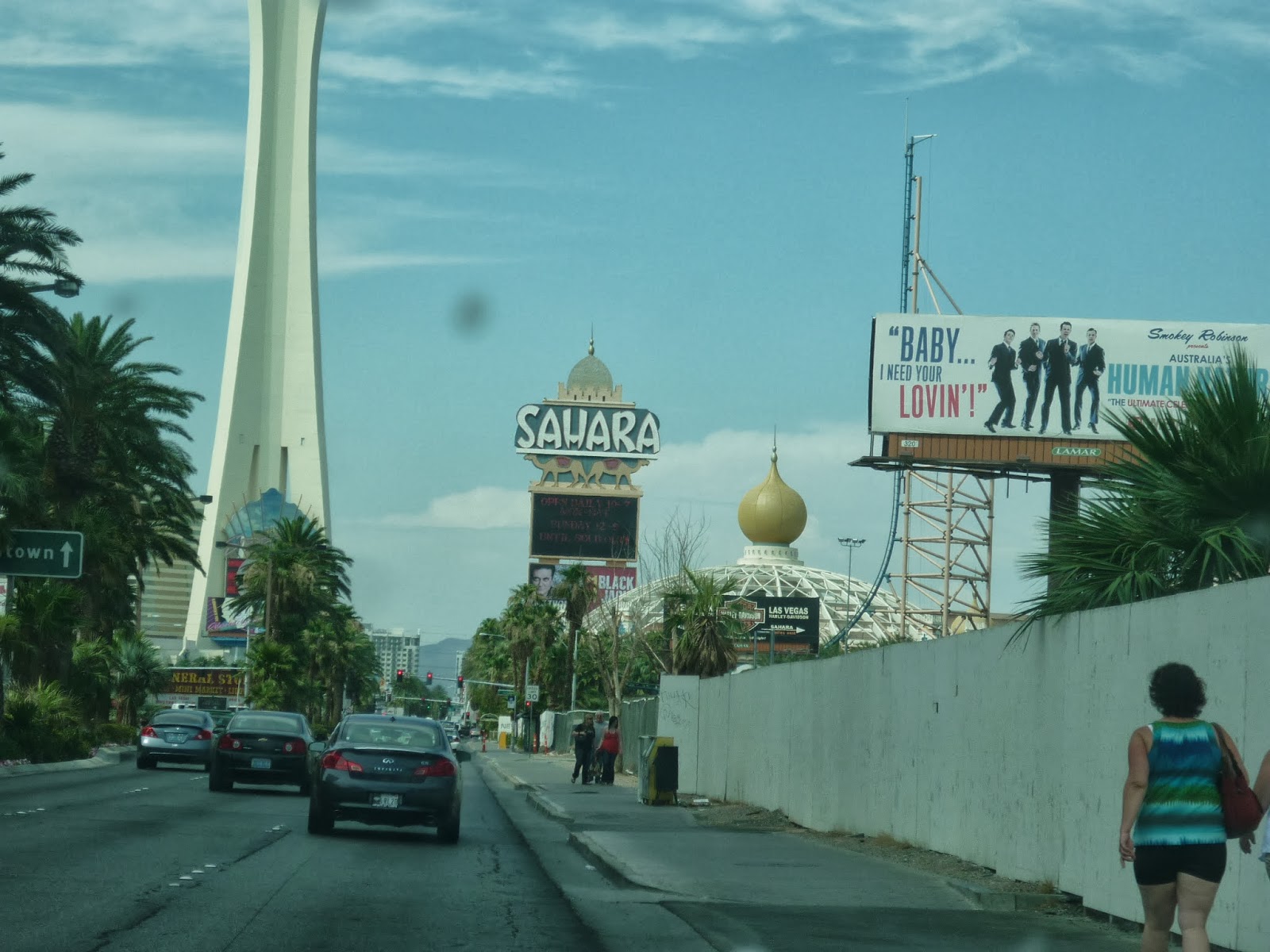

Of course, that is what this place is built on, memory directed to pleasant places and forgetful of reality, even in the recent past. Little has changed here in that regard; this is no longer the city built by mobsters to cater to greed and lust over an oasis in a bone dry desert which served as a stopping place for an army of religious settlers bent on creating a paradise out of it. This is now the city where whole families with kids in tow come to see a show, splash around in an exotic looking pool that they had to walk through a shark tank or past a habitat scene full of rare white tigers to get to. This is a place of dreams which mirrors the dreaming we do as a wider society.
Its fun, it can be sad, and its definitely much more than meets the eye. Las Vegas is definitely worth at least one trip, if only to see what it means to you and you mean in it.
Welcome back, readers! I did notice that the traffic never really stopped, but rest assured that things are moving again.
Subscribe to:
Posts (Atom)