Always to the frontier
Showing posts with label Central Appalachians. Show all posts

Monday, February 2, 2015

Where Is This?

Like yesterday's post noted, sometimes we have conceptions about places that unfortunately prevent us from exploring them and enjoying them.  Take California, for instance.  Most people see it as the beach, maybe some mountains and tall trees, maybe a little desert sprinkled in.  They see a superficial culture of surfers, media and film industry types, and aloof people in general.  In reality, the variable geography of California made for extremely diverse First Born cultures living in close proximity to each other, and the state features a colonial history (some good, some not so good) that stretches as far back as the 16th century.  This is all set against a backdrop of just about every sort of ecosystem one can imagine short of pure tropical, but also featuring the very rare one of Chaparral shrub land.  You can read a little about this natural California in one of my oldest posts, here:

http://americanvoyages.blogspot.com/2012/01/remnants-of-natural-california-canyons_10.html

Moving further east, I have found that some of the biggest misconceptions come from those who live in the larger cities and often groan when thinking of having to travel between them.  In particular, most east coasters seem to view everything beyond the Appalachian Mountains as being pretty much beyond the pale, with such people deriding said territory as the Midwest, a title that locals in the great unknown rush to embrace with equal fervor.  Such lands are unbearably flat (or maybe slightly rolling), covered in nothing but cornfields, and full of people more concerned with family values than with international affairs.  You know, some place like this:


Which is funny, because that was taken not ten miles slightly out of Appalachian valley and ridge country.  Yes, that is pure Pennsylvania right there, taken looking north off of the westbound lanes of PA 283 near Elizabethtown.  Pennsylvania is indeed pretty mountainous, but it also has its far share of rural farmland that could easily pass for something as different and distant as Ontario or Kentucky.  The colony itself, like the other North American European ventures, could not survive without resident farmers and ordinary settlers who came to simply live as much as many would come for various idealistic reasons. 

Here we go about 15 miles more down the road and find those mountains, and thus enter into more forested land and familiar scenes (never minding that Harrisburg is hidden behind the trees).

US 22 North; the ridge ahead slopes down towards the Susquehanna River.  This is in the north of Harrisburg.

Of course, even within those mountains one finds valley floors where rich, alluvial soils have long since been cultivated; the Haudenosaunee (Iroquois) had done so for centuries in Pennsylvania and upstate New York before European settlers found such places equally agreeable. 

Maryland 495 south, not even 10 miles south of Grantsville.

And sometimes, they cultivated up the more agreeable slopes, too.  I have to admit that I did not expect to see such a scene in extreme western Maryland, which is otherwise pretty vertical and sylvan as a default setting.  This could just as well pass for something in rural southern Michigan or Indiana, and judging from left over campaign signs I saw in the area, the locals probably vote for similar end goals.  Labels can be a tricky thing, though, as can misconceptions.  Why not take a trip down some seemingly boring back roads and be surprised now and then?  Just a few miles down the road was enough to turn that landscape into this:


That was taken on the same day, within a few minutes, and the sky was largely blue just like in the other picture.  It was almost surreal how majestic those blue and misty Allegheny Mountains looked...

Saturday, December 7, 2013

Residents Of The Piney South: The Virginia Pine

Head anywhere south of the Ohio River or the Mason-Dixon line and all of a sudden you will find more pines than you can shake a stick at.  The first such wonderful resident is the Virginia Pine (Pinus Virginiana), which looks something like a Jack Pine that moved south and got a bit of a fuller crown and straighter branching as a package deal.

Taken at Cumberland Gap National Historical Park, one of the most cultural significant, scenic, and underrated places to visit in the eastern United States.  Here we see an absolutely stunning specimen of our friend that I would have to rate as the finest Virginia Pine I have ever encountered to date.  Here we see the pine in her full glory, worthy of being counted among the most stately Jack Pines (as featured in the painting of the same name).  The tree also bears a silhouette not far from that of a mature Eastern White Pine (Pinus Strobus).

Needles borne in clusters of two, like the Jack Pine.

Irregular spreading crown, especially while young, also like the Jack Pine.
In the east, they like to wander only slightly far from their mountain homes and thus are found mostly in the backcountry, or Piedmont.  In fact, the Virginia Pine never seems to stray very far from the Appalchians in general, as seen in the following map of their current natural distribution:

Public Domain.  Thank you again USGS, and rest in peace, Dr. Ebert Little.


In Virginia, even right up north near Washington, they seemed to be filling a role comparable to what Eastern White Pines used to, individual trees scattered among deciduous forests, sticking up above the canopy (but in much less of a grand profile). 


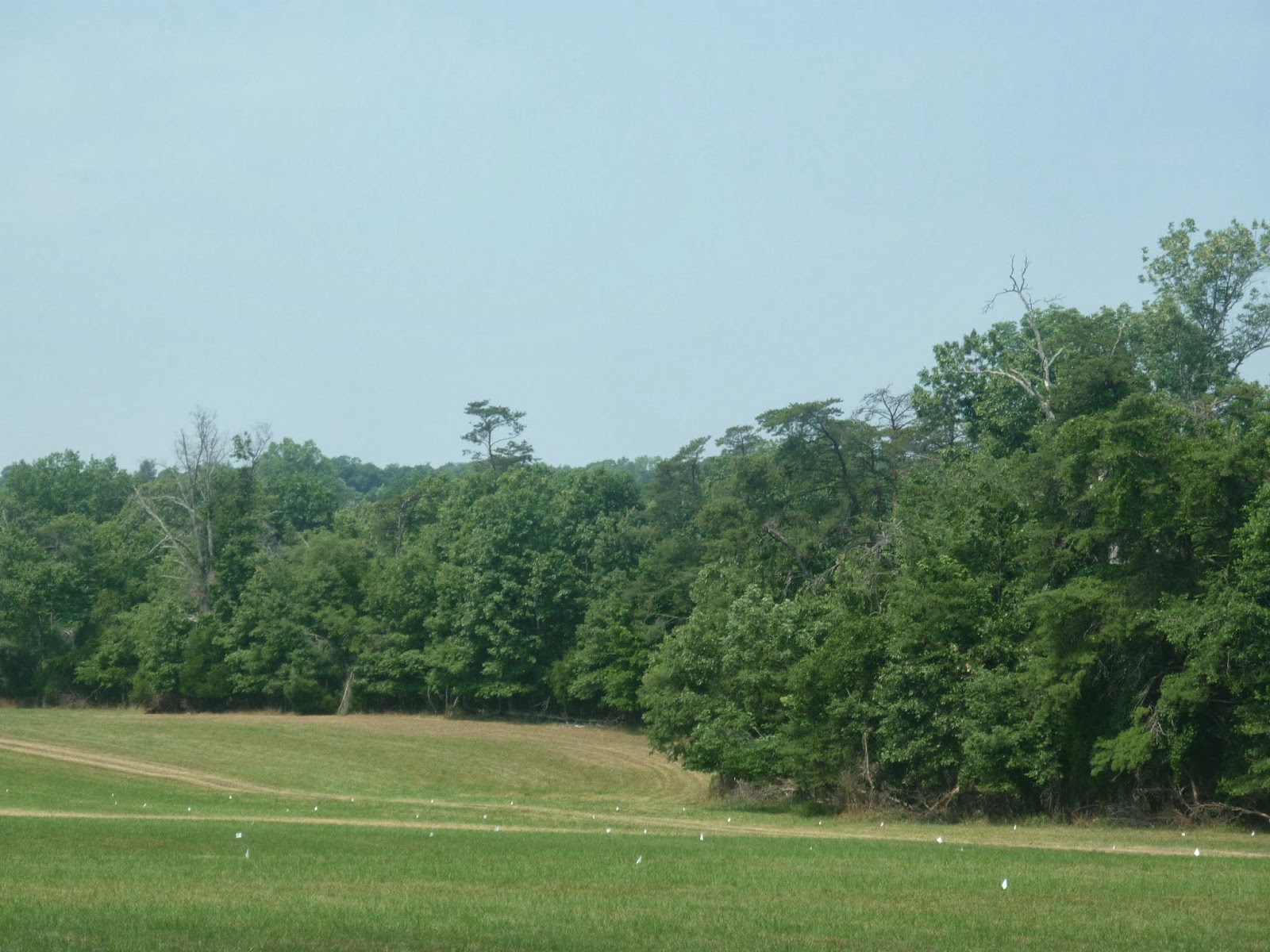
Not the best illustration of the concept, but it was the best I could do in 100 degree weather.  This was taken at Manassas National Battlefield Park, just outside of the Virginia side of the DC metro area.

Mind you, they do perform this role further on in their range, even if still only a junior partner to what the Eastern White Pines used to do in forming the supercanopy. 

Also from Cumberland Gap.  All such pictures were taken near the Pinnacle Overlook, which in addition to being a stunning vantage point to take in the Gap itself and the three surrounding states, is an excellent place for the casual explorer to have a taste of central and southern Appalachian flora.

Admittedly, I did not think too much of them for quite some time, a sentiment apparently shared by tree lovers of the past.  I do not recall seeing one at any botanic garden or historic home grounds anywhere one would expect to see them.  This is not overly shocking, as, again, they not present a robust profile as do the other native pines of the east.  Given a chance, however, they can form an elegant profile that makes for a lovely accent to the natural landscape and one that decidedly marks the passage between the Appalachians and the surrounding lands.

Same as above.
US 25 leaving Kentucky and approaching the modern tunnel under the Gap towards the junction of Virginia and Tennessee.
In the true Appalachians and plateau country to their west they are an entirely different animal, albeit again acting like the White Pines in certain situations.  Here they seem to favor rocky, well-drained soil and often grow as if emerging right out from the exposed rocks of the grand eastern mountains.  Much like the Pitch Pine (Pinus Rigida) barrens of further north along the Appalachians, or the Jack Pines growing under similar conditions on Georgian Bay, this is where we can find the Virginias often serving as the dominant tree, laughing at even the hardiest oaks and junipers. 

While not as open as the rocky haunts of the Jack or Pitch Pines, probably due to the greater precipitation available to them in their southward approach, the same effect is appreciable.  Both photos were taken at Pinnacle Overlook.


Such a phenomenon of the hardy pines can be found with relative ease by modern travelers: simply drive along any rock cut or past rock outcrops and even a thick stand of Virginia Pine might not be too far away. 

This blurry windshield shot was taken in a rather unwelcoming stretch of US 23 in Kentucky across the Ohio River from Portsmouth, Ohio.  While the valley had some lovely views, the area is lacking in safe pull out vantages.  Here they at least have a reason, as small bluffs press in close to the road.  

Further south along US 23 in Kentucky, somewhere between Louisa and Hagerhill.  Where there are rock cuts, there are Virginia Pines thriving in the rocky, thin soils that wash down onto them and collect in the crevasses.  And yes, another windshield photo, but broad shoulders are far and few between in this part of Kentucky.
But while they thrive in rocky, dry areas, they are perfectly at home in richer soils more befitting of a forest area. 

Taken near Martin, KY, on Kentucky 80.

Virginia Pines are often the first trees to make their way into abandoned fields.  While the Appalachians do have grassy areas, be they summit balds, small pockets of the easternmost extensions of the prairie, or (formerly) buffalo corridors, grasslands here tend to be but the first stage in landscape transformation rather than a permanent feature.  Most seedlings of the region are somewhat vulnerable to intense sunlight and exposure, leaving the hardier oaks and Virginia Pines the job of handling the scorching summer sun that reminds the human traveler and dweller that this is, even in the mountains, a land of heat and the edge of the South. 

But again, this is not the land of pine barrens, and the Virginia Pine does not get to be the star of the show as do the Jack or Pitch Pines.  Eventually, the pines get surpassed by the forest once trees start shading the ground and making conditions a bit more palatable to other species.  Unless they happened to form a dense enough stand in the harsher conditions or can be found where such conditions never go away (as in an outcrop), much like the mighty White Pines, the Virginia Pines find themselves thinned out and striving for the canopy:

It almost looks like a Pinus Strobus, really.
One of the many overlooks along the road to the Pinnacle Overlook.  The town seen beyond the pines is Middlesboro, Kentucky.

"Accent piece" or not, however, Virginia Pines are certainly a lovely and integral feature of the central and southern highland landscape.  They are very much a traveler's tree, being a pioneer that welcomes back the forest from even centuries of cultivation and welcomes the human wanderer into frontier lands beyond the greater regions of both North and South.  Want to see more?  Time to get really into the South!

Thursday, July 18, 2013

Rhododendrons: Flame Azalea (Rhododendron Calendulaceum)

This is the third in a series of posts in which we will take a look at some of our native North American Rhododendrons.  Rhododendrons (and their happy sub-genus, Azaleas) occur throughout the continent except on the Great Plains, the eastern interior plains (southern Michigan, western Ohio, Indiana, Illinois, etc.), and all of Mexico other than the mountains of northern Baja California.


"The perfect blossom is a rare thing. You could spend your life looking for one, and it would not be a wasted life."  -Katsumoto, from the Last Samurai.

Azaleas are a subgroup of the Rhododendron genus; they tend to be a bit smaller than their more robust looking cousins, and while they can put on quite the show in flowers, even in nice big bunches of flowers just like their bigger friends, they do not have flower clusters like the full Rhododendrons do.  They also tend to have a different general leaf shape than the familiar long and cold-curling Rhodies.  In North America, the Azaleas can be found everywhere from the usual mountain haunts to well into warmer, lower reaches near the coasts.  Unlike the Rhodies, most of which here tend to be evergreen, Azaleas in North America tend to be on the deciduous side.  We have 16 native species in North America, many of which can be found in the Appalachians.

One such species is the marvelous Flame Azalea (Rhododendron Calendulaceum), which has beautiful flowers that pull off some sort of heavenly combination of orange, red, and yellow.  Orange seems to be the most prevalent color in the wild population, but cultivators have managed to squeeze out brilliant selections from the neighboring colors of the rainbow to the degree that the Flames probably have as many garden children out there as most other Azaleas or Rhodies, even giving the Catawba descendants a run for their plant money.  While searching for wild type Flames at various nurseries, I have seen far more for sale than any other North American Rhododendrons or Azaleas.  And why not?  They are an incredibly beautiful flower that brings a real show of fiery color the garden.

All of these pictures of are of the same plant at milepost 361.2 on the Blue Ridge Parkway, the Glassmine Falls overlook.

Naturally, I just had to find one growing wild.  To be honest, I really had no idea they even existed until I was researching the genus two years ago, and ever since then I have been consumed with trying to find some wild Flames.  I knew I could easily find Catawbas and Rosebays, as their locations and bloom peaks are well documented, but for some reason the same has not been my experience of trying to find Flames.  So it was that when I took my recent botanical pilgrimage to the center of Rhodo heaven, well, even the majesty of Roan could not give pause to the hunt.  It turns out I was largely barking up the wrong tree.

The Flames are sort of in between the needs of the Catawbas and the Rosebays when it comes to elevation and exposure.  Like the Rosebays, they seem to thrive best under some amount of shade, yet they are also more than happy with a few hours of direct sunlight.  As such, they can be found on balds, especially the ultimate place to find them, Gregory Bald (which I did not find out about until I was leaving the Smokies), but they can also be found along slightly open areas in the forest understory.  I found a decent number along the Blue Ridge Parkway growing like this, mainly between Mt. Mitchell and Asheville, but like the Catawbas at Craggy Gardens, they were pretty much mostly done blooming by the third week of June at such altitudes higher than 4,000 feet but less than 5,500 feet.  In some places, they formed a decent patch of orange, but impatient motorists made stopping a pretty nasty prospect.  If you manage to hit the right flowering time for certain altitudes (they apparently can handle much lower elevations) it is likely that you will see a bunch more orange.  I was fortunate enough to find one growing half in the sun and half in the shade at the Glassmine Falls overlook.

For this reason I don't have many pictures of them, but the one I did find was a pretty nice specimen.


It was all alone, surrounded by a bunch of American Mountain Ash (Sorbus Americana), a pair of species that looked really nice and lush together.  As you can see, it (and the others I could not stop for) tends to be a bit more fragile looking than the Rhododendrons.  Flames are pretty delicate looking, but they still have nice globes of flowers (even if they only produce one flower per stem) and decent, somewhat glossy leaves.  I would still go so far as to call Flames such as this one a small tree rather than a shrub, because it was pushing twenty feet.  Among the Ash trees, it looked to be as much a part as the canopy as they did.  Elsewhere, especially among the maples and beech, they tended to function more like a second canopy just as the Rosebays do.  I hope to some day make it to Gregory or a similar bald to see them in their open habitat.

Just as Catawbas are a good sign, even an indicator, if you will, that one is close to if not decidedly in the Southern Appalachians, Flames for the southbound mountaineer are a mark that one has progressed at least as far south as the Central Appalachians.  They can be found infrequently in Ohio, and have been reported up in New York, although Pennsylvania claims they have been extirpated.  Like another showy plant that pops up in Ohio, the Crossvine (Bignonia Capreolata), the Flames look like they belong at the edge of the subtropical world.  I suspect that like the Rosebay, they might have once been a bit more common in the northern reaches, and probably got too much attention as a thing of beauty and thus been forcibly transformed into a hopeful garden dream, but their particular forest associations and preferences of habit leave me thinking they are not as northern in nature as their big leaf cousins. 

Wednesday, July 17, 2013

Rhododendrons: Rosebay Rhododendron (Rhododendron Maximum)

This is the second in a series of posts in which we will take a look at some of our native North American Rhododendrons.  Rhododendrons (and their happy sub-genus, Azaleas) occur throughout the continent except on the Great Plains, the eastern interior plains (southern Michigan, western Ohio, Indiana, Illinois, etc.), and all of Mexico other than the mountains of northern Baja California.

While I maintain that Catawba Rhododendrons are amazingly beautiful and something that every true plant lover should make a pilgrimage to see at least once, the Rosebays have a special place in my heart.  They grow all the way up to Quebec and Nova Scotia and might have once covered more territory in Ontario.  For a broadleaved evergreen, they laugh at the face of winter cold, more so than even the mountain-top hugging Catawbas, but they also have limitations.  Like the domestic cultivars of the genus popular in gardens, the Rosebay is not really fond of the hot sun of the afternoon.  They also don't tend to get a lot of attention from gardeners outside of their home region of the Appalachians, which is a shame because they can be every bit as impressive in flower and scale as their Catawba cultivar cousins.  Like the Catawba, they are properly considered a tree, having every bit the stature of one.

Great Smokey Mountains National Park, alongside the Newfound Gap Road along the Oconaluftee River in North Carolina.

That said, it tends to take on a bit more delicate of a branching structure than the mighty Catawbas.

The slender trunks of the Rosebay stand out in individual specimens.  This one was found at Cumberland Gap National Historic Park in Kentucky, along the Pinnacle Overlook road.

Like the Catawbas, it can and often does form pretty impressive forests in its own right.

Along the Oconaluftee River in North Carolina.
The difference here, however, is that they don't like the same degree of exposure that the bald species do.  This probably owes to the fact that they are a more intermediate elevation rhododendron, which in the southern portion means that summer brings much warmer temperatures, and anywhere in its range means comparatively less available moisture for the plants.  As a result, one will find Rosebays among the forests, where they can even form a secondary canopy in places that they tend to dominate.  In the southern Appalachians, especially in the Smokies and along the Blue Ridge, they really do dominate, perhaps even to the exclusion of other plant life on the forest floor, an invasive native if you will.  

Along the Blue Ridge Parkway, somewhere between Spruce Pine, NC and Mt. Mitchell.
Same as above.
Still, they do form a lovely understory, and fit in in a variety of surroundings, be they drier forests of oak and pine, where they are less common, and moister, northern forests of beech, maples, and hemlocks, where they can found at home both in the central and northern Appalachians and the Cove Forests of the southern Appalachians which duplicate these conditions in an otherwise much warmer setting.

A cove forest, but I don't recall where exactly.

They seem to perform the best, or at least occur almost without fail, along streams, especially in forests of Hemlock and associated trees.  Here they help to make for an incredible lushness in a darker green setting and reach proportions of size that put the Catawbas to shame.

Along the Oconaluftee River in North Carolina, in Great Smokey Mountains National Park.

Same place as above.  That Rosebay in the left background up there was half the size of some pretty decent trees, well over 30 feet tall.

And speaking of size, they are not called Rhododendron Maximum as a joke.  Their leaves are the biggest of any Rhododendron in the world.  They can usually be identified by these long, relatively narrow leaves even when not in flower.  Herein also lies their main attraction for this particular gardener: huge evergreen leaves that can take northern winters.

Same location as above.


And yes, they flower as well as a Catawba does, in the same big globe clusters, albeit sometimes not always at once, and not necessarily as prolifically.  They also take their time flowering, flowering as early in the southern ranges as March and continuing up into August pretty much everywhere.

These first two were taken off the same plant, again along the Oconaluftee River in North Carolina in that amazing National Park.


This one was found at Cumberland Gap National Historic Park in Kentucky, again along the Pinnacle Overlook road.

All in all, a nice, if not as dramatically special Rhododendron that the Catawba is.  They certainly are more common, and in some places it was hard to miss them.  I have yet to find some of their natural populations further north, where they do thin out a bit more in comparison to the thickets of the south, but they are pretty common as escapes from cultivation, and they can even get weedy in character as they like to take advantage of disturbed areas, something odd for a plant that likes being cool, moist, and shaded.  

A chance meeting near a highway widening project, where land looks to have been opened for some time, along Gap Creek Road near Elizabethton, Tennessee. 

This was the canopy above those Rosebays, which this far south means drier conditions than they would normally frequent.  Eastern White Pines (Pinus Strobus) are a true northern species, but down here they seem to also make a lower-middle elevation home among the dry and hot conditions favored by oaks.  I would figure sand would have something to do with it.
One can find tons and tons of them along I-80 in Pennsylvania, especially on the stretch between I-81 and I-476:

Many more where this came from.  Sorry for the blur.  This was in the thirties in February, and they did not really look overly concerned about the cold.

To return to the White Pine picture for some closing comments, I have to wonder about just how widespread these things used to be.  Current botanical thinking is that they are opportunists that have taken advantage of artificial changes brought by humans in modern forest settings, akin to how the Eastern Red Cedar (Juniperus Virginiana) is more prevalent than it once was.  While I don't argue with the evidence that backs up this line of thinking, because they really do tend to be opportunistic for a Rhododendron, the evidence also focuses on disturbed conditions, and in some decent growth forests they still do form an integral part of the scenery.

My thinking is, owing especially to their tolerances and favored conditions (I mean come on, they can handle cold just fine and they can pop out of rock hillside soil like its made of Miracle Gro), they were perhaps once a feature of forests in Ontario and decently into the Canadian Shield.  They do grow in upstate New York and Quebec, including parts of the Adirondacks and even Erie County, where urban development in Buffalo has probably removed a bunch of the wild population (I would looooove to find some if anyone knows of any wild ones there).  I could imagine that perhaps once, along with maybe Prickly Pear Cacti, grew happily in the sands of eastern Ontario below towering White Pines.  Sure, they might colonize disturbed areas bearing such conditions, but they are no stranger to somewhat dry pine lands, as this particular part of Connecticut demonstrates:

The Most Unusual Natural Area of Connecticut

Oh, and they are also movie stars, as far as plants go.  You can see a few flowering ones in the woods during the opening running scene in Last of the Mohicans!

Tomorrow we shall come across something a little different, an azalea!