Always to the frontier
Showing posts with label Grasslands. Show all posts

Monday, January 14, 2013

Yes, There are Trees in Kansas and Nebraska

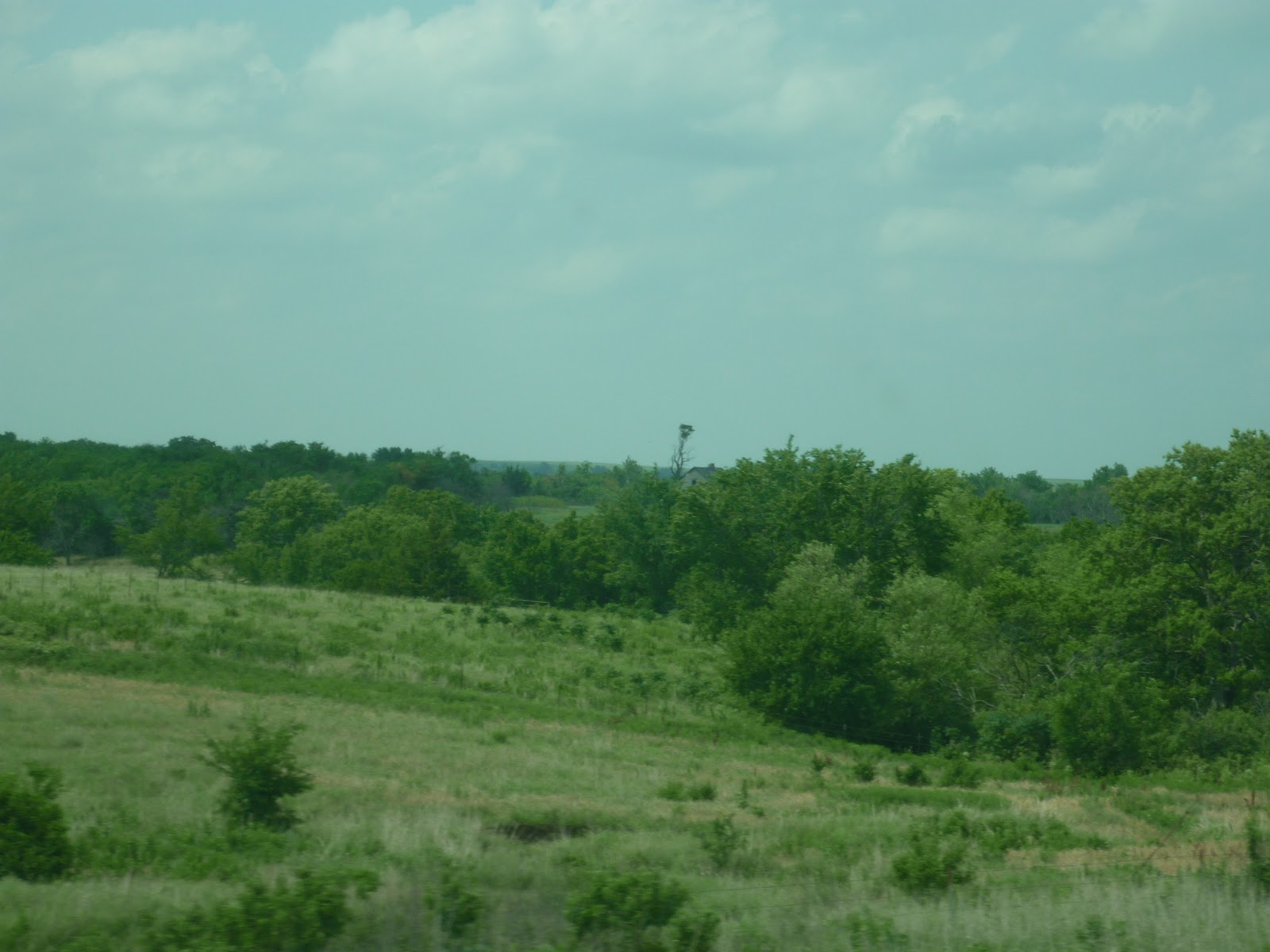
People sometimes ask how anyone can stomach driving across the plains through boring "fly-over" states such as Kansas or Nebraska.  They envision long, straight, flat stretches of land with nothing but corn extending into the horizon, perhaps at sometime replaced by open grass range.  While I could humorously make the claim that they are missing the forest for the trees and ignoring the majesty of the open grasslands and incredibly huge sky, such places are often better defended by stating that trees actually do exist in nearly all of non-tundra North America.  No, they might not be towering cathedral pillars as they can get to be in the northwestern or eastern forests, but they are hardly shrubs either.
 
This and below were taken at Tallgrass Prairie National Preserve near Council Grove, Kansas.

Each of the plains states and provinces, in fact, have arboreal symbols, some of which tend to surprise people.  Oklahoma's state tree is the Eastern Redbud (Cercis Canadensis), while chilly, open North Dakota's is the American Elm (Ulmus Americana), a tree of great size and commonly a beloved landscape plant throughout eastern North America.  Kansas and Nebraska offer the more common Eastern Cottonwood (Populus Deltoides) which can be found anywhere on the Great Plains that enough water has been provided for the plant to get its start.  Many historic routes and modern highways, in fact, are never far from the reassuring marching line of cottonwoods rising above the grasses and willows as signs of readily available water running along with them.


While the Trans-Canada highway, I-90, 70, and 40 make a clear shot across the grasslands, I-80 stays with the cottonwoods in much of Nebraska as it strikes west along the Platte River.  (See: "Green Is My Platte Valley").  Most towns spring up on the horizon with more trees than buildings in site, even on the high plains.  The truth is that there is enough groundwater and precipitation here that a planted tree can thrive quite well.  Nebraska, in fact, has quite national forests enough to green up the map as much as the eastern states can get painted over.  Grasses are the reason such trees can usually thrive in the first place, their roots being excellent retention agents for water and responsible for making the soil of the plains so workable to begin with.

While the trees do diminish naturally the farther west one goes, to the point of almost negligible forest cover in the rain-shadow of the Rockies, river courses and even slight sharp rises (such as bluffs) will feature some sort of tree cover.  In something of a parley of the trees, east and west invisibly meet in this great division point of North American botany.  Cottonwoods, willows, elms, and cedars follow river courses while they are seemingly watched by western pines and junipers atop river bluffs.

Friday, June 29, 2012

The Eastern Forests and Plant Succession

This was going to be another Q and A, but I ran into this question that deserved an extended response:

Q: It really is hard to imagine prairies existing so far east.  Are you sure that some of them are not just abandoned fields?  I mean I know you explained that we once got a lot of fires and such here, but we also have a lot of rain and water in general, and most land that I have seen go to seed again turns into a forest in a bit of time.  I think you just get excited when you find wildflowers.

A: More of a comment than a question.  Maybe both?  Cuomment?  Prairies and more so savannas existed well into areas that we imagine are only forests.  Central Mississippi and Alabama, both notable for being quite humid and rainy places, once had an extensive band of tallgrass prairie known as the Black Belt.  The pine flats stretching from Long Island to Miami were a mosaic of thicker forests merged with savannas, which southward also include wonderful shrubs in the underbrush like the Dwarf Palmetto (Sabal Minor):

Google Earth Streetview at above coordinates, or just south of Vero Beach, Florida, on I-95, east side, northbound.  

All of these areas were much more prone to regular rainfall than the interior plains, but what they shared in common, indeed, what makes grasslands possible is a combination of moisture, fire, soil, and sun exposure.   In earlier posts about how savannas and eastern grasslands work, I noted that the forest and grass were locked into a never-ending natural battle against one another that depended greatly on the specific combinations of the above ingredients.  In places a bit further off of the front lines, the ingredients would favor one over the other.  The suppression of natural fire regimes from the nineteenth century onward have skewed such patterns, but in other ways have showed us accelerated models of what a transition from a seemingly barren prairie into a lush forest can look like, often in a period of a few decades or even less.  While the above picture is somewhat natural and "ordinary", it is also somewhat indicative of what happens when the ingredients have been altered.  The shrubs are starting to take over far more than they otherwise would, and the forest is, well, turning into a forest rather than a savanna or "pine barrens".

Was the above stretch of land ever a thick forest?  It might have been, and it might be again, which is part of the wonderful process known as plant succession that defines the shifting mosaic of landscapes that is natural eastern North America.  Fortunately, there are ways to advance beyond conjecture to figure out what used to be "open" and what used to be "closed", ways which also do a lovely job illustrating what succession is all about.

First of all, we can check records from those who came before us.  When Europeans landed on these shores, they were often amazed at the world that stretched before them, leaving us journals and other accounts of what they found as they pressed into the interior.  While these days we get excited over things like skyscrapers and deluxe shopping malls, people then noticed things like big trees, rocks, and even landscapes that surprised them, like the "park like lands of pleasant Michigan".  We tend to think of our ancestors as hacking their way through a primeval forest that was untouched by the native folk, when the truth of the matter is that they often had a fascinating voyage of discovery and enjoyed the variation in the landscape.

Secondly, we can take a look at what is actually in patches of land like the above shot.  If this was once a "solid forest", there would be a lot of stumps in the palmettos, either from the passing of lumber men or a raging inferno, the latter of which would have taken out much more of the canopy and left us with a different forest from what we see, namely one with either fewer or no trees, or one far more arboreal, as in here:

Streetview, the special friend takes us to I-95 northbound again, this time just south of Jacksonville, Florida.

Where we do have more of a forest, we can also take notice of isolated elements in the canopy.  Where we do have either a really broad tree or one that stands out from the rest of a dominate stand of just a few species, this can indicate that at one point this area did have ground that was exposed.  Why is this?  Well, a canopy, while not exactly perfectly uniform, does more or less expand up and out at a rate that favors quicker growing species which tend to dominate everything else, such as maples.  Very rarely does an opening stay exposed long enough for a massive oak or pine to out-compete a bunch of sun-struck maples.  A really broad oak, for example, might be a sign that the area was once an oak savanna.

Taken in Island Lake State Recreation Area, Michigan.
A lone trooper like this Eastern Red Cedar (Juniperus Virginiana) almost certainly means that instead of growing so well in the shade of the canopy, the tree is a survivor of something far more exposed.


Taken at Brighton State Recreation Area, Michigan.  Yes, I know it looks like an Eastern Hemlock.
In fact, it would not be too out of place to suggest that the above scene may have once looked like this:

At an edge of Island Lake State Recreation Area, Michigan.  


Now I don't know the history of the site pictured well enough to claim it is an actual grassland, either emerging or remnant, but the soil is rather sandy (the hills around there, in fact, are stabilized dunes).  In any case, Eastern Red Cedar is an opportunist that can really only get started and prosper under sunny conditions, and often pioneers tree cover on abandoned fields.  Here it is a passing feature of changing landscape.  In more greatly open areas, such as parts of Oklahoma, it is native but actually considered a noxious weed!  I have seen some on oak savannas, which have always been a bit of a misnomer to me anyway.  Yes, oaks are resistant to fire and can handle the drier conditions offered by exposure, but so can these things, junipers, and pines.  


Regardless of what tree deserves the crown of the landscape, our isolated friends are but another way of showing us that nature is not as compartmentalized as we suspect her to be, but always in motion.  This is how we can get from this: 


Taken at Island Lake State Recreation Area, Michigan.  Prairie Remnant converging into Oak Savanna.


To this: 


Taken at Brighton State Recreation Area, Michigan.  Prairie Remnant with edges dominated by savanna converging into mature Oak-Hickory forest.


To this: 


Taken at Brighton State Recreation Area, Michigan.  A little bit of everything, but mostly becoming a mature Maple-Beech forest, a half mile from the above photo.

Basically, nature provides new conditions that the flora of the area then move in to take advantage of.  At first, sun-loving plants that can tolerate not only a bake but also some rather dry soil dominate the situation.  They can be maintained by fires even if they only occur once every few years to a decade, as competing shrubs and trees will be burned out.  Sometimes, however, the fires will not come around, animals such as deer will not graze on certain patches of ground during years of abundance, and the soil quality might have been good enough to allow some species to make a rebound quicker than others.  Given the chance, many areas of eastern North America will indeed progress from grassland to savanna to a dry forest to a more moist forest.  Again, it all depends on the ingredients available, how they are used, and how much they are used.  


Nature is not static.  Yes, we have prairies so far east of the drier rain shadow of the Rockies not because we share general climate conditions with the plains states, but because nature has provided opportunities for these ecosystems to flourish, but they are hardly always passing elements of the landscape.  This also means that not everything was a forest before we came by and plowed it all into farms and cities.  The forest, as much as the grassland, was dependent on conditions to make it possible in the first place.  Was there a lot of forest?  Yes.  Was there also enough open and park-like land to be noticeable?  Yes.  Very often we do have areas that have been forest for a very long time, often hundreds of years.  Sometimes we even get lucky enough to see a rather lovely marriage of the different worlds.

Taken at Brighton State Recreation Area, Michigan.  In the middle of a mature Oak-Hickory forest we have a shaft of sunlight penetrating to the forest floor and letting a Black-Eyed Susan (Rudbekia Hurta) grow amidst its much taller friends.

Friday, June 1, 2012

Q and A Session Four

This Q and A session is dedicated to the concept of not taking your backyard for granted.  I was lucky to get three questions that worked well this way.

Q: Why so many posts about prairies and savannas?

A: Grasslands are the most common ecosystem across the entire continent.  They can be found in nearly every state, province, and territory of our three nations, albeit in different forms.  In pre-colonial times, they were far more extensive than in the present day, engaging neighboring ecosystems in a battle royale of wildfires, rains, and herd grazing patterns.  Grasslands are extremely resilient and adaptable ecosystems that define the wild nature of our continent on the whole: a fairly warm, windy place that is full of water and yet also remarkably dry.  They can handle the worst weather we get, including extremes in temperature and precipitation, and manage to survive.  Conversely, they are among the most productive and diverse lands on the entire planet, positively exploding with life and beauty with just a little bit of rain and warmth.  They can be found at the edge of deserts, in meadows high atop mountains, far north in the tundra or far south in the leeward slopes of tropical Mexico, in sandy expanses left behind from the last glaciers melting away over the Canadian Shield, amidst the pines and palmettos of Florida, in patches of "barrens" surrounding the great cities of New York and Philadelphia, in clearings amongst great forests, and of course, in the great central plains that stretch from Alberta to Coahuila.

What's more, in addition to being emblematic of the frontier and survivalist spirit of this continent, they defy simplification, and are often the most misunderstood ecosystems out there.  North American grasslands are often thought of like so:


When in fact they are often wonderful worlds bursting with life like:


In short, they are often far more than meets the eye.  On the whole, nature has so many wonderful surprises awaiting for those willing to take the time and explore it.  Our hectic world these days is so caught up in activity for the sake of self-benefit that we often overlook the concept of self-improvement, and definitely leave wonder and exploration out of the equation.  Quite literally, we cannot see the forest for the trees!  Grasslands are wonderful places where we are forced to pay attention to what is underfoot and seemingly invisible to the glancing eye in order to fully appreciate what they have to show us.  This was certainly true for my development in observing and understand ecosystems.  After I gave the Great Plains a chance, I never looked at a forest the same way again.

Speaking of that, to respond to the question on a more personal level, I had always wondered where the forest stopped and the prairie began.  When I was a kid hungry for travel with that dog-eared and bent atlas in my hands, I always envisioned everything from Regina to Dallas to be one giant flat expanse of lawn.  I could not help but imagine what the line between this lawn and the forest to the east looked like, and I pictured a dark, lush forest somewhere in Missouri that all of a sudden petered out into the endless prairie, a wall of tree meeting a sea of grass.  The search for this grand line of division, though largely dispelled when I started to read about the places in that atlas, has always been a bit in the back of my mind even recently.  Whenever I head out west, when driving through Iowa and Missouri, I always take in the scenery with even more intensity and detailed interest than I do elsewhere ecological transitions, or ecotones, occur, expecting to find that line one day.  I wanted to know where the forest turned into the plains which gave way to the mountains which became the desert which... you get the point.  Ecotones are fascinating worlds of connections between diverse areas, both because of the contrast between life zones they display, and because of the shared features between regions they represent.  This dovetails into the next question:

Q: What are some places you have not yet been to in North America that you would put on your "bucket list"?

A: That would make for a very interesting post, and I say that because there are so many places I would want to see before I give myself back to the soil.  I suppose here I can cheat and qualify that question with a specific direction: what places would I put on my list of places I am most ecologically curious about?  I would say that have to do with transitions, and finding more of my great wall of forests.  Specifically, I would give my right eye to see (or rather have seen) where the boreal forest transitions into the central grasslands.  Picture an arc stretching from Edmonton to Winnipeg and down towards Minneapolis.  The biologist-powers that be call this "Aspen Parkland", where the great forests of spruce, fir, poplars, birches, and pines dance and meet with the prairies.  I have always wondered what an outcropping of Canadian Shield granite looks like emerging from tallgrass.  Yep, I have very simple desires and plans in life, a man who wants to find a rock sticking out of a field.  I imagine very little of this landscape survives intact in the United States, and the best bet would be to find it in Canada in some of the national parks set aside to preserve such a landscape, but the remaining ecotones in Minnesota hold a particular fascination for me because they share many species in common with the lands next door in Michigan and Ontario that I love so much.  Algonquin meets the prairie, I can only imagine it!

I would also love to see the Black Hills, as they are the easternmost extension of the great western mountain forests, one of the few places where elements of eastern, western, and northern forests come together, stuck in the middle of hundreds of miles of the Great Plains.  Again, I like putting the puzzle together as much as seeing the finished map.

On the same general note:

Q: You seem to be passionate about much of the country (I assume this is referring to the United States specifically), finding something nice about everywhere.  Is there any place you could not live?  I mean, could you actually live in a desert or on the plains?

A: Probably somewhere in the Deep South, and not out of a cultural bias that leaves me with a raised eyebrow and open mouth whenever I encounter "rednecks" (but when it comes down to it, I find all sorts of people to be far more interesting than undesirable).  The Deep South is exotically lovely, what with magnolias, live oaks (Quercus Virginiana) and balcypresses (Taxodium Distichum) dripping in Spanish Moss, and palmettos making the most of the steamy landscape.  All the same, it is, well, a steamy landscape.  I don't do heat and humidity in combination very well.  I would imagine parts of Mississippi would be my least desirable place to live, owing to the conditions and the fact that anything resembling a mountain would be at least a half day drive away.  Then again, the flora is lovely, the music is great, and the river and Gulf are never far away.  As for the desert and plains, as per my response to the first question, they are not as desolate and devoid of life as they seem to be.  They also both tend to be close to mountains, so if I wanted to, I could easily get my fill of some pine forest for a bit.  I like both snow and palm trees, so the desert or the southern plains could work nicely, sure.  St. George, Utah comes to mind, as they have both.

Well, actually, this is Washington, Utah, but that is right next door.


It also helps to have friends there.  The western migration trend never really has stopped, it seems.  Anyway, I would probably be most at home in northern Ontario or western Quebec, which would be outside of the United States, but you get the picture.  That would be the heart part of my "home is where the heart is" even if I could adapt to any place fairly well.  Even if circumstances forced me to live in Jackson, Mississippi, I would hardly consider my life shot to hell, but would get a really powerful air conditioner as soon as possible, or at least a nice ceiling fan.  I would explore every nook and cranny of my new home and get to know its flowers, trees, history, and way of naming soft drinks rather well.  The Creator left us a nice world to live in, and the least I can do is come to know and appreciate it.

Thursday, April 26, 2012

The Eastern Prairies

When a cross section of North America is pictured, starting at one ocean and travelling the breadth of the land to another, common imagination usually orders ecosystems into nice compartments of "what belongs here".  Starting, say, in Virginia along the Atlantic coast, we have southern forests of cypress trees and pines, moving into mixed-forests and maybe spruces and pines up on the higher parts of the Appalachians.  These forests continue, almost uninterrupted and dense until they part beyond the Mississippi river and open into vast grasslands, which in turn give way to mountains, deserts, and finally the verdant Pacific shores.  The truth of the matter is, this is a very inaccurate portrait.  Prairies once existed in parts of interior Virginia and western New York, forests once followed the rivers that drained the plains, and the pre-settlement map probably looked more like a mosaic than a well-ordered set of parallel vegetation zones.

Vast grasslands that once covered many parts of interior North America often existed in isolated patches between "solid forest".  They did so for different reasons, most often because the soil was not otherwise suited to certain types of forest, and because fires, both natural and set by native peoples, would clear out saplings often enough to let the grasses maintain a hold on the landscape.  The frontier between forest and grassland was constantly shifting, as two different worlds were locked in competition for dominance.  Most often, the interface between forest and grassland was convoluted and the two habitats engaged in a dance wherein a little grass and a little bit of tree could be found well within each other.  Dependable rains would usually keep things from being too bone dry to spark regular fires the further east one would go, but in the lands surrounding the eastern Great Lakes, a ton of glacial sand deposits meant that some otherwise moist lands would provide for the drier conditions to support grasslands, or partial grasslands.  Moderately high rainfall would still provide for certain trees that could take well-drained conditions to remain among the tallgrass, notably oaks, junipers, and pines.  "Eastern prairies" would thus be better termed savannas.

Much of these grasslands have gone, however.  The Nearwest has been under steady development and cultivation since the end of the War of 1812, and even where the land has not been completely harnessed, land management and fire suppression has turned most "wild" land into some pretty dense woodland.  Fortunately, western Lake Erie has several notable examples of remaining savannas, especially in the areas around Toledo and Windsor.  I intend to document these here, preserve by preserve.  In the meantime, below are three fine examples of what an oak savanna looks like.  As you can see, the trees are still as tall as one would expect them to be in the well-watered east, and while the tallgrass is impressive, this is hardly what one would call the open range.  Still, it is a lovely and unique ecosystem, and a place of significant ecological diversity.


These particular images were captured at the Kitty Todd Nature Preserve just outside of Toledo.  The preserve is often mistaken for an abandoned field, which is understandable, as most of the surrounding land does have active farms on it, rather than contrasting forests which once would have made this sort of grassland stand out.

Sunday, March 18, 2012

Sunday Afternoon Post: Pine Barrens and Cacti

Most people are surprised to find out that grasslands and savannas exist well into places like New Jersey and Ontario.  In northern areas, such as this picture taken near Manistique, Michigan, savannas are usually referred to as "pine barrens".

The famous pine barrens of Long Island and New Jersey also fit the description of a pine savanna, and are some of the last remaining non-governmental undeveloped land in the eastern United States.  In Michigan and Ontario, pine barrens can be found wherever the soil is sandy and relatively low in relief.  The eastern upper peninsula happens to have many scattered pockets of such land, especially on the margins of some of the coastal sand flats (but not dunes, which are a different ecosystem altogether).  In Ontario, scattered pine barrens can be found along the lower drainage of the Petawawa River, a vast outwash plain that served as one of the last primordial glacial melting rivers.

I plan to bushwhack the area quite a bit in the coming year or so, as I plan to write my dissertation on the development and existence of Opuntia Fragilis in northern Ontario, Quebec, and the Ottawa valley.  Fragilis is a prickly pear cactus, and supposedly one of the most cold hardy in the world, having migrated north and east on the heels of glaciers from refugiae during the last glaciation.  I have a suspicion that it might be more widespread in our local barrens than has thus far been documented.  For those wondering, Michigan and Ontario have two species of native cactus, Fragilis and Opuntia Humifusa.


The Humifusa seen above is wrinkled and recovering from its winter dormancy.  This was taken at Kitty Todd Nature Preserve, part of the Oak Openings Region of the Toledo, Ohio area, though Oak savannas and Humifusa can be found scattered in remnants throughout southern Michigan and southern Ontario, as far north as Saginaw and Peterborough, where they transition out and are replaced by the pines.  Yet again, here we see the delightful mosaic and interconnected ecosystems that make up our continent, a world where pines, grasslands, and cacti meet in a marriage of seemingly distant partners.

Monday, November 21, 2011

The Great American Desert

Last post we ventured into the Midwest and your author made shocking claims as to what it should actually consist of.  Daring arguments were made as to what could consist of cultural and ecological boundaries of the region, arguments that left out portions of states that are normally considered parts of the Midwestern area.  In the same post, the Midwest was largely described as a region of certain values and open lands.  The historical record given related that many settled in those lands, but some thirsted for something more, for truly open country, and headed further and further west.

Imagine, if you will, a family or two heading past the tallgrass prairies and scattered woodlands into the sunset.  Imagine them cutting through some trees and shrubs somewhere in Kansas or Nebraska, expecting to find yet another open space with a line of trees in the distance.  Instead, they find this:

They had heard stories before, of course.  Government surveyors, French beaver hunters, even caravan merchants headed for the Mexican markets in Santa Fe had come and gone through the cities of St. Louis and Chicago for decades, telling tales of a vast, empty dry land that opened up beyond the sunset.  They heard stories about many things.  Now the reality of the stark open lands was set before them.  But almost immediately, as a traveler from these days will find, they would discover that the Great plains would end up being far more than just a thousand miles of flat barren sands.


They would find rolling hills.


They would find incredibly rich soils, plentiful rains, and hundreds of species of wildflowers which blanketed the ground.


They would even find places where the eastern forests would refuse to give in to lighter rains and frequent, sweeping fires.  They would find large open expanses where there was more sky than planet, where the wind would constantly howl, where the horizon would go on forever.

They would choose to stay in the "Great American Desert" while others would turn back to the eastern lands  and still others would follow the wagon ruts and rivers west to the lands of promise in Oregon and California.  For a brief time, things were peaceful.  Americans, both immigrants and those born in the lands further east, would herd animals, plow and plant what they could, and hunt the Buffalo that teemed throughout the rolling lands of grass.  They would live in peace with their neighbors, the Osage and Pawnee. They would build homes dug into the ground and roofed with turf (there were trees, but there were few of them and they were not of construction quality or size).  In Canada, they would move out onto these lands and even marry some of the Cree and Assiniboine people there.

Then in the lands of the south, men from further east would insist on ownership of the land.  They would run metal rails across it, they would kill all the Buffalo (sometimes for fun), they would let their herds eat through the grass so fast and often that it would not regrow, and they would find shiny metals in the ground that would cause human stampedes.  The Osage and Pawnee would die from diseases, and the Lakota, Cheyenne, Arapaho, Comanche, Kiowa, and Crow would point fingers at the newcomers and one another. Much blood would be spilled.  In Canada, the descendants of the First Nations who married the French settlers and company men of the Hudson Bay company would perhaps see what had happened to their south and would rise up against the easterners before they could do the same to them.  Their leader would die for their struggle; their voice would echo far into the future.

The winds would carry these voices of the north and the south.  They would be so loud that no one would forget what had happened on these open expanses of grass.  Perhaps they have been heard, for few people would ever live in these lands again.  In many ways, the plains remain as they started.  They are still very much a land of frontier.  The buffalo are largely gone, Indians are a memory and the object of memorial battlefields rather than a presence, and barbed wire fences in different range lands.

Yet the grass still blows beneath a broad sky.

The land seems to go on forever.

The plains seem to retain a quality of the great unknown that they had two hundred years ago.  Many people dismiss them as something to quickly pass through, a stretch of land between the friendly trees and farms of the east and the grand vistas of the mountain west.  People insist they died of boredom!  Others call Oklahoma through Alberta the "fly-over" lands.

Then some people, like me, know they have truly made it to the west once they see those last trees grow shorter and shorter and cling to riverbanks.  Not that the trees out there are unimpressive, mind you.  Plains Cottonwoods and Green Ash can be quite the welcome site along rivers like the Platte and Canadian.

Yes indeed, such trees can be a welcome sight if the prairie becomes too monotonous.  Then again, very few of the crossings are.  Sure, I-70 has about 200 miles of pretty bland terrain in western Kansas, but most of the other routes follow river valleys, pass by volcanoes, and roll up and down with sweeping terrain.


And yes, in some places, you can stand literally in the middle of nowhere and see nothing but miles and miles of miles and miles.  Even then, though, you notice the small things.  The grass gets shorter.  The air gets drier.  You start seeing sagebrush everywhere, and tumbleweed blows across the road.  Shrubs get replaced by cacti.


And then, just when you thought you were going to reach the end of the world, where the ground dries up and you think for sure that nothing can be past that next hill but more endless plains...


You see this.

This then, is the point where you know you have not been going into endless wastelands, but you have been swallowed already by the immensity of the North American West.

This is why I did not include much of the plains in the Midwest, because they are truly part of the west.  The air is dry, the horizons are grand, and even the towns have more to do with silence and the war against a hectic pace of life then they do with being towns.  They stick up from the plains like small oases, little islands of trees, often with a church steeple in the middle, and broad dusty streets that still have tumbleweed flying across them in high winds.

Are you expecting a saloon fight to break out?  I sure was.  That is, until I realized that here are people who could care less about a good fight.  Or government.  Or how prosperous the downtown boutiques are.   Here, the most prominent features of town are the local eating/drinking establishment with the most cars outside (which depends on what is on the menu a given night) and the roundabout in the middle of town where sits the modest county hall and a statue to either a famous explorer or famous Indian.  You might see a statue of Truman in Independence or some army colonel in any given town in Illinois, but here you are more likely to find one of Black Kettle or Pierre DeSmet.  This is a land of farming immigrants, native peoples in love with the sheer immensity of the land rather than what can be grown from it, the descendants of French explorers and fur traders, Mexican and Texan ranchers, and homesteaders, even freed men looking for a new future.  This is where the western lands begin.