Always to the frontier
Showing posts with label Florida. Show all posts

Friday, January 9, 2015

Real Maple Syrup: Part One

While I was out today, dearest mother, who is thoroughly Canadian to the core, insisted that she simply could not live without maple syrup.  I agree, to a point.  I personally cannot do without a supply of good maple syrup.  Naturally, I looked at what was available, and naturally, it was from northern New England.  This is not to be unexpected, as maple syrup has been an ongoing concern among the Green Mountain folk for some time, ever since the earliest settlers to New England noticed the first born making it through the winter a bit better because of it.  That said, the first born a bit further north taught some other trans-Atlantic arrivals a thing or two about the miracle sap of the maple tree.  The French arrived on the scene even earlier than the first residents of second born Massachusetts, and believe me, Canada is far more savage in the winter time than anything coastal New England has to offer.  In the words of Samuel de Champlain, "there are six months of winter here". 

Therein lies a key truth about maple sugar production.  The whole journey begins with the sap of the tree being liberated from its arboreal prison, a process which happens only when the holy elixir flows.  For this to happen, the tree must become aware that its dormant period of winter rest is coming to an end, and starch stored in the roots then rises in order to get the tree back up and running.  The next part is the real trick, namely that things need to get cold again at night so the whole process is not rushed by the tree.  A slight increase in temperature over freezing during the day is enough to make the tree run more of that delightful root energy back higher into the crown.  Obviously, to get any sort of sap at all, the maple tapper is best off being in an area where such conditions are likely to happen on a regular basis.  Theoretically, any maple that will produce sap that can make for decent tasting sugar can be used, as long as the tree enters and exits dormancy; maple syrup has been made with some success down into the higher elevations of Georgia.  Funks from central Illinois near Bloomington has been producing "sirup" since the 1840's.  In a moment of sheer snobbery, I regret to say that I declined to make a visit while en route to Springfield.  To be fair, I was shocked to see any sort of a sugar bush in the heart of the eastern tallgrass prairie in hot, humid, flat Illinois.  I have since had the opportunity to try some of their creation, and it is pretty decent, considering the unfair conditions they have to deal with in terms of what may jokingly be called a spring thaw. 

Look at that, see, I'm already ranting. 

Anyway, as with so many other agricultural things, syrup can, and indeed does, vary based on a number of conditions.  While few would argue that differences between syrups are as noticeable and pronounced as those between wines, the truth is that an Illinois sirup made from a Black Maple (Acer Nigrum) will be noticeably different from a New Brunswick syrup made from Red Maple (Acer Rubrum).  Some people, such as your author, can also tell the difference between a Sugar Maple (Acer Saccharum) syrup produced in Lapeer, Michigan and the same produced in Mason, Michigan, places with relatively similar climates and even soil conditions.  Maybe I'm picky and imagining things, but one imagines that trees with such huge ranges and such varying growing conditions would be not without variations in sap taste, let alone general botanical characteristics.  Mr. and Mrs. Red Maple, after all, can be found everywhere from tropical Southern Florida to windswept and rainy Newfoundland:

Thanks, USGS!


Next post, we shall explore the wonderful world of things maple in terms of climate, weather, and all that stuff that happens up in the sky.  (And yes, Vermont syrup is fine, and yes, I will tell you all about how wonderful if inferior it is, etc.  And no, Everglades syrup is not a real thing).

Friday, April 4, 2014

Expanding The Horizon

American Voyages is dedicated to the exploration of North America, which I have thus far defined as being anything a part of our continental plate and landmass, as well as attachments such as the parts of California not on our plate.  Under this definition, I also include Cuba and the Bahamas, which have at least enough common features in fauna, flora, and history to be considered North American.  Where do I draw the line elsewhere, however?  Do I exclude Guatemala and Belize simply because they have more in common with the rest of Central America than they do with Mexico?  Do I refuse to talk about any of the Caribbean, especially when it does have a significant link to our continent?  In general, I started up this blog to show people what they have in their backyard (and as a secondary goal, to dispel myths about Mexico), and the thought of getting just a bit more tropical than what Oaxaca or southern Florida has to offer starts to look more like promoting knowledge about what people have in mind for their next vacation.

Ah, but there are people who live and have lived on the many islands beyond the reach of Floridian or Yucatan beaches.  The history of the three major North American nations is very much connected to what was going on in the Caribbean.  Many of the colonials there set up domestic, semi-representative governments just like the colonials in the North American mainland did.  Alexander Hamilton, along with a great many other British colonists living in the "West Indies", either lived in the Thirteen Colonies/United States or had involvement in trade between the various colonies and Britain.  Much of this trade involved the movement of rum, sugar, spices, and the "commodity" needed to make it all possible, slaves.  In this regard some of those distant islands were not too distant in culture and climate from some of the American South.  Barbados, for one, is very keen on reminding people that much of their population was once in the supplicant position in this culture. 

Many American ports would also bear a bit of a visible connection with distant islands.  New Orleans and Charleston have in many ways seemed more connected with the life of the tropical mariner and chic associations with motherlands back in Europe.  Florida, of course, had for the longest time been the meeting place of the Spanish Caribbean with mainland North America, and still largely is, particularly in Miami.  In return, Cuba has always seemed like another world from the rest of the Caribbean, even after American cultural connections were shut down once Castro took power.  From another angle, Cuba and Mexico have often expressed love and affinity with one another, as if sitting at another table focused on one another and no one else in some grand Latin American ballroom.  The Caymans Bahamas, and Turks and Caicos these days find themselves being sent similar love letters from fellow Commonwealth member Canada; the banks and financial concerns on the islands certainly reflect this budding, if unconsummated relationship.  The story gets more fascinating further south.  So why not shake off the last of the winter blues and visit some of those lands across the Straits of Florida?  Our first destination will be St. Thomas of the U.S. Virgin Islands.

Wednesday, January 22, 2014

The First Underground Railroad

I know I have been on a kick about the Carolinas, Georgia, and Northern Florida lately, but the truth is that this region was an incredibly diverse and storied region until it fought for the wrong side of history during the Civil War.  Yes, here there was the hearth of the house of Southern elite slaveholders and their belles, but there were also the non-slave holding Second Born Georgians, First Born, Spanish, French (of both Hugenot and Royal varieties), long forgotten Austrians, and of course Black people which would soon, through economic reasons, come to outnumber all of these groups.  Needless to say, I also have long loved the majestic world of palm and pine which thrives here in an otherwise humid, bug-infested wild country.  When I recently began to read more about both the birth of slavery and its opposition among abolitionists and freedom-seekers here, I just had to share what a powerful crossroads in history this truly difficult land had become.

No one can argue against the fact that the Spanish colonizers were brutal and racist in their treatment of the First Born, and that they enjoyed watching their conquered subjects tend the fields for them.  That said, it was the English colonizers who were real pros at commercial exploitation of the new land and exotic peoples from just about anywhere on the planet.  The Spanish, you see, were plunderers less than merchants (they kicked out a good portion of their merchant class when they told every Jew in Spain to head out of town in 1492), and they were also enthralled by the concept of converting the planet to Roman Catholicism.  In contrast, the English also plundered, but on a smaller scale (except maybe in India), so as to better gradually set up favorable economic conditions for their cult of free-enterprise.  Oh sure, they had religion too, many Protestant varieties of it in fact, but their concept of spreading the faith was pretty much centered on trying to get freedom for themselves to contemplate and pray as they so wished, which they had to cross an ocean for in the face of Anglican and then Calvinistic and then lip-service Anglican successions of power.  They rejoiced when the First Born converted, but otherwise just regarded them as pagans who could either be helpful to setting up commercial security or harmful in trying to dismantle colonial progress.  The French were another story altogether, and that one takes a while to explain...

Anyway, the Spanish would not hesitate to bring over Africans for use as slaves, but seeing as how plantations of cash crops were but one of many different agendas behind the otherwise important gold-plundering and conversion game, race slavery never developed to the same degree that it did in the English colonies.  Again, this is not to say that it did not happen; many Black communities can be found in Cuba and the Dominican Republic, and a few traces of where African slavery did make inroads into Mexico can be found in Veracruz and Guerrero, the two important states of colonial landing of the Mexican coast.  The ban on a Spanish-run slave trade made importation of Africans difficult, if nothing else.  When they wanted slaves, the Spanish could run to the English or Dutch for their needs, which further compounded the general aloofness from the enslavement of Africans.  What's more, racial hatred did not develop in nearly the same way throughout New Spain than it did it the English colonies.  As I state in my post about the most important event in North American history, while the Spanish came as conquerors and extractors, they also often fell in love with the land and the people of the New World.  Mexicans to this day are largely Mestizos of heritage reaching back to both sides of the Atlantic.   Yes, you can find hatred towards the First Born in the Spanish-descended elite of El Salvador or Argentina, but by and large the rest of modern Latin America is a culture resulting from pure exchange rather than separation. 

So it was that when a few runaway slaves heading south from the Carolinas made their way into Florida, they were not immediately chained up and re-enslaved in their new home of Florida.  Rather, they were not only welcomed, but encouraged to keep coming.  Those who chose a more colonial existence in St. Augustine would be required to convert to Catholicism, but often times the Black refugees found a happy existence with the First Born of the area.  Further north, they often helped the refugees through to their freedom, which as usual was a very difficult and terror-filled trip to safety, but down here in the still-largely natural hot and humid subtropical lushness, they had the advantage of not being readily followed by the prone-to-malaria and easily sweat-able northern Europeans.  The Spanish authorities figured that they would be so grateful to make their way into waiting freedom and safety that they would rise up in arms with them, Black beside colonist, against English advances from Georgia.  They were not wrong. 

Some stayed in town, some even enlisted in the Spanish forces.  Others left to form new societies of their own in the wilds, and sometimes they came across the First Born and formed a new culture of this encounter.

Public domain.
You can read more and see some pictures here.  Actually, that website can tell you quite a lot about some of the Black experience I never knew existed.

Saturday, January 4, 2014

Palms In The Carolina Landscape: An Historical Overview

When I recall traveling down to Fort Lauderdale back in the late 80's and early 90's for our annual winter romp from frigid Canada to tropical Southern Florida, I recall that I found narry a palm tree until one hit the Georgia-Florida border on I-95.  As if announcing that this was a truly unique land of eternal summers and palm trees even so far north near the rest of the country, palms suddenly exploded from the median.  Oh sure, Georgia nearby had a decent ground-cover of Saw Palmettos (Serenoa Repens) that emerged from the dense pinery around about Brunswick or so, but they had nothing on the veritable carpet of them that showed once one found high and dry ground past the St. Marys River.  One notable exception stood out, that being the Jelly Palm (Butia Capitata) which grew by two as a lovely frame to the entrance of a Fieldcrest towel outlet in Smithfield, North Carolina.  This was very, very much to the north of Florida, especially to the eyes of a child who liked to exaggerate distances.

This might, in fact, have been the occasion in which I started reading about trees, way back in either the second or third grade.  I was fortunate to have a mother who was wise to the concept of providing her offspring with as much book book book as possible, and no sooner did I turn to the palm pages in lovingly acquired Florida's Fabulous Trees than I found our friend the Jelly Palm, an import from exotic subtropical southern South America.  The block of text accompanying the delightful picture of the frosty-green fronds stated that the noble plant could be found as far north as Washington, D.C.  If this were so, and people liked palm trees so much, I wondered why I only ever saw the pair outside of towel land, and none more until far into the deepest reaches of Georgia.  Believe me, I looked!

Then this last year, when I made my way to a steamy South Carolina, I found palm after palm pop up starting with some lovely Jelly Palms planted beside a pool at a Days Inn off of I-26 exit 154 near Orangeburg, South Carolina.  Why yes, I do take botanical observation locations seriously!  Anyway, anywhere downstream from that location was awash in palms as part of the landscaping.  It seems that the last two decades have seen a flurry of palm planting as people are discovering the hardier species can take a few cold nights on an otherwise humid subtropical landscape.  Humorously enough, to the equal delight and chagrin of my traveling partner, I was worried that I had to stab very far south to see palms, either wild or cultivated, as common enough features in the landscape.  The truth was that they are EVERYWHERE in lowland South Carolina.  Again, I really do not recall this being the case back in my younger days, and believe me, I was every bit as botanically precise and insane back then as I am today.  This led me to question a few things, namely just how prevalent the mighty Cabbage Palm (Sabal Palmetto) was in older times.  Well, to start off with, the flag of South Carolina prominently features the lovely tree:

Thanks, Open Clipart!

This flag does not date back to Colonial times, but it does feature elements of one that does.  The blue field and crescent moon date from William Moultrie's original South Carolina military flag of 1775, a flag which flew over his fort to save Charleston from capture by the British.  Despite being in command of a tactically inferior force, Moultrie successfully defended the city from initial British assault.  He found that Cabbage Palm trunks are perhaps the most amusing and surprising military grade wood material known to exist on the planet.  Cannon fire from the British ships apparently bounced right off of the palm walls of his fortress, which is fairly believable considering as how the King's navy was unable to simply plow over the weaker Carolinian forces.  In 1861, when South Carolinians were getting ready to oust what they saw as Union invaders, the modern flag seen here was raised.  The Cabbage Palm, mighty defender of Charleston, was seen as a natural symbol of defiance against out-of-state invasion, and the newly-minted Confederate defenders of Fort Sumter declared themselves the heirs of the Colonial Carolinian defenders.

Like many state flags of the South, South Carolina held on to hers once Grant reminded them that their viewpoint was inappropriate, and in some cases, these flags are a sad reminder of the racism that belies a supposed continuing crusade for subsidiarity.  Don't get me wrong, I get the point of state's rights and all, I am a Canadian and therefore hold as sacred the intense power placed into the hands of individual provinces at the expense of anything not Ontari... er... you know what I mean.  Anyway, that is a post, indeed a blog and a lifetime of political and social upheaval unto itself.  Back to the point, this is one of those Southern Flags that can stand for something above and beyond what the flag makers intended, namely because it is cool enough to have an actual tree for a central figure.  Likewise, the intent of heroic defense symbolized in said tree has its greatest meaning invested in an older and far more morally-righteous rebellion.  In the north, they crowned an American Elm (Ulmus Americana) as Liberty Trees. and the economic symbol of American independence, used even on one of the first flags of the continental army, was the Eastern White Pine (Pinus Strobus).  Down here, in warm, lush South Carolina was the Cabbage Palm.  That's right, this country had trees for symbol before it had flag-dressed women or men, eagles, chopped-up snakes, or any other sort of symbol.

So if I don't remember seeing so many of them before the cold-hardy palm craze caught on, just how widely planted were they as a landscape feature for our Second-Born ancestors?  Did they tend to leave the small space trees alone when clearing their fields of otherwise broad pines and oaks?  Did they line their streets with them?  Art from the period does not really seem to show the city as being particularly gardened, at least not nearly to the extent that it is now.  Considering the relative sophistication and connections with Britain that the city did maintain in the Georgian era, one wonders why this would be the case.  Botany was extremely popular among the planters and merchants alike, and both got rich off of a thriving plant trade.  Perhaps palms did not get much press as most gardeners did not see them as being particularly hardy or useful in the place where most of the commerce was directed, rainy and cool England (unlike today where they have gained a bit of popularity).  The palms that did start catching on in Europe in Georgian times were mostly Old World palms, notably the dates and in particular the Canary Island Date Palm (Phoenix Canariensis), which saw container planting use at Versailles.  I can't say I blame them, the thing is pretty freaking cool looking, and can even be trimmed into, well, a pineapple.  Down in our yard in Florida I wanted one really bad, at least as a kid who knew nothing about the difference between plants native and exotic.  I can see the appeal for people in an age when the world was still largely being discovered by everyone and the backyard took a backseat. 

Very few Georgian era depictions of Southern life bring palms into view, however.  Magnolias appear now and then, as do moss-draped oaks, but by and large paintings of the era, in fact those up until the 1860's, seem to be Colonial versions of the romantic natural visions of John Constable.  American landscape art in general seems to emulate the dreamy, sweeping romanticism he championed.  On the one hand, the concept of broad, vast frontier wilderness is celebrated, but on the other hand, art and gardens alike seemed to want to give homage as well back to manicured England, which in turn wanted to be more flowing and open like North America, and yes, I seem to really be opening a slew of topics at this point.  I end the post with a question as much as a summary of the concept of historical overview: how were palms envisioned and used by early Americans, and where have they come today?

Wednesday, January 1, 2014

Wednesday Filler: Redwoods Of The East

While next post we take a look at the broader canvas offered by the boardwalk at Congaree, here today we can catch a glimpse at one of the defining features of the lowland experience.  Seen below is the trunk of a Baldcypress (Taxodium Distichum), in fact an extremely large and old one, at chest height, from about ten feet away.

Why yes, the camera has a rough time in 90% humidity.  The trees seem to enjoy it, though. 

There are other trees of vast scale in the east.  Live Oak (Quercus Virginiana) and Bur Oak (Quercus Macrocarpa) are massive sprawlers of immense volume that can dominate nearly every setting they can find enough crown room to stretch out in.  Eastern White Pine (Pinus Strobus) and Florida Royal Palm (Roystonea Regia) can both grow incredibly tall and dwarf a mature forest of some of the tallest eastern and northern Caribbean trees in their respective northern and Floridian/Cuban habitats.  For a lovely combination of both features, however, the Baldcypress certainly holds its own.  These things are massive in the western redwood family sense of the concept, and just as few of them remain, despite having a much broader range of acceptable native habitat. 

It's a shame we don't have more of recorded testimonies from the early European explorers about what they thought of such sights, and why people were so astonished by the western forests when the East put on quite the show for the centuries leading up to their Californian discovery in the mid-nineteenth century.  If Americans are more so impressed by frontier than the familiar, then what a wonder a frontier in the eastern backyard must have been.  Perhaps words failed so many times, and the redwood family got more attention because people started understanding how so many failing words had started to cause their frontier to disappear before the approach of the civilized world.  John Muir came to his botanical passions when growing up in Wisconsin, and fermented them on a long walk through forests such as these to the shores of the Gulf before he set off for California, and by ship rather than experiencing the heart of the continent the long way.  His loss!

And yes, I just said something bad and silly about John Muir.  Makes you want to pay attention to your backyard more, doesn't it?

Thursday, December 12, 2013

Residents Of The Piney South: The Slash Pine

The final leg of our pine tour takes us to where the South leaves frost and snow behind, except during the coldest advances of frigid Canadian fury.  In this place the land becomes half sea, and the air is often tinged with a bit of salt or at least the smell of some rather fishy water, a land where at least an estuary or inlet is never far away.  Things are quite low here, but they are also often sandy or elevated enough to be decently drained.  Hence we have more pines, in this case another fine pine that has very long needles, often the better part of a foot.  Say hello to the Slash Pine (Pinus Elliottii).

All but one of the pictures seen here were taken at what has to be one of the most amazing places on the continent, Hunting Island State Park, just a hop, skip, and jump from Beaufort, South Carolina.  This was taken about a few hundred yards from the mighty Atlantic.
The Slash Pine has a regal form that tends to be rather thick near the top of the crown and somewhat sparser underneath, a silhouette not entirely different from an Italian Stone Pine (Pinus Pinea) and bearing the look of other typical globular pines, would that were on massive amounts of fertilizer.  This pine is nothing if not as robust looking as the rest of the flora in its home turf.  Like the rest of its companion vegetation, especially the Southeastern palms, the Slash Pine can grow in low, mucky land and is no stranger to the world where the swamp and the dry lands blend.  Granted, it can only take so much water, and so does not handle the same sort of situation where a Baldcypress (Taxodium Distichum) reigns supreme, such as in the Everglades.  That said, the Sea Islands are positively FULL of them, and they grow right up to the edge of the Atlantic. 

That's right, what we see here are the first trees one landing on much of the Atlantic shoreline south of Charleston would see.  I have used this picture before, but it illustrated the concept so nicely that it had to be used again.

Like the Longleaf (Pinus Palustris), they form savannas or at least something like them.  Unlike the Longleaf savannas, however, the Slash openings feel just a little sparser and sun-baked, which is odd when one considers how dense an upper crown the pine can produce. 

Looking into the edge of the forest from the Atlantic, or rather the side of Hunting Island near the pier.  Things seem dense, but...

This is what it looks like inside of that vantage point.  Again, these pines have a dense crown seemingly only at the very top.
 
At some points the older trees do form some nice shaded patches, but the ratio of sky and foliage is almost half and half even there.
 Heading southward into the heart of Florida, these savannas get positively full of Saw Palmettos (Serenoa Repens), adding to the feeling that this might be less of a savanna and more of a shrubland sheltered by a super canopy over a nearly missing main canopy, a sort of forest without a forest.  One still feels like they are in a woodland, but in general things remain somewhat open rather than like a jungle.  That sort of ambiguous classification seems to fit in nicely with the bridging role the Slash Pine performs; the other Southern pines lose steam in Central Florida as the climate and conditions transition into true tropical.  A tree that seems at home in something neither called a prairie, nor a forest, nor a swamp, but maybe a little bit of all three seems perfectly suited to a place where the seasons seem to have lost their watch and the land can't decide whether it is a part of Cuba or Georgia (no political pun intended). 

They grow insanely fast, especially compared to the Longleaf, which they are slowly replacing across the land, even farther north than where they are wild.  Many timber interests consider them just as valuable as the Longleaf, and in some cases of mistaken identity or just ease of use, landscape restorers have taken to promoting re-forestation with this species instead of the ancestral Longleaf.  Their fire ecologies are similar, and in fact they look downright terrible in pure tight stands compared to most other pines.

Even when they get thick, though, they still look a bit open!  There is no way that those Cabbage Palms (Sabal Palmetto) could grow in a stand of many other pines.  The thing is, forest diversity permitted or not, they need space to fill out to look less than sickly.
 Both are trees that flourish in a savanna setting, and the most southerly forms of the species even have a similar grass-like seedling stage.  In many ways, this is symbolic of the South trying to focus so much energy on a semi-resort climate and shove the pines and other less than trendy natives away to make room for palm tree after palm tree, exotic flowering trees, and even mild-winter cacti!  A pine, after all, is all sticky, sappy, too big, and "common".  But oh what a lovely backdrop the Slash does make, even in a town setting:

This is the one photo not taken on Hunting Island, but in Beaufort itself.  Many professional gardeners think that tall trees, even ones with a narrow profile, are too big for appreciation in one's garden, to which I have to say that such a philosophy is greedy and self-serving, contrary to the beauty of the neighborhood as a whole.  So what if you can only see the trunk...
And for that matter, one wonders why more cultivars have not been made to show off its already incredibly beautiful wild-type bark:


One would think that the bark is the reason for the name, but apparently a "slash" refers to the sort of jumbled shrubby half-swamp these giants arise from, just like a Loblolly refers to a mire of sorts, or even the scientific name of a Longleaf, Palustris, refers to the swamp (never mind that none of them like their feet entirely soaked).  I digress!  While the Longleaf ecosystem is definitely something that should not be replaced for mere economic convenience, at least the world of the Slash Pine is not too far off, and they really are quite amazing trees.  The thing is, they are a creature of the other edge of the South, the Deep South, more so than a main feature of the broader part of it.  Let's face it, when you find them even at the northern edge of their range in a place like Hunting Island, you can tell that you have arrived in a place that puts the tropical in subtropical. 

Looks a little more Florida than South Carolina in some ways...

Someone tell that Loblolly to get out of the way, people might get confused!  Can you find it?

Monday, December 9, 2013

Residents Of The Piney South: The Loblolly Pine

Sometimes a tree is just considered a weed with a trunk.  In much of the South, pines are considered to be simply background material, stuff that grows in the way of development and agriculture.  A friend I met back in college, a Carolinian in fact, told me that pines were sometimes even considered to be more than just a weed but a real nuisance.  "They don't take too well to storms and hurricanes, and leave a tangled, sap-filled mess to clean up".  Pines are nothing if not sap-filled, but I hardly considered that to be problematic.  After all, they are just as ubiquitous in Ontario as they are in the Carolinas and we go out of our way, occasional tornado or violent microburst aside, to pay vast sums of money to get mature ones in our landscape if they are not already present.  In mostly deciduous SE Michigan and NW Ohio, nearly every public works landscaping project includes at least shelter-belts of pine, usually Scotch (Pinus Sylvestris) or Austrian/Black (Pinus Nigra) but often the native reds and whites.  Mile after mile of I-75 is lined in such a way up in these parts.

I-75 in Georgia or I-95 anywhere south of central Virginia look like such a landscaping project put into years of growth, and a nearly solid wall of Loblolly Pines (Pinus Taeda) screen off the northern tourists and other thru-travelers from the local world.  Janisse Ray even insisted that this was their purpose in her masterpiece Ecology of a Cracker Childhood.  Janisse, you see, loves all the spires of her native forests down in Georgia, but just as I have a particular weakness and reverence for the Eastern White Pine (Pinus Strobus), so does Janisse look upon the noble Longleaf Pine (Pinus Palustris) with grand esteem.  To her, is the Loblolly a seemingly unworthy also-ran that has filled a niche that the Longleaf once dominated?  Without a doubt, she considers it an important and lovely tree, but it is just in so many ways ordinary and second-fiddle to the monarch that was once the Longleaf.  This is not to say that Loblolly Pines are bad trees, just that they are an unfortunate sign of the times wherein entire ecosystems have been disrupted and trees such as this one find a place in an ever-changing world made by humans that lets such highly adaptable species thrive.  The Loblolly is one such tree.

The Lobolly, you see, does not mind getting its feet wet, unlike most other pines.  It can tolerate being at the margin of a swamp better than most of its genus, even while it can handle the harsh, alkaline conditions of an abandoned clay-soil farm field baking in the sun.  Surprisingly, it does not take well to the pure prairie environments found scattered in the South, notably the eastern extensions of the central prairies into the Louisiana coastal plains and the Black Belt, an arching area of prairie (that can now be seen on physical maps as a dense concentration of farmland) stretching across central Mississippi and Alabama.  Like most established prairies, the incredible roots of the grasses and forbs have contributed to the formation of a rich, dark mineral soil.  Likewise, rich soils can be found in the Mississippi valley, an area which forms a significant gap between the eastern and western portions of the Southern forests.  While the Loblolly does tolerate getting its feet wet, it does not like them soaked.  Such land is instead reserved for incredible stands of tupelo, cypress, cottonwoods, and willows (along with the lovely Red Maple <Acer Rubrum>).  In short, we can see that it dislikes certain ecological extremities and even in its very broad choice of tolerable situation is still... average.  Simply put, the Loblolly is a common tree that you will find across much of the South, from Texas clear to southern New Jersey. 

That's the direction I became inspired by when writing this post.  You see, I have so very few specimen pictures of the Loblolly because of how "common" they really are.  Most of my shots incorporate the sentiments of how they get viewed by Southerners, as background scenery behind modern development.
There they are, filling up the backdrop in Santee, SC, just off of Loblolly-framed I-95.  I witnessed very few trees, except maybe old survivors that were big enough to not be considered "weeds", used in a landscape around homes or businesses.  That honor instead went to cold hardy palms (like that lovely Pindo Palm, Butia Capitata) and magnolias fighting with crepe myrtles for places of honor on the front yard.
 In fact, aside from the photo of your typical "it was too big to just yank out" Loblolly back a few posts ago, this is the only canopy or crown shot I have of them!  I regret this, as a stand of Loblollies (and do they ever make fine stands, just like the Red Pines do up north) is a wonderful wall of green, a wall which I remember fondly as a child welcoming me to a South that otherwise felt so very distant from my far north.  I always tried to squint deeper into those dense growths along I-95 and wonder what the forest was like inside them.  Even at that age I figured that this was not a natural situation, that there had to be more in the forest besides a single giant plantation of one tree.  For the life of me though, even as common as they were, they were a tree that seemed to outweigh all the other elements of the landscape.  Only after a half day of Loblolly wonder would I notice the subtle changes that happened in Georgia as Saw Palmettos (Serenoa Repens) started carpeting the understory and Slash Pines (Pinus Elliottii) started to take over, especially into Florida.  The bigger needle globes of the Slash Pines were part of the very different world of the Deep South and Florida, not a Red Pine look alike that the Loblollies were.  The Loblolly fit perfectly into a Canadian child's image of what the South looks like: the same as the north, but with even more pines, palm trees, and a night time that was as hot as a Northern day time, complete with some buzzing outdoor light illuminating this mysterious pine that grew even in such a hot land. 

I was too young to imagine that things had not always been this way.  This is not to say that I had no imagination or that I knew not what a wilderness was (I grew up in one), but that I was simply ignorant of the fact that the Loblolly would have been truly an "also ran" back in the days when the Longleaf was king of the forest and savanna.  The settlers who followed the First Born would have seen that very different world of an incredible arboreal diversity, with towering pines stretching forth above grasses and flowers stretching as far as the eye could see, kept open by the same agent of nature that made lower Michigan, Ohio, and Southern Ontario into a natural park of oak openings, fire.  I imagine, as Janisse Ray does of a South long past, settlers living among these giants, every bit as transfixed upon them as... a child doing the same thing when confronted by the inheritor pine, the Loblolly.  Maybe it is not, after all, such a common tree as it is a survivor and a triumph of nature trying to cope with human development.  I consider the Loblolly to be an arboreal emblem of the modern natural South, in which nature still manages to rebound like, well, a weed!  Even in farm country down there you can't help but run across a tree every few hundred feet, and often enough it will be a Loblolly.  In truth, I have never seen the ancestral forest with my own eyes, and I can only imagine the grandeur of the Longleaf Savanna.  The Loblolly, though, has managed to welcome me home every time I have come back to this land of the South, which holds such an irresistible lure to a botanist who is still a child at heart. 

A part of me wonders what life was like where this tree held its own once against the broad rule of the Longleaf.  Perhaps places like Jamestown, places where the continent started to forever change into the modern land it has become, are places where one can still find a forest of curiosities otherwise stepped quickly past by human advancement.  Here maybe can be seen not some oak or pine parkland that provided an irresistible lure to colonial settlement, but a needle carpeted half-forest, half-opening maze of strange trees that grew beyond the landings of mushy cypress forest infested with mosquitoes.  Would the first Virginians have tried to press on toward higher ground capable of more agricultural wonders and either ignored or found inconvenient the odd forest that was too open to give good shade, yet to thick to plop a house on?  What would they have made of this place come winter when even the leafy shrubs beneath the pines would refuse to surrender their greenery, like the Red Bay (Persea Borbonia) or the Loblolly Bay (Gordonia Lasianthus)? 

Both of these delightful messes were captured at Historic Jamestowne, in the drier center of the swampy hook of land that John Smith and company tried to give Virginia a decent go at.

Were such forests taken in by the colonists like the Red Pine forests of wonderful blueberry (Vaccinium Augustifolium) and Wintergreen (Gaultheria Procumbens) understory of an otherwise grand White Pine dominated North, which together with the more open Jack Pine (Pinus Banksiana) openings on sand and granite (depending on what side of Lake Huron you would find them on), and considered second fiddle and scrubish by their northern settling counterparts (compared to the valuable timberlands of the White Pine supercanopy forest)?  We may never know.  After all, we don't even notice the trees around us these days...

But what about that Longleaf?

Wednesday, December 5, 2012

Expanding the Horizon

The very first post on American Voyages defined North America as everything consisting of continental Canada, the United States, and Mexico, but technically speaking, such limits are not really being fair to what North America really encompasses.  In truth, our continental plate extends as far east as half of Iceland and as far west as parts of Russia and Japan.  Now of course, a blog about North American geography, history, etc. would be rather silly if I took some time to cover Hokkaido or Siberia, but my recent reading into everything botanical regarding Florida got me thinking about some of our outlying nearby continental islands, namely Cuba and the Bahamas.

Both places have been historically linked to the rest of North America, in some cases in far stronger ways than with the rest of their Caribbean neighbors.   Cuba was the departure point of choice of Spanish explorers and colonizers for expeditions into Mexico and Florida, and the island was lusted after for years by the United States during the late nineteenth century.  Though the current embargo keeps Cuba at arm's length from the United States, she has decent diplomatic relations with both Canada and Mexico.  The Bahamas pretty much experience economic vitality because of trade and tourism links with the United States.  Both nations feature a climate and biodiversity remarkably similar to that of southern Florida.  I have been fortunate enough to see this up close and personal in the Bahamas, but my only experience thus far of Cuba has been of a few distant glimpses of a mountainous coast from the Straits of Florida.  There are no reasons why we can't occasionally talk about her though, especially since I have some rather controversial posts about language coming up this week.  You know, posts about, gasp, that dreaded Spanish language everyone here seems to be afraid of.

Oh, and for those of us wondering, this would be where North America technically ends down south:

Thanks USGS!  This map and all sorts of fun stuff can be found here.

Thursday, July 12, 2012

The Great Mojave Snowstorm of 2008

With the possible exception of taking an extremely southerly route through Mexico, there is no guaranteed safe passage across North American in the wintertime in the worst of years.  Yes, one can assume that travel along the Gulf will not result in encountering any sudden blasts of winter weather, but even Houston and New Orleans have seen nights in the 20s and a good blast of snow now and then.  Likewise, despite encountering some of the driest lands in the world moving further west, the desert seems to forget it is a desert sometimes, and otherwise bone dry, 110+ degree locations in the summer can turn into frigid deathtraps in which the local driving population is sorely unprepared.  In December 2008 in the Mojave Desert, the land became blanketed with well over two feet of snow.  

Now, yes, those are desert evergreen plants in that picture, and what you see is a normally toasty portion of the Mojave outside of Baker, California.  The snow also persisted for over a week, with temperatures remaining low for the duration.  It was a strange event, all the more so because everything else on the trans-continental trip had not at all prepared me for an actual blizzard.  Yes, there was an absolute terror of a snowstorm in the Rockies, and yes, the higher elevations around a place as close as Cedar City, Utah, were frigid in the single digits, but 30 miles later, a descent into the Mojave raised the temperatures into the 50s and the snow was melted, leaving the red landscape of St. George and environs even more brilliant than normal.  I did not have an unreasonable expectation in assuming that the even lower Las Vegas would feature similar milder conditions.  Instead, a blizzard ripped across I-15 near the end of the strip.

Yes, this is really Las Vegas, Nevada.  Let me tell you, the rates on rooms were amazing that night!
This was a really interesting experience, to say the least.  At the start of the descent into Las Vegas Valley, the external thermometer on the car was reading 46 degrees.  A drop from St. George's high of 50, but not a surprising one considering that there were fewer gaps in the clouds.  Then the numbers kept getting lower every mile until Las Vegas was reporting a chilly 32.  I wondered when the few raindrops falling from the now solid cloud sky would turn to snow, and sure enough, the normally baked landscape played host to a fair impression of a Great Lakes blizzard.  

Now, again, we are a cold continent.  Frost has been reported everywhere throughout our land except the Florida Keys, a thin strip of coastline in extreme southern California, and the tropical parts of Mexico (though even a place as far south as Tampico has seen it).  Jacksonville, Florida has seen snowfalls of several inches that managed to stick around for a while, and the last few years have seen arctic outbreaks which have threatened the citrus crops in the state.  At the same time, while these are not entirely unexpected occurrences, they are also not normal by any stretch of the imagination.  An average December day in the Mojave sits anywhere from the mid-50s to lower 60s, depending on elevation.  Some of the higher rises in the desert might see a dusting now and then, but it is hardly persistent.  The pools in Las Vegas stay open all year, and palm trees are a reality of landscaping throughout the region.  Worst of all, they do not have snow plows at the ready around these parts, and I-15 became a parking lot at the border with California.  This, of course, led to a night in Vegas and a chance to see what happens to palms in the snow.

This would be the famous "Whiskey Pete's" in tourist tr... er Primm, Nevada.  The hotel was packed with stalled travelers.  
Let me tell you, palms and snow do not mix.  Your hardly desert dwellers like the California Fan Palm (Washingtonia Filifera) and such are used to the occasional upset like this, but they still get weighed down and look very, very sad.  In the same fashion, the local drivers know that things are more dangerous when frozen and slushy, but like the palms bent under the weight of the snow, they cannot help but apply their defenses and hardiness with a lack of grace and hit the brakes hard enough to get locked into some truly embarrassing fish-tailing.  Again, this can happen, but it rarely does, but then it also gets remembered.  While it might be convenient to blame climate change for a mess like this (and the frequency of such events does tend to support the theories out there), the fact is that travelers have historically encountered such shocking visits from Father Winter.  Juan Bautista de Anza and his expedition, in fact, encountered one heck of a snowstorm down in the warmer Sonoran Desert not far from Palm Springs, California!  

Southbound I-15 approaching the 4,900 foot pass that in the Mescal range near the California/Nevada border.
 Travel inconveniences aside, the snow tends to melt pretty quickly in the lower elevations and urban areas.  By the next day, downtown Las Vegas had chunks of ice in the shadows of buildings, but not much in the way of snow except a little dusting on the grass and in the trees.  The higher elevations, though, like the mountains pictured above near Ivanpah Dry Lake in southern California, continued to carry a load of the white stuff well into the next week.  The result was stunning, to say the least, and even left dry lakes like Ivanpah with a bit of water in them for a while.

Friday, June 29, 2012

The Eastern Forests and Plant Succession

This was going to be another Q and A, but I ran into this question that deserved an extended response:

Q: It really is hard to imagine prairies existing so far east.  Are you sure that some of them are not just abandoned fields?  I mean I know you explained that we once got a lot of fires and such here, but we also have a lot of rain and water in general, and most land that I have seen go to seed again turns into a forest in a bit of time.  I think you just get excited when you find wildflowers.

A: More of a comment than a question.  Maybe both?  Cuomment?  Prairies and more so savannas existed well into areas that we imagine are only forests.  Central Mississippi and Alabama, both notable for being quite humid and rainy places, once had an extensive band of tallgrass prairie known as the Black Belt.  The pine flats stretching from Long Island to Miami were a mosaic of thicker forests merged with savannas, which southward also include wonderful shrubs in the underbrush like the Dwarf Palmetto (Sabal Minor):

Google Earth Streetview at above coordinates, or just south of Vero Beach, Florida, on I-95, east side, northbound.  

All of these areas were much more prone to regular rainfall than the interior plains, but what they shared in common, indeed, what makes grasslands possible is a combination of moisture, fire, soil, and sun exposure.   In earlier posts about how savannas and eastern grasslands work, I noted that the forest and grass were locked into a never-ending natural battle against one another that depended greatly on the specific combinations of the above ingredients.  In places a bit further off of the front lines, the ingredients would favor one over the other.  The suppression of natural fire regimes from the nineteenth century onward have skewed such patterns, but in other ways have showed us accelerated models of what a transition from a seemingly barren prairie into a lush forest can look like, often in a period of a few decades or even less.  While the above picture is somewhat natural and "ordinary", it is also somewhat indicative of what happens when the ingredients have been altered.  The shrubs are starting to take over far more than they otherwise would, and the forest is, well, turning into a forest rather than a savanna or "pine barrens".

Was the above stretch of land ever a thick forest?  It might have been, and it might be again, which is part of the wonderful process known as plant succession that defines the shifting mosaic of landscapes that is natural eastern North America.  Fortunately, there are ways to advance beyond conjecture to figure out what used to be "open" and what used to be "closed", ways which also do a lovely job illustrating what succession is all about.

First of all, we can check records from those who came before us.  When Europeans landed on these shores, they were often amazed at the world that stretched before them, leaving us journals and other accounts of what they found as they pressed into the interior.  While these days we get excited over things like skyscrapers and deluxe shopping malls, people then noticed things like big trees, rocks, and even landscapes that surprised them, like the "park like lands of pleasant Michigan".  We tend to think of our ancestors as hacking their way through a primeval forest that was untouched by the native folk, when the truth of the matter is that they often had a fascinating voyage of discovery and enjoyed the variation in the landscape.

Secondly, we can take a look at what is actually in patches of land like the above shot.  If this was once a "solid forest", there would be a lot of stumps in the palmettos, either from the passing of lumber men or a raging inferno, the latter of which would have taken out much more of the canopy and left us with a different forest from what we see, namely one with either fewer or no trees, or one far more arboreal, as in here:

Streetview, the special friend takes us to I-95 northbound again, this time just south of Jacksonville, Florida.

Where we do have more of a forest, we can also take notice of isolated elements in the canopy.  Where we do have either a really broad tree or one that stands out from the rest of a dominate stand of just a few species, this can indicate that at one point this area did have ground that was exposed.  Why is this?  Well, a canopy, while not exactly perfectly uniform, does more or less expand up and out at a rate that favors quicker growing species which tend to dominate everything else, such as maples.  Very rarely does an opening stay exposed long enough for a massive oak or pine to out-compete a bunch of sun-struck maples.  A really broad oak, for example, might be a sign that the area was once an oak savanna.

Taken in Island Lake State Recreation Area, Michigan.
A lone trooper like this Eastern Red Cedar (Juniperus Virginiana) almost certainly means that instead of growing so well in the shade of the canopy, the tree is a survivor of something far more exposed.


Taken at Brighton State Recreation Area, Michigan.  Yes, I know it looks like an Eastern Hemlock.
In fact, it would not be too out of place to suggest that the above scene may have once looked like this:

At an edge of Island Lake State Recreation Area, Michigan.  


Now I don't know the history of the site pictured well enough to claim it is an actual grassland, either emerging or remnant, but the soil is rather sandy (the hills around there, in fact, are stabilized dunes).  In any case, Eastern Red Cedar is an opportunist that can really only get started and prosper under sunny conditions, and often pioneers tree cover on abandoned fields.  Here it is a passing feature of changing landscape.  In more greatly open areas, such as parts of Oklahoma, it is native but actually considered a noxious weed!  I have seen some on oak savannas, which have always been a bit of a misnomer to me anyway.  Yes, oaks are resistant to fire and can handle the drier conditions offered by exposure, but so can these things, junipers, and pines.  


Regardless of what tree deserves the crown of the landscape, our isolated friends are but another way of showing us that nature is not as compartmentalized as we suspect her to be, but always in motion.  This is how we can get from this: 


Taken at Island Lake State Recreation Area, Michigan.  Prairie Remnant converging into Oak Savanna.


To this: 


Taken at Brighton State Recreation Area, Michigan.  Prairie Remnant with edges dominated by savanna converging into mature Oak-Hickory forest.


To this: 


Taken at Brighton State Recreation Area, Michigan.  A little bit of everything, but mostly becoming a mature Maple-Beech forest, a half mile from the above photo.

Basically, nature provides new conditions that the flora of the area then move in to take advantage of.  At first, sun-loving plants that can tolerate not only a bake but also some rather dry soil dominate the situation.  They can be maintained by fires even if they only occur once every few years to a decade, as competing shrubs and trees will be burned out.  Sometimes, however, the fires will not come around, animals such as deer will not graze on certain patches of ground during years of abundance, and the soil quality might have been good enough to allow some species to make a rebound quicker than others.  Given the chance, many areas of eastern North America will indeed progress from grassland to savanna to a dry forest to a more moist forest.  Again, it all depends on the ingredients available, how they are used, and how much they are used.  


Nature is not static.  Yes, we have prairies so far east of the drier rain shadow of the Rockies not because we share general climate conditions with the plains states, but because nature has provided opportunities for these ecosystems to flourish, but they are hardly always passing elements of the landscape.  This also means that not everything was a forest before we came by and plowed it all into farms and cities.  The forest, as much as the grassland, was dependent on conditions to make it possible in the first place.  Was there a lot of forest?  Yes.  Was there also enough open and park-like land to be noticeable?  Yes.  Very often we do have areas that have been forest for a very long time, often hundreds of years.  Sometimes we even get lucky enough to see a rather lovely marriage of the different worlds.

Taken at Brighton State Recreation Area, Michigan.  In the middle of a mature Oak-Hickory forest we have a shaft of sunlight penetrating to the forest floor and letting a Black-Eyed Susan (Rudbekia Hurta) grow amidst its much taller friends.

Tuesday, June 26, 2012

North America's Artificial Tropical Land: Southern Florida

With the exception of historical photos, data maps, and otherwise very impressive photographs and videos, I have wanted to display only pictures that I have taken.  This is not so that I may show off my amateur photographic skills, which a professional photographer friend have said are lacking, but so that I may present things from experience and a personal perspective.  Pictures are wonderful things, but as I have stressed so many times before, they don't complete the story.  That said, I have not been to certain parts of the continent in a while, meaning I don't have a lot of pictures around.  At the same time, even a picture backing up descriptions of sensible experiences is still just a description.  Let's face it, the time has come to move around a bit a more here, and so from here on out, I will be making use of images gathered from around the internet (so long as I have some sort of a sensible connection to them).  When they are not my own photographs, I will include their source in every caption.  This will also be a great way to explore "off the beaten path" from more than just the blog.

So, that in mind, let's head to the Florida that exists beyond the tourist hot spots and postcard perfect beaches.  Why?  Because when I was browsing some nature books last night, time and again, I came across a refusal to document anything from southern Florida (and Mexico) because it feels too much like a copy of the Caribbean islands.  If you ask me, I think they were just afraid of the production costs of adding in a bunch of more pages to make their guides exhaustive, but here we are.  Southern Florida is a very unique place on this globe, deserving of far more recognition than to be dismissed as "part of something else".  True, it does have some botanical and animal species that are also found in Cuba, the Bahamas, and southwards, and it also has some species that extend their range slightly into the tropical realm from as far north as Quebec, like the Red Maple (Acer Rubrum).  Raccoons (Procyon Lotor) live alongside American Flamingos (Phoenicopterus Ruber).  More unique and becoming increasingly rare is this scene below:

http://forums.gardenweb.com/forums/load/palms/msg0319222516174.html?28
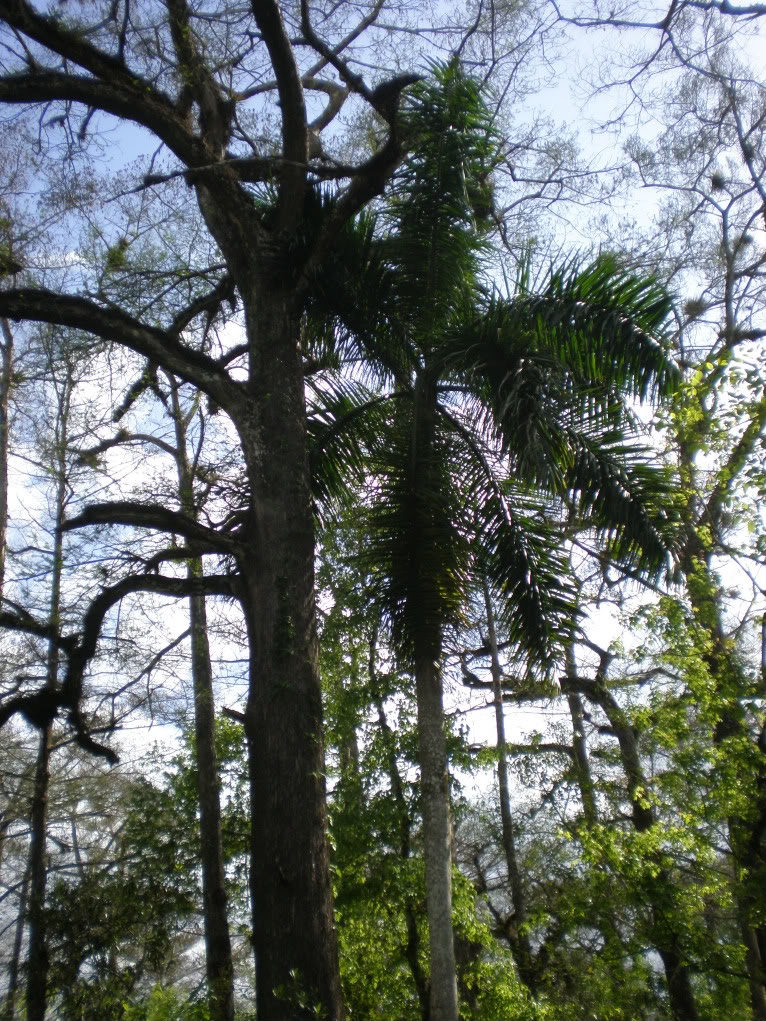
Here we have a wild Florida Royal Palm (Roystonea Regia) growing in a hammock among the Bald Cypress trees, which are noticeably bald during the winter, even though it is commonly in the mid seventies or warmer even in the depth of January.  Deciduous trees do still lose their leaves here, though sometimes the change of brilliant color to bare branches back to spring flowers and leaves only takes a matter of weeks, if even that long.  For the most part, the casual visitor to southern Florida will not even notice this subtle transformation of a pretend winter, as the wild areas that do remain are full of enough broad-leaved evergreens and pines that the northern species do not make much of an impression.  There are native mahogany trees here, as well as the Gumbo-Limbo (Bursera Simaruba), three kinds of mangroves, and 13 native species of palms!

The parts that are not wild, well, they are packed so full of exotics and invasives from the tropics around the world that one would be hard pressed to find something genuinely southern Florida.  This happens to be the case because it is the one place in the United States where tropicals can safely be grown, and in the fine American tradition of planting one's property with perceived beauty over native species, there are manicured lawns everywhere along the suburban streets of Miami and Fort Lauderdale that boast just about every kind of flowering tree and palm you can imagine.   I would know, because when I was growing up, it was the first place and time where I realized that many of the trees around me were not there when things were wild and untamed.  I was six years old and had just taken an interest in both reading in English and noticing that the trees in our Fort Lauderdale backyard were very different from the trees in our Milton, Ontario backyard.  Of course, at that time, even while I wondered what "forest Florida" looked like as opposed to city Florida, I also delighted in the sheer beauty of all the tropical flowers, trees, and even lizards around me, native or not.  I did not care that everything was here artificially and introduced, and especially did not mind that we were even in the actual tropics.


That's right!  Southern Florida does indeed have a tropical climate, but even Key West lies 40 miles north of the Tropic of Cancer.  This is because the land is surrounded by water, and very warm water at that.  This is the birthplace of the Gulf Stream, which also (usually) makes Europe's winters much warmer despite being as far north as much of Canada.  Artificial climates and plants aside though, nothing can really take away from how exotic this land is, both its manicured Miami environs and its primordial but vanishing Everglades wilderness.  The contrast is very noticeable:


Much of the densely, yet comfortably, packed urban areas are built on the only true solid ground in the land, a ridge of limestone which rises only 10 feet or so above the surrounding ocean and everglades, with 24 feet marking the highest point in Coconut Grove, a Miami neighborhood which has retained much of its hammock character of dense mahogany and Gumbo Limbo groves towered over by pines, palms, and the odd high-ground Bald Cypress.  Still, Coconut Grove is but a remnant, and a very incomplete remnant, of what the Miami rocklands once looked like, which was mostly dominated by southern pines.  Development aside, the absence of regular fires in the landscape has altered what remains of the vanished pine rocklands even more. Below is a sample video of some of what remains of this ecosystem and the role of fire in maintaining it, presented by Everglades National Park, which gives you a pretty good idea of what Miami looked like before it was Miami:


This is also a good video for illustrating the role of fires even in a wet and humid place like this.


Outside of the developed areas are vast open prairie-like stretches of sawgrass interspersed with other hammocks; in essence, a very wide, very slow river that drains much of what is green on the map there.  Much more can be said about this unique extra-tropical tropical land, but hopefully this post has served as a nice introduction to one of the extremities of the continent, which we will be revisiting a lot in the future.

Friday, February 17, 2012

Parks in the News: Pythons in the Everglades

The story can be found here:

http://www.nationalparkstraveler.com/2012/02/sixteen-foot-long-python-captured-everglades-national-park9475#comment-36838

North America is a very diverse continent geographically while also somewhat isolated from the rest of the world, and thus is prone to invasive plant and animal life originating throughout the world.  No matter where something is from, there is most likely a suitable climate and environment somewhere on our continent that is able to proliferate, and in the absence of evolved natural defenses, invasive species can actually come to dominate entire ecosystems rapidly.  Native peoples were painfully aware of this in the form of a myriad of diseases unleashed upon them following European contact, and Kudzu, Tamarisk, and Giant Reeds have demonstrated this within plant communities.

Case in point, the Everglades.  The only truly tropical portion of North America north of Mexico is southern Florida, which accordingly has become heavily populated in recent decades.  Furthermore, the relative affluence of the area means that there are and will be exotic pets, which tend to escape or be released from their homes now and then.  Many exotic pets, especially aquarium fish, reptiles, and birds, are tropical in origin, and most do not survive long outside of the warmest parts of the country.  In southern Florida, these animals flourish.

Read the story to see why this is a problem, in case the truth was not clear.

Tuesday, January 17, 2012

Trees in the News: The Death of a Baldcypress

How unfortunate that after posting about Baldcypresses, news comes that the oldest one around did not make it.

To start with, here is the story:

http://www.thestar.com/news/world/article/1116206--3-500-year-old-cypress-tree-in-florida-catches-fire-and-collapses

I suspect that this is an act of arson.  For one, Baldcypress grow in swamps, usually standing water or very moist soil, and even under the dry spell that central Florida is currently having, the tree would be incredibly moist.  A tree like this does not spontaneously ignite.  How could a fire start in a place like this, naturally?  Lightning.  There were no thunderstorms in the area that day.  Furthermore, the thing is pretty resilient to that sort of damage even then, and if it was truly that old, then it would take more than a strike or two to down her.  Sequoias and other large trees, for instance, usually have some splitting and bark burns from lightning strikes, but normally do not die.

No, to light this thing up you would need to go about it artificially and under controlled circumstances, or at least be young, dumb, and pathetic with a false idea that you have nothing better to do.

Yes, the tree was old, and yes, it was pretty hollow inside.  The thing is, it was still alive, and tree or not, it was a well-loved landmark for locals.  I was hoping to see it for myself one day...