Always to the frontier
Showing posts with label City. Show all posts

Monday, February 9, 2015

The Magnolias Of Philadelphia

When I was first learning about various trees of the continent back in my idealistic youth, I was blessed to come across a free copy of Audubon's Field Guide to North American Trees (Eastern Region).  This was a marvelous book full of fun things like maps, pictures, and even illustrations of trees in silhouette, with the evergreens being nice and full, and the deciduous trees shown in their bare winter glory.  Now and then, I came across a remarkable leafy tree... with leaves on it!  I knew about them before, of course, being a traveled veteran of Southern Florida, but what really impressed me was the fact that some of them could be found very north, namely the American Holly (Ilex Opaca) and above all else, the majestic Southern Magnolia (Magnolia Grandiflora).  In specific, the guide noted that the beauty is noted for hardiness "north to Philadelphia".

In gardening circles, people are lately growing fonder of the art of "zone pushing", which is to say that they, ahem, we, like to grow things far north of where they are considered hardy.  Gardeners in Detroit, Chicago, Toronto, and Cleveland (and associated friendly cities) have long since considered anything that retains leaves in the winter to be of high prestige and a reminder that life goes on during otherwise snowy and cold dark months between November and March.  Alright, so October and April...  Anyway, its a hard thing to take even a cold hardy palm or broadleaved evergreen and expect it to dance for you while the blizzard rages, at least this far inland.  Philadelphia, on the other hand, is perhaps in one of the perfect situations for attending to a variety of cultivation.

While it has far more in common with the ocean than the Appalachians, it has elements of both; pine species form extensive barrens in nearby rural areas in both Pennsylvania and New Jersey, as well as more mountain species like rhododendrons in surviving woodlands.  It's not too hot, it's not too cold, and due to an atmosphere of tolerance, it was the American city that got the most brains to boot.  Massachusetts was all about religious agenda/freedom, New York was all about commerce, Charleston and Williamsburg were all about slave-powered farming, but Philadelphia was about letting you pray how you wanted, letting you argue with people over politics, and, surprisingly, letting you talk about what academic subjects were currently in vogue.  Alexander Hamilton of the spice islands by way of New York tried to get finance to set up a crown here too, but ultimately the city is still best remembered as more of a home to the Benjamin Franklin type.  This is a city of books, trees, and people who still like to read newspapers on a park bench.

One such popular academic interest was plants.  Aristocrats in Europe went crazy over trying to acquire New World vegetation for their estates, especially in England.  Various botanists made quite the name for themselves detecting and acquiring such treasures, and Philadelphia's own John Bartram earned the respectable but low paying title of the "King's botanist".  While Charleston, under Michaux, served as a secondary port for the thriving plant and seed trade, the varieties of climate and plant life meeting here, as well as the royal connection, ensured that Philadelphia would remain the chief point of departure for the finest trees finding their way to the finest clients.  Unlike Charleston, however, Philadelphia grew up much more snug and dense, seemingly paved over, much to the distaste of the founders and succeeding generations of planners in the city who wanted everyone to have a growing space.  Thomas Jefferson disliked the environment, and like many other politicians, wanted to try to escape to greener pastures when possible, which usually meant taking a trip to Bartram's house (which I regret upon regret not stopping at).  There they talked about plants.  No, really.  Jefferson and Washington were plant geeks.

Philadelphia has since greened rather nicely, even if the concrete which has replaced the brick is still the dominant feature everywhere.  The riverbanks are lush, there are parks and green spaces never far away, and the city is home to the United States' first urban national wildlife refuge.  Out of all this, however, what caught my eye was, well, the magnolias.  My little guide book did not disappoint.  I can't remember where half of them were taken at, with the exception of the line of tall ones at Betsy Ross House.  They are not hard to find, though.  Just wander through the historic core and you will find quite a few, some very impressive in size.

Yeah, that's a Sugar Maple (Acer Saccharum) intruding on the top left.  Pretty cool seeing them together!


These last fellows were at the Betsy Ross House.

There is also a garden consisting almost entirely of imported magnolias which, while not the majestic Southern Magnolia, do put on quite the show in spring.  I ran into some volunteers at the garden who gave me the unofficial history of magnolias in the city, as well as the intent behind the creators of this garden.  They explained that Washington, plant geek, wanted to green up the city he had to spend so much time in as president.  He was particularly fond of magnolias, which the ladies and I deduced to probably be his proud Southern Magnolias, arboreal symbols of American robustness.  As a symbolic tree, Magnolia Grandiflora is much more associated with the deeper South and with Andrew Jackson, who planted them at the White House as they were his wife's favorite tree.  Nevertheless, Washington probably would have run into plenty of them in his boyhood tidewater stomping grounds, as the tree was already making quite the impression in the trans-Atlantic trade and was already being cultivated as an ornamental in the southern lowcountry.  He probably enjoyed seeing a tree as robust as this in remaining green even in colder winters, and as a horticulturalist probably thought about bringing them further north with him into his presidential exile from Mt. Vernon.  The creators of the garden, acting 150 years later, apparently did not have the same design in mind, which the volunteers and I grumbled about.  The Asiatic magnolias, they said, are nice, but they only flower in the spring, and, well, are not very American.  At the risk of sounding like an ecological imperialist, considering the intent of the design of the garden, I have to agree.


Still, it's a nice garden (with a fountain, which I did not take a picture of), a quiet space of reflection surrounded by quiet streets (Locust between 4th and 5th streets) and various quiet places of worship.  There are thirteen flowering trees and shrubs which represent the thirteen colonies, but most of them are imports, and ironically, two of the species are iconic of England!  I'm a proud subject of the Commonwealth myself, but the concept seemed rather nutty to me.  If I had to guess, I would think that the creators wanted to put on an incredible burst of spring and early summer color, and to be fair, the garden was set up long after the colonial era passion for natives had faded and the Victorian and Imperial passion for exotics had become the rage.  Remember what I said about zone-pushing?  That's something fairly new, the current emerging vogue.  People maybe just weren't planting southern trees here back in the day, just as they weren't planting palms in Vancouver or London until fairly recently.

The worm has since turned, and the National Park Service tends toward at least the homegrown and preferably native ecological restoration as much as possible (and to be fair, as much as they work here and are not too distantly native, Magnolia Grandiflora is native no further north than the central Chesapeake, if I am allowed to make such a bold statement).  In the garden we get to see shifting trends in horticulture presented as a history lesson about a history lesson.  I have to admit, regardless of my angst, I stopped and enjoyed the patch of green for a while.  Washington probably would have done the same.  Jefferson would have turned cross, purchased nearby land, and started over on a superior garden.  Bartram would have sold him the plants.  All of them probably would have been in awe of the many Southern Magnolias found through the rest of the city.  I have to admit, seeing them together with so many other trees, including my favorite Eastern White Pine (Pinus Strobus) gave the city a pretty interesting arboreal landscape.  You can do that in DC too, but then you have to pay for it with hot, muggy summers that do not get nearly as bad here.

What's the rest of that city treescape look like?  Come on by next post for a tour. 

Friday, January 30, 2015

Cheap Beer In New York City?!

In honor of the fact that another Friday is upon us and that there no doubt plenty of people taking a detour on the way home to get absolutely sloshed, I proudly present McSorley's, where you can still get two beers for 5 American dollars (cash only).

15 East Seventh Street
(Third Avenue)
New York, N.Y. 10003

Like any good old ale house, McSorley's and its patrons do not have a record of when the place actually opened; the sign says 1854, however, and I'm sticking with that.  When rioting Irish-Americans pretty much burnt many parts of lower Manhattan to the ground during the draft riots of July 1863, they were careful to keep their watering hole and veritable community center largely intact.  The place has stood and gathered dust ever since, one of the few physical things in New York that has passively resisted change by simply not changing.  Its a lovely experience, and for just five dollars, you can get a light and a dark (or two of each), the only beer they serve.  Perhaps it was the awareness of being in what is pretty much the closest thing to the heart of Irish (North) American history, but that beer tasted pretty damn good the first and every time since that I have had it.

The walls are covered in various pictures and paintings, many of them with as much dust on them as the rest of the place.


And of course, the floor is covered in sawdust.


Those pictures though, some of them give hints that there have been visitors here beyond what the management claims.  One particular New Yorker who first showed me the place insists that the Kennedy brothers came here for a victory drink after Jack won the presidency.  I have a pretty good feeling that Mr. Roosevelt the first came here now and then during his policeman days; there's no proof, but it just seems to fit his character.  While his sort was much more from the other side of town, and though he personally loathed populist politics, well, he was also no stuck-up rich snob.  In many ways, McSorley's was the beating heart of old New York.  Take what I say with a grain of salt, of course, because I've only been a frequent visitor and temporary resident in the city.  The best way to experience the place, as usual, is to come see it.   They have food.  I've never had it.  It's probably good stuff, though I usually wander around the neighborhood later and find rare odd-ball things like Khyber Pass, an Afghan restaurant just around the corner.  There is nothing like having Afghan cuisine served to you by a Russian waitress...

Oh, and did I mention that there are restrooms on the premises?  The gents have urinals that you pretty much can't miss, no matter how many lights and darks you have had.  The first time I saw them I nearly burst out laughing.  Like the urinals, the other best free part about McSorley's is that it is really off the beaten path while still largely accessible.  Most tourists don't head anywhere near here, which is not to say there is nothing to see here.  The cheapest attraction in New York City is just walking around and enjoying the experience, and there is no shortage of great shops, restaurants, art, music, and pieces of history to be found in East Village.  It's also probably one of the best places, aside from Harlem, to see how average Manhattan people exist (at least until rezoning and gentrification really get underway).   


Monday, January 26, 2015

Philadelphia: City Of Brotherly Sandwich

Part of the fun experience of traveling is to find lodging and food that is local flavor.  Its nice to see the mundane as an evolution from ages of cultural development, and how particular regions and even cities and towns have produced both high and low culture with their own touches as a result.  Sometimes it can be hard to find something that is not overly "tourist", but sometimes you have to sit back, laugh at the kitsch, and dive right in.

Philadelphia, like any destination city, is full of things drawing tourists into the bright, sparkling lights.  It manages to do this in a way that very much blends in with the normal reality of the city, however, and even though some places feel like a museum packed into a modern mess of skyscrapers and freeways, she does so out of concern for the past while moving on with the future.  "Out with the old, in with the new" does not apply here.  That's a tangent for a different time, but the lesson holds strong in the living example of finding a place to eat the local flavor.  When I was last there in 2014, I had a choice between going to some re-invented gastro pub that was a recreation of some colonial era tavern, or... Pat's King of Steaks.


This was not a hard decision to make.  What might have been hard was choosing to go there, or to Geno's, right across the street.


But, being a traditionalist, as Pat's claims they started the whole thing, and far more attracted to the particular smells coming out of Pat's (not to mention the faster moving line), I went for it.


Despite what some reviews might say, Pat's gives you a pretty impressive sandwich.  That, some fries, and a coke (9-10 bucks total) was more than enough to sate me for some time, and it was a pretty active day walking around much of the historic core of the city.  The steak was definitely better than what is offered for the sandwich in most other places, the cheese was pretty delightful (but honestly, as much as it sounds gross, traditionally I would have been better off going with cheese-whiz than with American, at least according to my traveling companion, as it melts and fills the thing so much better), and the bread was pretty good.  The most refreshing feature, however, was seeing the options in a nice grill from which one could self serve.  There were peppers, more onions, etc. piled together with condiments.  You can see one of the wee green peppers behind my sandwich.  Normally I'm not much of a pepper guy, but... amazing little things.  Grilled to perfection.

All in all, a pretty enjoyable experience, with a caveat: Know what you want (use the website for instruction) when you order, or else they kick you to the back of the line.  They serve people fast, and don't like to mess it up.  Seating is somewhat limited, but the tables were moving pretty fast, like the service.  In terms of accessibility, the steak shops are off the beaten path, decently south of the historic core.  Some people have said that the neighborhoods are scary, which I suppose is true if you have lived in a cave outside of some no name town in North Dakota your whole life.  As a reward for braving the non-tourist actual city, you get to see a small slice of how the normal folk live.  My take?  Pretty clean, pretty open and airy, fairly laid-back compared to New York or Washington. 

Passyunk ave and Wharton st., looking south, right across from Pat's.
Really, the neighborhood is one of families and working people, ethnically diverse and with typical urban east coast atmosphere.  We went at lunch time and the place had quite a few suits milling about.  Multiple bus lines are in the area, and if you drive, you just need to sneak a few blocks away and find a parallel parking spot.  Tip: try it off of the main eating hours for easier access.  Otherwise, be prepared to find a space in this:

South along 10th street, beside Capitolo Park/Playground, a block walk from Pat's.

Now, as for the sandwich itself, I would say that the Philly is a pretty average street food for something from an east coast city.  You get the sandwich, something European if not downright traditionally English, then you get the American spin on it turning it into something huge and more than just a snack, and then you get really good meat, lots of it, and on a superior bun, representing the Italian blessing on most east coast street and deli cuisine.  It's a democratic sandwich that has evolved in a city born of liberty, that has survived total transformation by government and high finance, and ended up as a place where you can get relatively greasy, cooked with gusto, here-enjoy-this eating.  You had suits next to tourists next to construction workers, and no one gave off any attitude or got in anyone's way. 

Next: Greek food... in the desert?!

Thursday, January 1, 2015

The Mystery Holiday, Where People Got Drunk Last Night (Times Square), And 2014

New Year's eve and day have always been something of a mystery to me.  Many people, even those who don't overly imbibe the night before, expect to get the day off, and are often quite surprised that even essential services and stores remain functional and open for business.  Maybe the day is seen as a time of "me" in contrast to the function of Christmas, which in North America seemingly serves a two-fold function to the secular public as a time of family obligations and a time to spend deeply into debt in order to satisfy supposed needs of gift recipients.  The whole exhausting affair might in fact give purpose to the night of selfish excess which provides for cheap entertainment; large bar tabs can otherwise be forgotten in the suds.  In the rest of the Gregorian calendar observing world, people do in fact celebrate, but in North America, more so in the United States, Mexico City, and urban Canada, people get downright crazy.  No other place in the world gets more insane than Times Square.

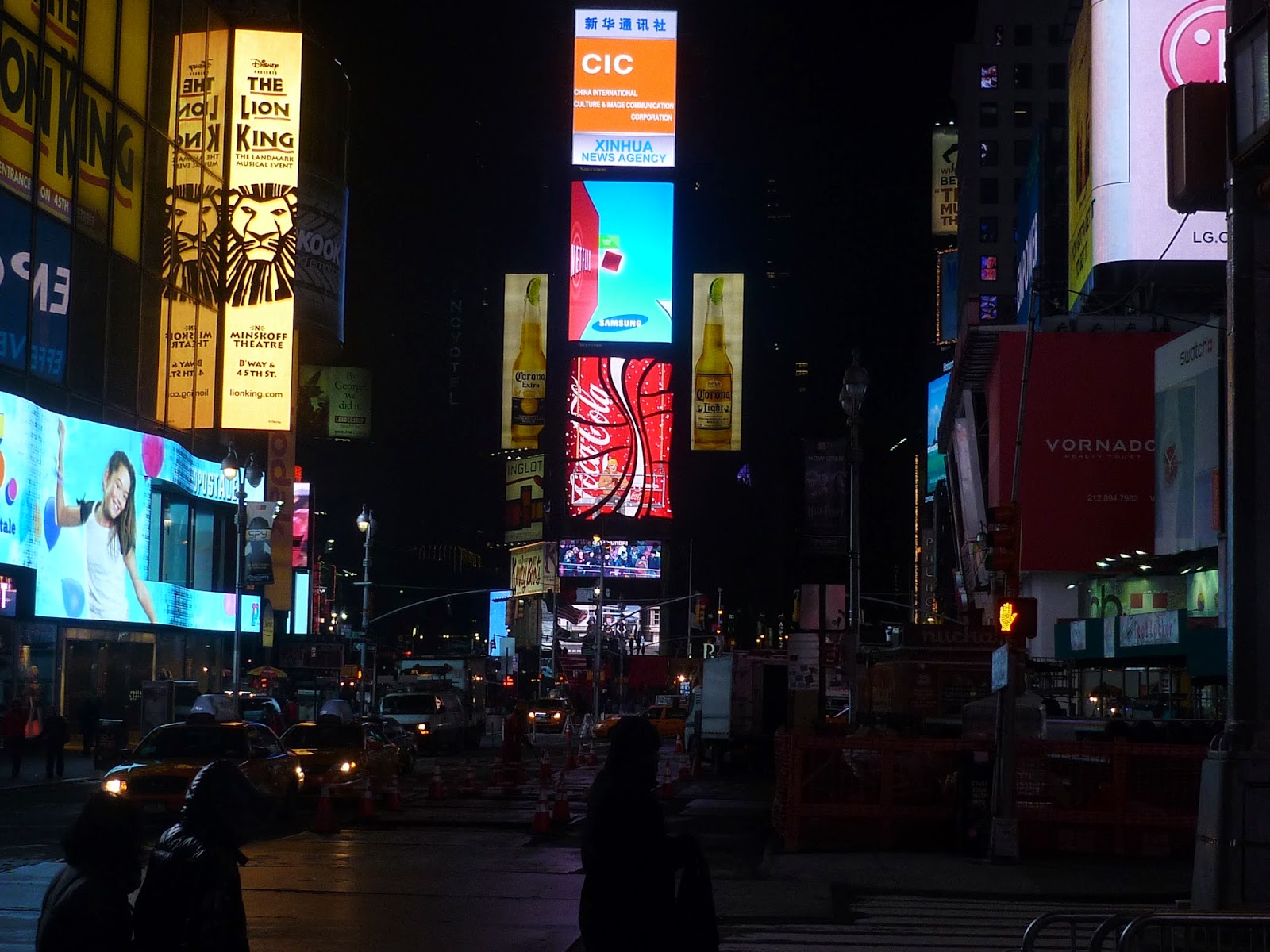
Clutter, shadows, and isolation among the bustling heart of a city...  Insanity as urban art.

I could write a rather lengthy post about the history, glitz, glamor, shame, etc. that is involved in this meeting of roads in Midtown Manhattan, and I actually have written about the statue of a Roman Catholic priest which is the unnoticed centerpiece of the northern part of the square.  Really, though, that is easy information to find, and this is one of those instances where the description simply pales in comparison to the experience of exposing the senses to it in person.  No photos of it really do the place justice; it pretty much glows.

Its amazing what standing just a few feet closer into the scene with the same camera on the same settings can do to this classic picture scene.  The signs all seemed to have gone off at the same time, the construction is hidden by passing cars, and even the metal plates on the road seem to light up.  This angle is, of course, looking south towards One Times Square.

It glows almost as good if not better than Vegas, perhaps even more so.  Vegas exists to purposefully take your money without any regret, surface of otherwise.  Tourist New York, on the other hand, exists to take you and your wallet on a ride that you both seem to, above all else, enjoy, and not merely for the purpose of spending.  That said, even while you can be entertained here just by people watching and taking in the sights, all those signs, especially the big ones front and center on One Times Square pretty much exist to get you to spend something.  They want you to eat, drink, and take in a show.  They even want you to know that the police and around to make sure your experience is as unmolested as possible.


Which leads us into the second bit of our post, and away from the relatively quiet February scenes photographed above.  It seems that last night, much like last year in general, people were gathering to protest and break the silence about what they view to be ignorance.  Apparently more protests against racial discrimination and police brutality were set to take place last night in Times Square, but there were so many people there to simply party, revel, and lose themselves in the moment that nothing significant ever got underway.  The protestors could not even make it to the party, and Times Square did its usual job of distracting everyone from the reality of what was happening in the rest of the country.  2014 has largely been like that, though, perhaps more than any other year before it. 

The 24 news cycle and the ebb and flow of internet trends have largely ensured that people really don't think about things like government spending and corruption, international incidents, disease outbreaks, and even, well, joy over things that have gone right.  Times Square is a reminder that our society often gets bombarded by all sorts of information, is driven towards pleasure, and has a very short term memory.  Times Square is a lovely place in some ways, but one that is extremely artificial.  It is very purpose driven towards an intoxicating excitement that in the end is all too ephemeral.  In many ways and for many people, such was the experience of 2014 in North America. 

Thursday, March 6, 2014

The Best Big City Place To Stand In Toronto

One of the most interesting places to stand and gaze at the financial fortresses of downtown commercial Toronto is on the northeast corner of Bay and King streets.  You can look around in all directions and see nothing but tall buildings (including First Canadian Place, the tallest skyscraper in Canada) all around, with an effect rivaling that of Manhattan's financial district surrounding Wall street.  The canyons created by the tall buildings produce a windy effect on the local micro-climate, and the sun is blocked out for much of the day.  If you want to see what such a high urban setting is like, this is definitely the place to stand in slack-jawed wonder.  More than this, though, this particular corner (actually just a little bit to the north, say about ten steps or so, on Bay street) features a really impressive view of the CN Tower:


I had presumed that this view had been forever lost in the face of continuing high rise development along the lakeshore, but the signature feature of the Toronto skyline was still exposed as of February 2014, framed ever so nicely by the Toronto Dominion Centre and it's neighbor, which I assume is the Standard Life building (all banks look the same to me).  The CN Tower is definitely one of those things that most people do (and should) come to see when touring Toronto, but most visitors never seem to give it a second thought when it comes to views of the structure itself.  It seems to blend in, albeit as an essential element, of city skyline shots, especially those taken from Lake Ontario, but the way it silently dominates even land side views of the skyline is even more impressive.  When I was growing up, I remember being able to locate Toronto from even as far away as Rattlesnake Point on the Niagara Escarpment near Milton, from the height of land on the Oak Ridges Moraine to the north, or most impressively, from atop Queenston Heights alongside the Niagara River.  That particular view had always struck me as being the mythical vantage point of Canadian sovereignty, an emblem of the might of Canadian rail power which now extends from Ocean to Ocean to Gulf, all within the view of one of the most important battlefields of Canadian history and just yards from the American frontier.  Sure, it's an overly romantic and silly sort of patriotism, but...

Let's just say it felt good to see it still standing there, probably not even noticed by half the people in the city who were otherwise too busy looking down at their shoes, the pavement, or their smartphones, people too busy to look around and be happy and enjoy this immense gathering of humanity of all shapes and sizes merged into one working, tolerant whole.  This viewpoint, taken at one the most artificial and busy vantages of Ontario, a province otherwise noted for incredibly vast stretches of wild land, probably never even stirred so much as a smile in the somber people milling about me when I took the photograph.  That's just fine, because despite all that, I have to say that I felt pretty good being in the heart of a place that has so much more to do.  Toronto is photogenic, and she does have some pretty amazing views. 

Saturday, March 1, 2014

What Toronto Looks Like Now (Winter 2014)

Toronto is what most people who know anything of it would expect it to be, a rather large city that sprawls horizontally beyond the typical vertical business district downtown.  There are large buildings, a public transportation system covering most of the high traffic areas, and a general environment of connection with the rest of the world.  In comparison to New York, Toronto is much more spread out and less dense, but in comparison with Chicago, Dallas, San Francisco, or Montreal, the scale of the city does not necessarily shrink in relation to distance from the economic core.  There are skyscrapers of considerable height all over the place, often dwarfing the neighborhoods around them or consumed by them.

Example provided farther below in image with lots of taller trees.

Despite being a relatively young city (200 years plus to foundation), at least in terms of it's current level of importance (50 years or so), Toronto has not developed into a clean grid.  This is in part due to topography, and in part due to another grand feature of what makes her somewhat special in North American standards of cities: foundation era historical buildings being located in developmental harmony with modern structures.  These are everywhere in the city and surroundings, probably due to the Canadian virtue of a respectful, if somewhat nearly religious attitude toward the past.  As I can probably break many such images into further posts, I will just present a few of the most striking examples, with captions, here.

This is Campbell House, one of, if not the, oldest surviving houses in Toronto.  Despite being so deep into the retail core of tightly-packed Queen Street west, the Georgian survivor still bears a large lawn space and stands out even while it is near other historic buildings of larger scale.  Campbell House is a fine example of how the cityscape has not demolished a sense of historical memory, which will be useful in building a better Toronto.


This is the Fairmont Royal York Hotel, one of the best surviving examples of Canadian Railroad grandeur, typical of the Edwardian and Late Victorian architecture still in vogue in Canada in the 1920's, long after England and the United States had moved on to other styles.  She was the tallest building in the British Empire when built, and today is dwarfed by the commercial district towers.  Still, she stands out even better this way, another part of a Toronto that cherishes history even while seemingly isolating itself from consciousness of any time period. 
 That said, Toronto is hardly just a museum of Georgian and Victorian glories sharing space with International style homages to Manhattan architecture.  There is indeed that towering business district, complete with canyon like streets that turn a gentle breeze into a violent, chilling wind.


This is also the sort of big city downtown that paves everything over with concrete and maybe throws occupants some rather artificial looking reminders of the nearby presence of nature.

King Street just west of Bay.

Toronto, of course, is full of trees.  Any look beyond the concrete jungle of the money district will demonstrate that.  The residential neighborhoods are well-treed, with an urban canopy that does a fairly good job at hiding most of what lies below.  Toronto does this better than most other cities I have seen, with the only other dense urban canopy of comparison being in Detroit (honorable mentions given to smaller southern cities like Richmond, Memphis, and Charleston).

Notice the twenty story apartments at the end of this relatively well-treed residential street, a typical example of the merging of densities common in the cityscape.

Then there is the abundance of park space and natural land which we covered in our last post.  Spurred on by Hurricane Hazel and given continuing promotion by environmental groups, the city has enough green space to compete well on the world stage in this regard.  Sadly, especially if there have been no recent rains, Toronto does not have a pristine blue sky to prove this point to the average visitor.  The sky is bleak and brown, not quite to the level of Los Angeles or Mexico City, but definitely far worse than what can be found in New York or even industrial Gary, Detroit, or Pittsburgh.  This is in part because Toronto has a very typical North American addiction, the automobile.  Highway 401, the main artery of traffic in the Montreal-Chicago corridor has the responsibility of moving not just a heavy percentage of trade between the United States and Canada (and thus also land based trade between Canada and Mexico), but also commuter traffic between the city and its eastern and western suburbs.  Southern Californians may mock the concept, but Toronto often has worse traffic than the usual nightmares one can find on Los Angeles parking lo... er freeways.  The horizon suffers for it dearly, and while I did notice that breathing was not the chore it seemed to be in London or Mexico City, the place is far from having a nice effect in the sinuses. 

She also has an ugly side here and there.  While on the whole Toronto is a fairly clean place (as bad as the locals claim it can be, the subway here is miles ahead of the smelly mess down in Manhattan and about the same as London's Tube), some of the infrastructure does show age and deterioration.  The Gardiner Expressway, in addition to being an eye sore which has long since divided downtown from the waterfront on Lake Ontario, looks rusty, broken, and far more Detroit or Chicago than Toronto.


In some places the electric lines, streetlights, and streetcar cables add to the dated image of the city, which, to be fair, is not entirely a bad thing.  Toronto definitely looks like it just stepped out of the late 19th century on some streets:

Queen Street east in an area called "the Beach" or "the Beaches", depending on who you ask.

That said, a quick turn of the head usually shows off the ever present construction going on.  This is a very strange, amazing city that refuses to forget itself, even while it also thinks too much or too little of itself.

Those are the buildings of the Ontario Legislative Assembly, a.k.a. Ontario Provincial Parliament.  They are surrounded by an ever expanding provincial capital. 
 Expect more up close looks at various little bits of Toronto, and of North American cities in general.  Remember, there is always something right around the corner that is worth taking another, if not a first look, at.

Friday, February 28, 2014

The Natural Setting Of Toronto

One of the memories of Toronto that had fashioned an overly-romantic vision of my great Canadian city was that of the physical setting in which she has grown.  Unlike the pancake landscapes of Detroit or Chicago, Toronto was born on some more realistic, diverse ground.  Unlike Manhattan, she has since not paved it over in order to create the illusion of flatness.  In general, Toronto is like the other Great Lakes cities in that she is dominated by her most prominent feature, the water.

Yes, that is open water even in frigid February 2014.  Lake Ontario is the most protected of the Great Lakes, at least from the cold north-western winter winds.  It also gets sloshed around quite a bit by the inflow from the mighty Niagara.  This obviously has a heavy effect on the surrounding climate, both good and ill.

Lake Ontario is the reason why Toronto is here, really.  The city was founded on one of the great portage places between portions of the Great Lakes, specifically Huron and Ontario, a route that had to wait for the dropping of Iroquois hostility to become viable (hence Toronto had never been a French city, even though a fort had been established here in 1750).  Near the lake, the land is level and the shoreline is relatively protected by the offshore islands, making the site attractive to settlement once English Canada became a going concern.  The climate was also a nice, inviting feature.  Further east, the winter gets a bit snowier from lake effect squalls, and the growing season grows just a little bit shorter. 

Toronto, in fact, is noted for being one of the northernmost places in Eastern North America where the eastern deciduous forest (known in Ontario as the Carolinian Forest) exists in the same recognizable form before giving way to the north woods.  As part of this package deal, Toronto gets Atlantic coastal flora, some boreal elements, and even the easternmost extension of the great Prairie Peninsula which is an extension of the central grasslands well into Ontario and even parts of western New York and interior Virginia.  In Toronto, the best place to see surviving grasslands is in High Park, where some oak savanna remnants can be found.


Indeed, in comparison to the mysterious transitional forests and rolling terrain further inland and to the east, the oak openings and level shoreline must have seemed very inviting to settlement.  Early English speaking Canadians were very eager to find land comparable to what they might have had further west along the Lakes or in the Midwest and Ohio Valley, and it helped that Toronto had just this available to them, all at a comfortable (but not ultimately safe) distance from the American border.  That said, again, the place is hardly a level grassland in it's entirety.  Things get very steep, very fast.


Much of Toronto is within a few minute's travel (by any means) of deep ravines and even minor cliffs.  This affords for a very dramatic cityscape, at least as far as eastern urban North America goes.  The other Great Lakes cities, with the exception of Hamilton, really do not offer much in the way of relief, and the end result is that Toronto features some pretty natural park spaces right beside high rise buildings, and not merely because someone thought a park would look nice there.  Back in 1954, in fact, there were actually buildings going up in the ravines.  Then came Hurricane Hazel, the first time in modern history when the Great Lakes got to remind us that they are really little freshwater oceans; the ravines flooded in rages that put an end to both people and urban planning alike.  After the floods had reminded Torontonians just how fragile their up and down rolling city landscape could be, the city started building around, rather than on top of or through, it's topography. 

Most other major cities in eastern North America simply can't say the same.  No defensible ridge of land remains where Detroit was once founded atop the rise where Woodward avenue now runs atop.  Manhattan is relatively flattened in comparison to what it once was and even now is surrounded by.  Our ancestral city of ancient urban concept, London across the sea, has long since fooled people into thinking it was always solid ground devoid of water in all but the Thames.  Boston certainly has done a good job of containing the aquatic geography of its foundations!  Miami looks nothing like the combination of barrier islands, mangrove swamps, and limestone pine ridges that it once was.  Toronto, on the other hand, is a nice lake plain, set of islands, one river valley after another, and even has, well, sea cliffs.  These are better known as the Scarborough Bluffs, one of the coolest and most under-appreciated features of the city.  Sadly, I took no pictures to truly do them justice, but the ones below can decently illustrate how interesting they are. 


So what sort of city has since been built around and on top of these features?  That's in our next post.

Thursday, February 27, 2014

Toronto And The Power Of Memory

To a Detroiter, Toronto is a thing of distant majesty, be it seen in either the eyes of envy or romance.  In comparison to a decaying industrial behemoth which once had the possibility of rivaling Chicago or Los Angeles in terms of culture and influence, Toronto looks to be the promise of a Great Lakes capital fulfilled.  Here we have a stable city of incredible economic strength and fortune with all the diversity one would expect of a city the size and importance of New York.  Here we have gleaming skyscrapers, a remarkable landscape of ravines and naturalistic city parks, all within easy travel of anything from oceanic expanses of water to cliffs, mountains, and north woods.  Here we have a city, which while being well-developed, is still so full of promise and young enough to proudly declare that she is far from being finished and ready for so much more.  I always thought so.  Part of me still does.

This, of course, is the viewpoint of an expatriate looking back ever so passionately over that long, so-called undefended border and dreaming of what life without exile in this United States would have been like had I stayed.  Like so many Torontonians, I can only envision my gleaming city as the accepting, open, safe alternative to a post-911 New York.  I would love to envision her as being as equal among names like the city at the mouth of the Hudson, London, Paris, or Hong Kong.  While instead I realistically consider her to be of the same caliber as a San Francisco, Milan, or Sydney, part of me still imagines Toronto to one day, along with Canada, claim her position in the supreme pantheon of global divinities.  She is, after all, extremely well connected and perhaps one of the most tolerant places on the entire planet.  Therein, of course, lies the problem.  Toronto is too Canadian.

Before I have my countrymen come down on me like a bad case of NAFTA, I would very much like to qualify that statement.  I realize how self-hating I sound in writing this, akin to the James Joyce who loved Ireland but for the Irish and their culture (something I could never seem to forgive him for), but the truth of the matter is that so much of the Canadian cultural and political identity is based off of a defensive self-image: namely, we are not American.  Even my presentation here of Toronto proposed that part of her greatness lies in being an alternative to an American city!  Canadian culture, at least what I have known of it from Ontario, the most defensive province of all, has little maple leaves everywhere poised to force Canadians to remember that while we share material culture with the Yankee beast to the south, those little leaves acting as an apostrophe in a fast food sign tell us that we could not be more different.  To a great extent, we are, but again we have the problem in having to point that out to ourselves or the the American tourists who pass through southern Ontario and see strip mall after strip mall standing in silent reminder of just how much control branding has over the world these days... but of course we think instead just about how surely they point and laugh and call us the fifty first state.  Some do, to be fair.

But we also don't look at government, guns, or history the same way.  The border remains largely because a difference of mentality marks far more of a difference between, say, Michigan, New York, or Ohio and Ontario than there is noticeable between Ohio and Kentucky.  Sure, as neighbors we live on the same street, have half the time fought on the same side in battles, to say nothing of fighting in the same battles, and we both eat far too many Big Macs.  The truth remains, however, that we are still neighbors and not part of the same family in the same house.  This truth, time and again, keeps getting neglected by those in the Canada house, at least in the Ontario department.  Those people instead prefer to see their house simply as being either better or worse than the house next door!  Any concept of what is Canadian thus evaporates beneath the heat of the comparison lamp.  Meanwhile, that city of Toronto keeps getting larger, keeps adding in more people from every part of the known world, and turns into some settling basin where the diverse elements never really add something to the mix but tend to keep to themselves.  Unlike New York, where the magic of the city has always been the transformation of cultures into something American and then ultimately into something New York in it's own right, Toronto does not have a Canadian or even Torontonian glue sticking it all into some amazing sculpture.  There is neither assimilation nor destruction here, but, in true Toronto fashion, people lowering their heads to the ground or a phone and ignoring one another.  Here tolerance is taken to the ugly extreme of opted compartmentalization. 

That, of course, is a cultural sin.  No, it is not the apparent evil that is the mutually agreed upon racial and socioeconomic segregation popular in Detroit and Buffalo, the two closest border cities, but it is perhaps just as dangerous considering as how this sort of self-absorption is preventing Toronto from becoming truly world-class at the highest levels.  This sort of selfishness is deadly insomuch as it is passive-aggressive to the point of not even being acknowledged, even by people who look out for that sort of thing, like your author here.  You see, until I was able to see the people avoiding eye contact and concerned about the possibility of random conversation, I did not believe that my Toronto had become so cold and indifferent.  I figured that such an image of the city was the result of a worldly friend who wanted more than the mundane every day of next door.  Torontonians, after all, have a legacy of self-loathing to uphold, at least in the realm of civic pride.  Yet the Toronto that I remembered was through the eyes of a child, who did indeed remember more hopeful people back in the early to mid nineties, who saw those gleaming skyscrapers, and more importantly, who saw that incredible parliamentary mace, gloriously surrendered back to us by the neighbors who finally had to admit that we made it as a country.  When I looked at that mace, when I looked at those old buildings next to those new buildings, I knew what Canada was.  I knew what Toronto was.  I knew that I was the citizen of a country that proclaimed liberty with a dressing of tolerance, a desire to move cautiously forward with a healthy respect for the past, and a passion for freedom both from without and within.

I also remember a small cluster of the most beautiful tree in existence planted out front.  There, in plain sight, I remember three Eastern White Pines not much taller than our teacher, planted surrounding a smaller Colorado Blue Spruce, which then I figured to be nice but unimpressive.  The trees, like the mace, were still part of a Toronto that I simply had refuse to acknowledge had changed, or rather refused to change.


A quarter of a century later, these native pines have grown from the fresh landscaping Christmas tree size into their more natural, flowing, majestic sway.  The American-born Colorado Blue Spruce has grown with them, and in a rather amusing and illuminating way has not managed to overtake its companions, yet probably still draws more attention than the common place pines.  The truth here, though, is that the image has changed somewhat.  Like the city around them, they have remained the same but taken on a much grander form... but those who pass them every day probably don't even look up, as they surely don't look around at what an amazing thing has grown around them in the past thirty years, let alone the past ten.  Instead, Torontonians are busy with the illusion that they are at the top of bottom of the world, depending on perspective; the city has indeed become something global, and yet...  They cannot see the miracle of transformation and continued growth with the fascinating world of formal identity specifics that exist both in the now and then.  Toronto is a city that denies itself a taste of what it can be, what it has been, and even what it has become, amazing in being a living example of philosophical potential being, that "which is possibly everything but actually nothing". 

I do promise to show, as I do in this blog in general, what Toronto is.  Better yet, I invite you to see it for yourself and draw your own conclusions.

Monday, January 6, 2014

The Palms of Charleston

In the last post we pondered the question as to how well palms were received for ornamental purposes in past eras, at least in the United States.  As noted, very few depictions of gardens, cityscapes, landscapes, or even individual botanical subjects include palms as a regular feature, even while we also know that the settlers of the Carolinas and Georgia were certainly familiar with their abundance in the wilds around their settlements.  The islands from the Charleston area southward do indeed have the mighty Cabbage Palm (Sabal Palmetto) growing in abundance among the pines, magnolias, myrtles, and all other sorts of wonderful Southern plants.  The Dwarf Cabbage (Sabal Minor) also grows here and north halfway up the coastal areas of North Carolina (in the west well inland to extreme southeastern Oklahoma).  Crepe Myrtles and various broadleaved evergreens are easily grown here, and considering what I had thus far seen of the new subtropical crazed South, I was expecting to see a few streets nicely lined with Cabbages, such as in the scene below:

Yes, it was humid, hence the blur.  Yes, like much of the eastern United States and Canada, everyone here seemed to be glued to a cell-phone, at least in the trendier shopping areas and business-dominated streets.
 But while there was some formality to the plantings as in the standard lined street above,the older sections of town seemed to focus slightly less on formal layouts than in fitting in vegetation wherever possible. 


That's a story for another post, but the theme of the finding is important in understanding how palms are simply everywhere here, almost like weeds.  Understand, Charleston is very groomed and formal.  Yes, some of the brickwork and paint could use some work, but the overall effect is more one of proudly displaying an aged antique.  Most of the people here have public dress which belies a concern for respectability and a sense of decorum.  Manners are refined even between people in rush hour traffic.  Once you get away from the hustle and bustle of the urban core, the cell-phones even disappear.  The backstreets have a quiet, reflective pace.  Again, this is owed another post, so back to the palms, but you get the idea.


They are allowed to grow to their own designs.  It seems wherever there is a little bit of room for soil and roots they are planted, and not necessarily to the exclusion of other trees and shrubs.  They do range naturally here, and probably spring up just as often wild as cultivated.

If this were so many other cities, the little one at the lower left would be groomed right out of existence!

But let's face it, the tourists like them, the locals have long since made them their floral emblem, and they are low demand trees.  I still question how long they have been this popular, but in some places where the overall formal lines do return, it is obvious that the Cabbage Palm has long since been a favorite of Charleston, the planned city with crooked edges. 


And really, they do look like they belong here, far more so than the imported cherries of Washington or the nearly-imported Mexican Fan Palms (Washingtonia Robusta) of Los Angeles and environs.  Though there are so many other reasons beyond imagination as to why one should pay a visit to Charleston, coming to see the palms is not exactly a bad thing in and of itself. 

Charleston, after all, is a special place where garden and building seemed to have been created for one another.  It's almost like a place that sprang into existence so that both concepts could be celebrated in unison.  Much like the modern lake shore of Chicago, Charleston looks as if it and the trees were trying to grow into one another.  Very few North American cities seem to make this much room for vegetation, at least not to the degree where the cityscape as a whole would be at a bit of a visual loss without it.


After all, the city owes its salvation to this wonderful tree, and the tree is etched into the human era of artifice because of that role:


Want to see more of Charleston's organic setting?  That's where I'm headed next.

Friday, December 13, 2013

Fitting Big Trees Into Small Spaces

This can be done!  Now, yes, one should plant in favor of letting nature do its thing and not confine the wild to something as ignoble as pot, but when you don't have the room and want to dwell among more than just concrete, well, there are trees that can do that.  Even better, there are native trees that can adapt oh so well.  Take this lovely creature, since we are talking about the South and all:


You know, in most places they would try to clip the thing into a fine topiary to keep it off the windows.  Not here.  This was taken on Broad Street in Charleston, South Carolina.

 This is a Balcypress (Taxodium Distichum), a tree that around this part of the world gets very wet feet and often stands at the edge of rivers and lakes in actual open water.  Here it was, however, in the heart of Charleston growing practically out of the sidewalk.  It was not alone!

For those wondering, the palm is a Cabbage Palm (Sabal Palmetto), which can be found in almost every viewpoint in the city.  I think this was taken on Church street, but I am not entirely sure.

Here we have a Live Oak (Quercus Virginiana) forming a rather broad crown with such a tiny base.  Granted, the base was filling out its growing space rather impressively.

That adorable little palm growing next to it is a Dwarf Cabbage (Sabal Minor).
Clearly the people of Charleston, even with such limited space, preferred their skyline to be a mixture of artifice and nature.  Except for the some of the major streets, it seemed as if every plausible inch of the city was planted and then on a grand scale.  I have always noticed this a lot about any urban area in the South older than the past few decades; our winter home in Fort Lauderdale had a backyard featuring two seventy foot tall Royal Palms (Roystonea Regia) and a sixty foot Slash Pine (Pinus Elliottii) graced the neighboring yard.  The climate is just going to ensure that a giant scale is the default setting, and the locals don't seem to be too quick to put a stop to growth.  This is not to say that the North is lacking in such a mentality, but just that places like Charleston seem to promote a more organic approach to the city landscape.  I could probably write loads more on the topic, but I figured I would let the pictures do the talking here. 

Monday, June 4, 2012

City Skylines: Kansas City

Though usually trumped by nearby Independence, Missouri in terms of perceived historical importance, Kansas City won the population and commercial battles later on and is one of the larger cities of the Midwest.  As such, it has one of the larger skylines of most cities in the eastern Great Plains.


While nothing like the grand skylines of Chicago or St. Louis, this one does stick out of an otherwise very rural landscape dotted with cities much smaller in scale, such as Topeka and Omaha.

As you can see, the landscape is rolling and well-forested.  Kansas City sits on the confluence of two great rivers and the gentle valleys associated with them.