Always to the frontier

Wednesday, April 17, 2013

A River Runs Through It

People from the United States and Canada just do not walk enough.  Even going one step up, we largely abandon bicycles by the time we can drive cars, or we reserve them for pleasure activities or such.  Some would say that our increased mobility and commute times are the natural progression for a cultural development that tries to include as much of the world as possible in plain sight.  We have, after all, access to an information that network that can tell us almost anything about the globe within minutes if not sooner.  Yet for as connected as we seem to be, so many of us here know so little about how people from even the other side of town live.  We form images that correlate to our political and social expectations for other people, and we dismiss other countries and regions outright just because they are different from us.  Then again, perhaps we are not so xenophobic as we are indifferent and self-centered.  We can, after all, get almost anything we need right down the block at a supermarket or even just online.

In doing so, we lose a lot of perspective.

Not so the people of thousands of years of time until recently, not so of our ancestors.  While we envision some "Indian" sitting by a creek being at one with nature with a bow in his hands, we tend to think of him as primitive and unaware of a wider world around him.  While we envision some rough and ready frontier settling Kentuckian or Ontarien splitting wood outside his one room log home, we think of him as little better, just some backwoods guy with little on his mind other than digging a root cellar.  The reality for both sorts of person, however, was quite different.  

Before the second born even came close to having regular contact with the world across the ocean, the first born were busy traveling thousands of miles up and down the vast waterway networks which honeycomb the continent.  

The Clarion River in Pennsylvania as seen from I-80 westbound looking north.  


Trades were made across vast stretches of land, polar bear furs in some cases being exchanged for shells from the Gulf of Mexico (and a bit more than that, for sure).  People in Mexico knew about the colder lands of mountain and plains to their north, as people in the Ohio valley knew about Moose hunters far to the north of them.  As much as peaceful exchanges happened between such distant peoples, conflicts also approached this sort of grand scale.  The Haudenosaunee (Iroquois), attempting to wipe out the Wendat (Hurons) chased their victims from the north shores of Lake Ontario clear to the north shores of Lake Superior, only to instead run into the Ojibwe (oh come on, you know it's Ojibway) who then fought the combined forces of most of the Six Nations back to the Alleghenies only to focus their own attention then back all the way over to Wisconsin and drive the Lakota clear out onto the plains of western Nebraska and eastern Wyoming!  

When more capitalistic minded Virginians, Quebecois, Mexicans, and such figured out that North America, while vast, was also something good to explore, settle, exploit, and marvel at, they took every page they could out of the native handbook to continental mobility and wanted to see just what was on that western horizon.  Of course, they did so the same we do, albeit with a twist: they took the highway.  The highway, of course, was the river.  

As you can see from the picture above, our rivers are just plain big even thousands of miles inland.  Sure, we have rapids and waterfalls that rival anything else in the world, but we also big wonderful waterways that can take one more than 1500 miles into the continent from their mouths at the ocean without causing too many difficulties in terms of travel hazards.  Our rivers can even help travelers cross deserts in relative safety, a feature which really helped to open up northern Mexican expansion and get people to California from out east without passing out in a thirsty mess.  We had overland routes too; they were simply indispensable shortcuts, but until the coming of the railroad, they could be difficult runs and even a bit frightening.  People usually did embark on grand journeys across the land on foot, but they often did so on a path beside the waters which they knew would lead them to a more pleasant destination, and maybe even end up as the destination itself.  

Next Post: One such river.  Let's take a look at our neck of the woods as a town on a road rather than just a town and maybe see what sort of perspective people without (yes, I know, ironic) internet would have.

Wednesday, April 10, 2013

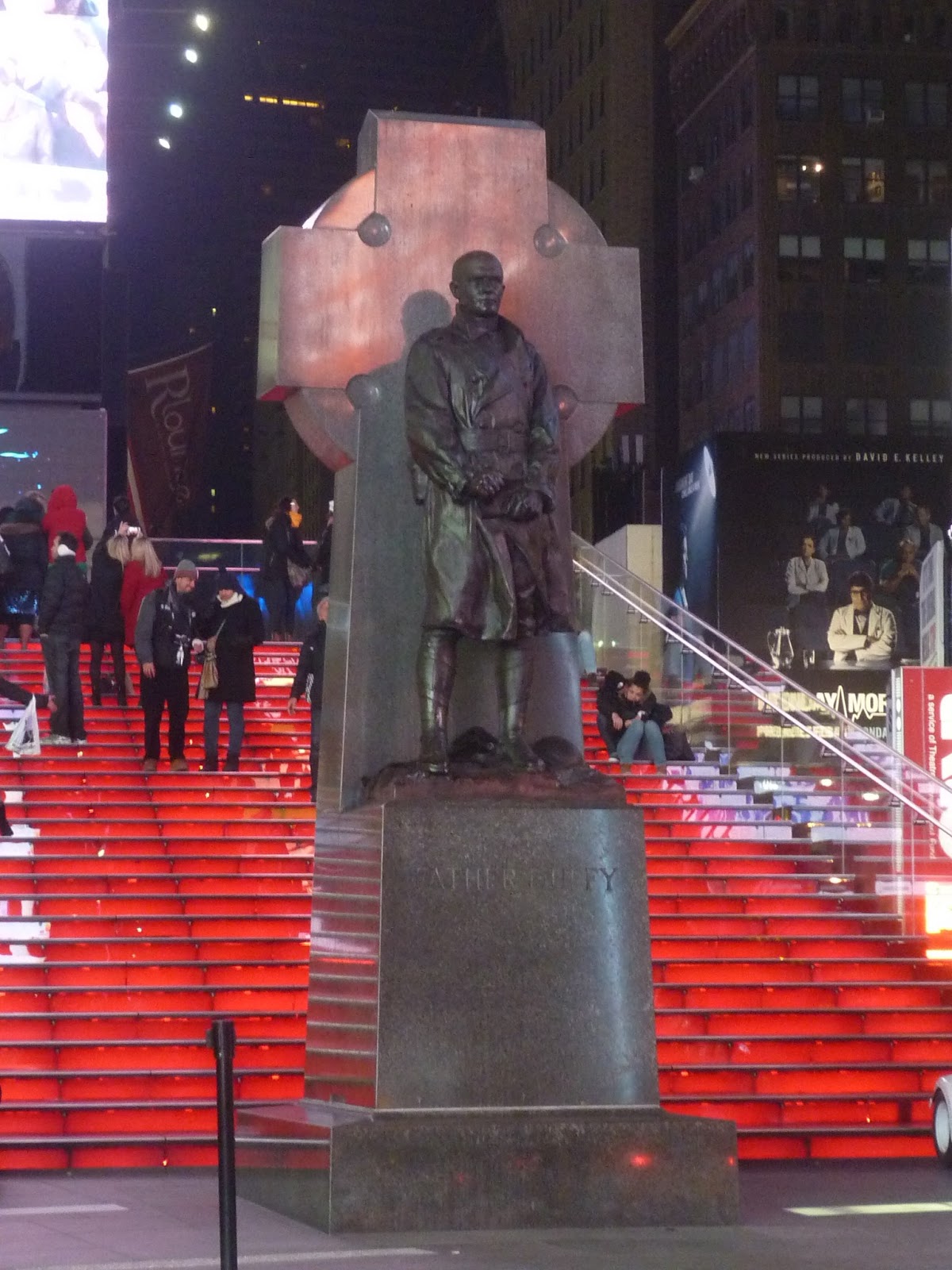
A Priest Among The Temple Of The Secular

Continuing with some off the beaten path New York coverage, we come to Time's Square.  A little bit on the beaten path, you might say?  Maybe if one focuses entirely on the neon signs, huge advertisements, people lining up in restaurants and shops to spend, spend, spend...  But among the noise and glitter, right in front of everything and everyone stands a statue of a Roman Catholic priest, Father Francis P. Duffy.


Like your author, he was born in Canada, moved to the United States to live there, and responded to a divine call to become a priest in the Roman Church.

He felt very passionately about his adopted homeland and served as a military chaplain for her.  He proved himself every bit as much the leader on the battlefield that he was in a parish or seminary and was regarded highly in this respect by his Irish-American regiment.  Back home in New York he was among the most influential speakers in the public sphere to convince the country that Irish-Americans and other Catholic Americans could be and indeed were patriots and in love with their country, a rather uphill battle for anyone to fight until well into the 20th century.

Times Square, like so much of New York, has been paved over and illuminated to attract tourists, commerce, and perhaps help the city get rid of the memory of its difficult rise to global prominence.  The prosperity and immensity of today's New York, however, has been built on a foundation of racial and cultural conflict, environmental destruction, and the illumination of history.  The arduous and often bloody struggle to help define American liberty and purpose saw New York burned and turned into a pit of people against people in segregated bastions of neighborhoods.  Men and women like Father Duffy were there as American consciousness awakened here in the heart of her historical imagination and memory.

He is honored by a statue that no one looks at (not a single person took even a passing glance in the ten minutes that I stood near it just to see if anyone cared) in the northern part of a square that bears his name.  In some ways we are like a Rome of Late Antiquity, too concerned about the politics of the moment to pay any attention to the statues in our forums that record our past, even while we continue to build more monuments to the glory of our people.

If ever you find yourself among some great wonder of the human world, do not be afraid to question where the foundation lies for what you stand upon and have come to appreciate!

Monday, April 8, 2013

Manhattan Before Manhattan: Ontario in New York? A Rocky Question.

Most images of Manhattan focus on its world class skyline and numerous commercial and cultural attractions.  Broader shots of the island as a whole, usually taken from the Empire State Building, show a rather rectangular flat island crowded over in all but Central Park.  In reality, however, the New York area, even Manhattan island, is an incredibly beautiful natural landscape featuring everything from mountains and forests to prairies and lovely beaches.  Before the urban core of New York was paved over it featured a very attractive paradise which lured both First and Second Born alike to her shores.  Most of her natural features have long since been transformed; even where nature seems to persist (such as in Central Park) the world has been carefully groomed and altered to human tastes.  Some protected areas, such as Fire Island, contain remnants of what the early Dutch colonists found here.  Pine barrens persist in central Long Island, and the New Jersey Meadowlands have so far still largely eluded development.

Most enduring of all, however, would be the geological features of the area.  While human development has generally preferred flat spaces for urban growth, the fact remains that the rocky Earth still manages to defy modern engineering when using its own weapon of economics against itself.  A cliff is too expensive to level, and large outcrops of granite, gabbro, and other fun ancient stuff is just too much of a pain in the ass to constantly dynamite.  One of the most impressive features to be seen from the big city, right in it in fact, would be the Palisades, sheer cliffs that confront many westward views across the Hudson River into New Jersey.

The lower deck, westbound, of the George Washington Bridge (I-95) looking toward New Jersey and those majestic Palisades.  You can see views like this from upper Manhattan northwards for some distance, until around the Tappan Zee Bridge.  

Perhaps I have always been focused enough on the natural world to notice the contours of the land and natural features even when surrounded by human grandeur, but one of the first things I noticed when emerging from Penn Station in my first ever trip to New York was the beginnings of those cliffs as I stared all the way down 33rd street and across the Hudson.  I always subconsciously imagined New York as being flat and nothing but buildings, even if my reading had told me otherwise.  When I left the city after that first visit, I took the Empire State line clear back to Buffalo and was able to see the entire length of the tidal Hudson north to Troy, including going underground past what looked remarkably like the rocks of the Canadian Shield so very far to the north.  The great city, riddled with sewer and subway tunnels, was carved into a very rocky heart that looked like it could have been pulled out of northern Ontario or Quebec.

The inspiration for this post, in fact, came from a very Shield looking outcrop that I passed along the Harlem River, not too far opposite from Yankee Stadium.  It even had quartz veins in it!  I could not snap a picture because I was focused on dealing with the insane traffic, but thankfully Google streetview helped me find again what really took me by surprise.

To find this and other outcrops, simply look anywhere along Harlem River Drive or the stretch of I-95 in Manhattan.  

I mean come on, the thing could very well be something one can find in Ontario!  The actual stuff is too young by far to hold a candle to that Shield rock, however.  What you see is probably only 500 million years old, even if it does have schist and gneiss in there, even a little bit of marble.  The ancient Shield can be found relatively close by, 150 miles away in the Adirondacks, a detached part of the Laurentian Mountains.  Billion year old granite, which not part of the geological core of the continent, can be found even closer in the strip of Appalachians which the Hudson forces through in between West Point and Sing Sing Prison.

Forgive the fuzziness, it was dusk.  This is along I-87 southbound, pretty close to where New York's suburbs start.  

That's right, the mountains of the east come within a mere twenty miles of the concrete jungle.  The Appalachian trail passes through here on a pedestrian bridge over I-87, and is among the lowest elevation (and most urban) of stretches of the otherwise wilderness oriented trail.  It can be amusing to think that some tourists are camping out and even sleeping under the stars even as others are posting photos of Time's Square from their mobile devices not a few dozen miles away.  Even in New York we can find ourselves still trying to interact with our wild world which is never truly far away.

Tuesday, April 2, 2013

Thanks!

Last month, despite a paucity of posts, American Voyages hit an all time high viewer count of any month out there.  Apparently you like reading my takes on history and international relations, which probably means I need to write more on the matter.  The purposes of this blog are to share perspectives on the geography and history of our continent, and thus far it seems like that is something I have been doing.  I was debating about shutting down the blog as I do not seem to have much time for it these days, and it does come with a cost; in the absence of any ads or monetizing efforts (and trust me, I would be earning a decent income off of this), the blog costs money to keep up and running.  I keep getting pageviews, however, as well as comments and questions at BKryda@Gmail.com.

That in mind, let's keep up with this thing.  In the spirit of a continuing exploration into the heart of a North American identity, have this shot of heading west on I-80 through the Delaware Water Gap, one of the great breaches in the Appalachian wall that our ancestors used to see just what was beyond yet another western horizon.

The left rise is Pennsylvania, and the shot is taken from New Jersey.

Tuesday, March 26, 2013

Heading South To Go North


I have been through many mountains across North America, including the grand Rockies of Colorado, the Sierra Nevadas of California, even the great mountains around Mexico City which tower above tropical landscapes in glorious displays of snow throughout the year.  Try as I might, however, I find myself still more so in awe of the subtle majesty of the Appalachians.  I think this is because the forests of all these mountains are what holds the true attraction for me, and the Appalachians are amazing southern continuations of the grand Boreal forests of northern North America.  Boreal species can be found as far south as West Virginia, where the right combination of altitude and cold, boggy conditions let a forest survive as it would have during the last ice age in the same place.  At the same time, multitudes of species extending from the Atlantic, Southern, and Midwestern worlds converge in what is one of the most under-appreciated ecologically diverse areas on the continent.  Maybe I just like rooting for the underdog!

Pictured below is a scene off of NY 165 just south of Roseboom, NY.


Only a couple of hours out of New York City one can experience scenery that looks like what one could encounter hundreds of miles to the north in Quebec and Ontario.  There are some "southern" trees and shrubs even in the photo, of course, along with rhododendrons and azaleas among the pines on the mountain slopes or cottonwoods and willows lining a stream, things that one would not find in the northern Boreal world.  Then again, one would not be so close to some of the largest cities in the world, either.  One of the catchiest slogans of the Upper Peninsula tourism billboards along I-75 in Michigan is "Up North: Closer Than You Think".  In the case of the Appalachians, up north can even be to the south!  While most residents of the east coast pride themselves on the marks of civilization they have all around them, they should also know that they still have a little bit of the wilderness that not only the second born American colonists and immigrants had in their backyard, but that has been here for tens of thousands of years.

Monday, March 25, 2013

Parks In The News: Three New National Monuments.

http://www.npca.org/news/media-center/press-releases/2013/national-parks-group-applauds-7.html

The United States now has 401 national park units!  President Obama designated them protected sites of national interest today.  Two of the sites help us to discover more of the heritage of Black people in the country, centered especially on the Civil War era.  The other gives Delaware something to finally put on the map.


A Border Between Friends: Different Priorities.

In the last post on our current topic of discerning a political-cultural divide between Canada and the United States we visited some primal history regarding the development of a modern notion of liberty in our nations. We opened and returned to a concept of liberty that the political forces of the late eighteenth century were familiar with, one that was intimately bound to the power tied to capitalism (or more specifically, capital).  We also ended on a note of something far more simple and familiar for most of us: the desire to live a life unmolested by those who would seek to impose either economic or religious views on people.

Many of the first Colonists or Habitants were probably primarily after a better existence away from all the conflicts over in Europe.  As colonial Canada and the United States grew in size and economic import, however, men of political ambition followed the early colonists and freedom seekers and tried to create little dominions of their own across the sea.  Likewise, any who came over to read the Bible in peace and quiet found some religious reformers and revolutionaries take the same boat and try to start little religious battles that were clearly making life difficult enough over in Britain and even France.

In the end, the religious and economic revolution was forced out of France by a Louis XVI obsessed with eliminating the resistance of Le Fronde; the country was made forcibly Roman Catholic with conservative and slightly Jansenistic agendas.  In Britain Catholicism was instead ousted, and any particular Protestant factionalism shelved in the face of pursuing economic power for the nation and thus for the individuals of the nation (which was clearly tired of religious-inspired civil war).  The battle cry of Liberty thus was suppressed in France for some time, and embraced in Britain, until in the last half of the eighteenth century, when parlors in France became occupied with nothing other than the talk of freedom.  Likewise, talk of Liberty was popular in Britain even after the outbreak of violence in France during the Revolution, but the talk became far more pressing over in the colonies where new waves of taxation were awakening some very old debates.  Liberty for the reason of economic or personal freedom was starting to become an international affair.

So what was it like for everyone, including and especially the ordinary people?

In the thirteen colonies, Liberty meant not having your property infringed upon, especially in the form of taxation or the quartering of soldiers meant to enforce said taxation.  Liberty also meant being able to freely exploit the land, especially the opportunities awaiting beyond the Appalachians which Westminster was otherwise eager to reserve to the First Born of the continent.  Liberty meant being able to defend one's land against encroachment from any hostile party, First Born, British, or even someone from another colony.

In Canada, Liberty meant being able to speak French, remain Catholic if so desired, and preserve a culture while also enjoying the benefits of English law and British developments in representative democracy which had all but been suppressed in France.  After the Loyalists arrived, it meant holding on to hearth and home, just as it did back in the colonies, but not under threat from Britain and King George... under threat instead from intolerant Yankees.  When free land was offered to Americans interested in resettlement, passions became a little less hostile, but the American invading forces in 1812 were seen as no less hostile by such transplanted Americans who actually enjoyed the stability and, yep, lack of government offered by the ruling British.  Here we start to see the beginning of what the negative definition of Canadian identity: being North American and not American.  When the American threat died down, the Loyalists turned their attention to the French-Canadians, who stared back at them from across the Ottawa River, sometimes even from across the street, as my Franco-Ontarien ancestors did.

The English and French wanted protection from each other, in something of a cultural personality battle, even as some loud-mouth, but minority, factions do to this day.  Liberty started to mean "I have rights as a province".  What rights were focused on, exactly?  Language.  Religion.  Education.  Business was, and in my opinion still is, secondary to the debates of cultural freedom.  This is probably why Canada, while decidedly a capitalist nation, has shown only minor aversion to socialistic intervention by the government, in great contrast to the United States where the opposite has been a point of much political drama in the past decade.

In the United States, of course, the states also wanted protection from one another, but this was largely out of economic issues, most notably the issue of slavery.  While cultural debates have always raged on in American political warfare, notably in the realm of civil rights, the power of the Federal government to mess with what the states are allowed to say goes in regards to property has always been the leading force behind helping to define Liberty.  Why?  The United States had long shared a broad common culture, even as immigrants would later pour into the country and regional cultural identity differences were apparent even before the Revolution.  And what of those immigrants?

Canada has had just as many, in proportion of course, as the United States.  The end of the nineteenth century saw all sorts of nationalities pour into both countries, usually for the general reason of seeking a better life and escaping political garbage back in the mother country.  Both countries proved exceptionally capable to absorbing the entire world into a melting pot, but this is the key point of departure:

In Canada, the differences were not considered crucial in deciding how to make someone a Canadian.

In the United States, the differences were considered crucial in deciding how to make someone an American.

Stop for a moment, before drawing conclusions about both countries, however.  Take a look at something very simple in both places, the concept of official language.  Canada has two.  The United States does not even have one, at least not one ever officially declared.  Canada features petty fights over both tongues.  The United States features a general acceptance that English is the way to go and gets into absolutely huge and dramatic patriotic stand-offs over the matter despite, you know, not having declared English the official language.  Citizens have to take an English test, but an interpreter and a lot of assistance in the process are provided for the newly minted American.  In Canada, this is less the case, and you need to do English or French (unless you happen to be in the far north and want to do Cree or something).  Confused at the irony yet?

And what about the general concept of a melting pot?  In the United States, there is little strange about a Black family sitting down for a spaghetti dinner and not having it mentioned that they are eating Italian food, or everyone in town going nuts on St. Patrick's Day despite being in no way Irish whatsoever.  In Canada, half the town might still be throwing an Orangeman's parade!  Go to Wegman's supermarket in Buffalo and find a huge variety of groceries celebrating every known culture on earth with a Christmas display featuring everything from Mexican goodies to Polish-American toasting wafers.  Go to Loblaws over in Niagara Falls, Ontario and notice prominent displays of traditional British cuisine and a Christmas display featuring those annoying Victorian Christmas crackers that my Mom insists are necessities.  Head over to Quebec and find a different world entirely.  Head out into the prairie provinces and find Ukrainian and Icelandic stuff.  First Born influences are also everywhere.  Multi-culturalism is assured, but the individual influences are very obvious.

This is not to say that you can't find tons of different cultural treasures in Canada, especially in places like Toronto (one of the best places to get a curry outside of India is either in London or Toronto) its just that... well the differences will be highlighted, even as they are diluted in the States.  In Canada, cultural differences are viewed as the purpose behind Liberty, and are given anointed protection even as they cause tension here and there.

We certainly have a different emphasis on democracy, to say the least.  But this is not where the differences end.  Again, we return to perspective.  The history of democratic struggle in the United States has always been one of assertive action, sometimes to the point of raw aggression.  In Canada, political freedoms have gradually evolved, with social action being taken defensively.  Political freedoms in Canada have come about  in a parallel history of development with the United States, sometimes even in reaction or as an alternative.  Again, the Canadian mentality is about the democratic experiment looking at the broader portrait of historical awareness, even perhaps into the fishbowl that is British, American, and French democratic evolution.  The American mentality is about the front line of the struggle, an experiment always in a state of flux and even survival.

This is, of course, all opinion and the viewpoint of this French-Irish-Canadian-American looking at his two nations with the perspective of an expatriate looking at both host and home nation from a standpoint straddling the border.  I remain a Canadian citizen because of perspective, even as I continue to live in the United States because of intense fascination.  If ever the two nations were united...

And what of that?  Could they be?  Definitely, and yet not without some pain and difficulty.  We already share a lot in common.  At the same time, we also hold on to a history of "get off my lawn":

The Isaac Brock monument on the site of the Battle of Queenston Heights, overlooking New York across the Niagara Gorge.  This is probably the most poignant reminder that a border still exists between two otherwise peaceful friends.

Yet we also have a history of being allies and building the way to having the longest undefended border in the world.  Signs leading up to border access points on both sides of the line declare not that a checkpoint is coming up, but that there will soon be a bridge to the other country.

Not too far from that monument are multiple bridges manned by immigration officials more concerned with how much duty-free alcohol you have in your car than with how you intend to spend your time in their country.  Above, pointed at the New York side, is the Rainbow Bridge, along with the American Falls of Niagara Falls.  

When you cross over, you will probably see a McDonald's on both sides, you drive on the same side of the road, and you just feel like you are on the other side of a river... and yet it always feels a little bit different, units of distance measurement aside.